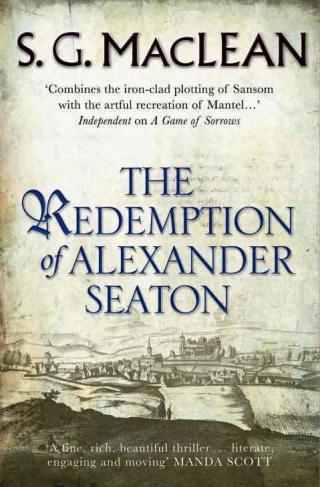
The Redemption of Alexander Seaton
- Автор: Маклин Шона Дж.
- Серия: Alexander Seaton #1
- Год: 2009
- Язык: английский
- Год: Quercus
- ISBN: 1847247911
- Жанр: Исторические детективы

Электронная книга - «The Redemption of Alexander Seaton». Краткое содержание книги:
Is the young man merely drunk or does his tottering walk suggest something more sinister?
When he collapses, vomiting, over the two whores who find him on that dark wet night, they guess rightly that he’s been murdered by poisoning.
So begins this gripping tale set in the town of Banff, Scotland in the 1620s. The body of the victim, the provost’s nephew and apothecary’s apprentice, is found in Alexander Seaton’s school house. Seaton is a school master by default, and a persona non-grata in the town – a disgraced would-be minister whose love affair with a local aristocrat’s daughter left him disgraced and deprived of his vocation. He has few friends, so when one of them is accused of the murder, he sets out to solve the crime, embarking on a journey that will uncover witchcraft, cruelty, prejudice and the darkness in men’s souls.
It is also a personal quest that leads Alexander to the rediscovery of his faith in God as well as his belief in himself.
Among her many strengths, Shona MacLean is brilliant at evoking period and place. You feel you are in those cold, dark, northern rooms, eavesdropping on her characters. You are totally involved in the rich, convincing world she has re-created.
There was the baillie, watching. I was not greatly surprised to see him: despite his oft-rehearsed condemnation of such ‘popery’ as the lykewake, he was a man who liked to know his enemy. And there, not amongst the general throng, but alone in the shadows of the doorway to the apothecary’s house, was the provost. My eye met his and he gave me the briefest of nods before retreating further back into the shadows, where a white wraith flitted behind him; Geleis Guild also had come to mourn her friend and helper. As I turned my gaze from the doorway I caught a glimpse, from the corner of my eye, of Jaffray. He was deep in conference with Thomas Stewart, and had evidently not seen me. I took a step towards them and the doctor looked up in my direction. I had not seen him since he had pleaded with me not to go to Darkwater. He raised a hand to acknowledge me, but the notary avoided my eye. Stung, I turned back towards the place the music was coming from.
My minister’s garb cutting a path for me through my astonished neighbours, I made my way eventually towards the circle at the front of the throng, nearest to where the song schoolmaster and his scholars stood. Charles directed the boys in the old way, standing before them behind a makeshift lectern, turning the pages of the choirbook with one hand as he directed the boys behind him with the other. Away from the inn, away from Jaffray’s, away from the kirk, he was a man transformed. The cares of his world and the confines of his duties lifted from him, he was at liberty, so seldom granted him, to enjoy fully and to offer to us his God-given gifts. The psalm he now took up was not, as the others had been, a monotone, stripped of all decoration and ornamentation, but something worthy of the gifts and training of a true musician. Voices of master and boys rose in magnificent polyphony, urging the Lord, for Marion Arbuthnott, to ‘judge and avenge my cause’.
Baillie Buchan, whom I discovered a few feet away from me, did not move throughout the rendition of the whole piece, yet his face hardened in disapproval with every new proof of the virtuosity of my friend. He never once took his eyes from Charles though, and it was only as master and boys then set themselves in reports on the eighteenth psalm that he seemed to notice me. He said nothing, but moved slowly closer to me, evidently set on the guarding of either Charles or myself from escape.
In a moment he was at my shoulder. I was emboldened by the gradual dying of the light. ‘The psalm is not to your taste, baillie?’ I asked.
‘The psalm is to my taste,’ he said. ‘The words of King David, cried out to our Lord, assured in the righteousness of his cause in a sinful world. But this playing upon it, this decoration and ostentation, born of the vanity of men, turns my stomach. What need has the psalmist of such perversions?’
‘Surely, baillie, our music master’s voice is a gift from God?’
He turned on me a look of frozen contempt for my words. ‘Do you not recall the words of John Knox? Or is he out of favour with the great Episcopalians of the King’s College?’ There was the disdain in his voice of a man who made no compromise.
‘I am no stranger to the works of John Knox,’ I replied, ‘and neither were my masters.’ And indeed I recalled the words of the great Reformer, and their exposition as my classmates and I had debated the place of music in the worship of God. For the baillie, there was no debate.
He spoke quietly. ‘He knew of the snares of the world waiting on all men, and warned against such as these. The schoolmaster’s gifts should be applied to the edification of the people, not to the parading of his own vanity.’ The vehemence of his words was almost beyond his strength to muster, and the baillie was overcome by the now familiar retching cough.
A spit with a hog roasting on it turned in one corner, near to the apothecary’s well. Some ragged urchins were already gathering near it, ready to risk the wrath of the cook for the chance of a hot meal. I was hungry, and would gladly have sat down and eaten something myself, for I felt weak from hunger and fatigue. It was not time for eating though; the long trestle tables laid out in the courtyard were as yet empty of the delights that the women of Arbuthnott’s kin had been preparing all day. The time of solemnity had not yet passed – that of gluttony and excess was still to come. My fine suit of English wool with its long cloak and collar were not sufficient to take the damp and cold from my bones. I began to feel shivery, and searched out a place beside the fire. Gladly would I have returned to my bed, for I had little time for lykewakes and the superstitions they recalled, but I felt impelled to stay and see the night through.
The psalm the scholars were singing was finally brought to its dolorous end, and, with scarcely enough pause for breath, a new sound filled the air, a sweet and melancholic melody I knew well. One of the older boys had taken up his flute, while another played on the rebec, his bow calling a plaintive tune across the strings, and Charles began to sing out, no psalm now, but a mourning lover’s air – ‘I wish I was where Helen lies’. The women had come out of the house now. Some still stood on the backstairs, while others moved softly amongst the guests in the courtyard. And then, as from another place, the timeless notes of a clarsach joined with the flute and the rebec, matched to Charles’s own voice. I turned my eyes to the source of the sound, for I knew Charles was no harpist. There, on a stool a little behind the musicians’ dais, sat Ishbel, the doctor’s girl, her fingers gently caressing the strings of the clarsach, as those of her people had done for centuries before. The instrument spoke the agony of lost love, of a life and of dreams departed, and for a few moments all other noise ceased. Charles himself fell silent. As the notes followed one another on the air, and the song came at last to its end, I saw that many in the crowd were now weeping. Marion Arbuthnott’s moment had come. The doctor moved towards the girl, pride and love glowing in him. At the top of the forestairs, engulfed in her desolation, stood Marion’s mother, her head buried in the shoulder of Mistress Youngson, whose eyes looked out on her own memories. Most of all though, it was the baillie that I noticed. He too was looking out, far from the place and time he now stood in, to an image of something long lost, long gone. I had never before seen such humanity in his face. Charles did not move, but watched Ishbel for many moments. His lips parted slightly and gradually came together again. A veil had been lifted from his eyes.
Once having composed himself, the doctor, with Ishbel firmly clamped in a father’s embrace, called out, ‘Come now, Charles, let us have something to lift our hearts.’ Charles took a moment to come out of his spell, but smiling, took up his bow, called out a name to his players, who took up pipe, drum and tabor, and led them in a hearty harvest tune. The new sound was as a signal to mourners – guests and hosts both. Women bustled and boys ran up and down from the kitchen to the courtyard, and soon the trestles were filled with salvers, bowls and baskets of every sort of food imaginable: pies filled with pigeon, fish, rabbit; all manner of breads, pastries, puddings; custards, cakes, sweetmeats of every description. The council and the session had proclaimed time and again against such feasting, and this indeed was more of a wedding banquet than a funeral feast; but for Marion Arbuthnott there would be no wedding and all that her anguished parents could now do for her, they would do.
The sun had gone at last, and its amber glow faded. Torches were lit in sconces about the courtyard walls, casting grotesque shadows of men, women and children in perverse celebration of the passage of a soul, two souls, into death. I tried not to look at them. I wanted to talk again with Thomas Stewart – it was not right that things should have been left between us as they had this afternoon, and it was for me to set things right with him. I stood up, my head setting inside my skull like molten lead as I did so, and began to cast around for some sight of the notary. There were too many people now, moving about alone or in groups, from fire, to table, to spit; I had no clear line of vision or access anywhere. I gradually pushed and jostled my way through them until I reached the place where I had seen the notary talking with Jaffray, but both were long gone now. The shivering of earlier now alternated with waves of intense heat throughout my body, culminating in the thumping of my head. I came to a bench and sat down again, fearful that my legs would buckle beneath me. Before I could breathe out my relief to be resting again, an arm shoved into my shoulder, almost knocking me from my seat. I looked round quickly but saw nothing save the ragged hem of a deftly retreating cloak. Lang Geordie’s men had somehow got themselves here tonight, I was sure of it. It was not a night to sit in the dark corners, on the margins: safety lay in the heart of the crowd, and I forced myself to my feet again, and towards the busy tables. I could not tell if it was my own body that swayed, or those I pressed through, yet I knew my feet were not steady. I cursed the wise woman of Darkwater and her sleeping tonic, and my own stupidity in taking it not seven hours ago.