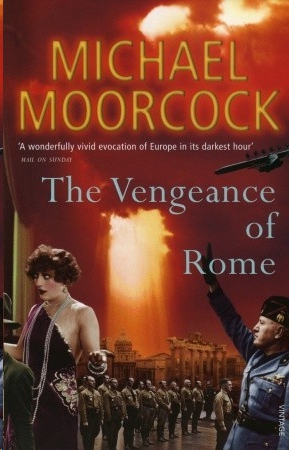
The Vengeance of Rome
- Автор: Муркок Майкл
- Серия: Between The Wars #4
- Язык: английский
- Жанр: Научная фантастика

Электронная книга - «The Vengeance of Rome». Краткое содержание книги:
At length I decided to take a stroll in the tranquillity of Briennerstrasse. The great houses seemed as tranquil and as inviolable as ever. The Brown House, flanked by trees, had acquired a look of permanence and stability. I waited nearby for a while in the hope of seeing a friend. Instead, I received nothing but insults from the untrained boys, unaware of my standing, who came and went in their battered trucks and delivery vans. At one point I saw a more experienced SA man caution one of these green recruits. I tipped my hat to him as I went by. I bore them no animosity. I recognised in them a vitality which might sometimes express itself crudely but was renewing Germany at last. They did not understand how much we had in common.
Everyone of any importance was in Berlin. I took my supper at the hotel. I had no choice. Because I remained unsure of the Baroness’s intentions, I found it difficult to settle down with a book and wait for something to happen. Did she plan to expose me there and then to the Munich press? I was reluctant to walk out on the streets in the evening, since I had already been the object of mockery. I wondered what the same people would say if I put on my Fascist uniform or told them that I was a captain in the SA.
As I passed the concierge’s desk one of the under-managers saw me and called politely, handing me a large envelope containing a telegram. I opened it up. Tom Morgan had sent it. I was a little baffled by the message.
REPORTS OF YOUR DEATH CLEARLY EXAGGERATED STOP BUT SHOULDNT YOU BE IN ALBANIA QUERY CALL ME SOONEST STOP TOM
The only Albanian I knew was Rose von Bek, and I was convinced by now that she was dead. Was Tom’s query connected with her? And who had reported my own death? It was too late to telephone his office, and he had not left another number. I assumed there had been a simple confusion or that Tom was joking. I would have to be patient and wait until morning to find out. There would be no one at Tom’s office before then.
I had not felt quite so desolate and uneasy for some while. I was confident of my overall security, for I knew some of the most powerful men in Europe, yet I was still nervous. However, if civil war broke out in Germany, as some were predicting, Munich was better for me than Berlin. I could get over the Swiss, Czech or Austrian borders fairly easily. My best bet, I decided, was to concentrate on finding a car I could use.
After the War I ran a small repair business until they closed down the arches. I was next door to a man who specialised in pre-war and American automobiles. He made a fortune. Every so often I was able to help him with a difficult job. When the council decided in its wisdom to move us out, I could not afford the expensive shops they offered me in Bassett Road. Besides, I said, the entire row was condemned. I happened to know that. The council is completely corrupt. All Jews and Yorkshiremen. They notoriously look after their own. It was some years before I could open up in Portobello Road, because of the short lease. Mrs Cornelius told me about the place. Her children were small then.
Frank Cornelius is trying to sell Miss Brunner a Ford Fiesta. Miss Brunner points out to him that she was in the garage when the mechanic told him it was a write-off. He apologises. His memory is not what it was. I would imagine there is hardly a neuron in him unsubjected to a bath in some mind-bending acid or other. He no longer describes his body as ‘speeded-up circuitry’ as he did in the sixties. It seems to me that much of the circuitry is already burned out. His head hangs with superfluous skin as if he wears a larger man’s face. His clothes, intended to disguise his origins and display the authority of a higher class, are growing threadbare and stained. I have more fashionable shmatte in my shop.
Mrs Cornelius has been in the toilet for twenty minutes. I think she could be throwing up. Her other son comes in, looks around and is about to leave. I have nothing better to do. I raise my hand to him. He comes towards me. He is too thin. His long jacket and tight trousers make him look like some kind of Teddy boy in a woman’s black wig. He has on those blue two-tone shoes and a T-shirt with ‘Anarchy’ written on it. What can he know of Anarchy? Makhno would have gobbled him for breakfast. He resembles an overgrown Munchkin from The Wizard of Oz. He is trying to get into the entertainment business, his mother says. He is in touch with that rogue Auchinek. Auchinek is today a rock-and-roll manager. Yesterday he was an immigration specialist. The less said about that the better.
‘Afternoon, Colonel,’ says Jerry. He at least has never addressed me by anything but my full rank. ‘I was looking for Cathy.’
His sister is not here. His mother, I say, is in the toilet. He looks at his watch. ‘Bit early, isn’t it?’
I must admit I was thinking the same.
I have never liked Jerry. At least Frank works for a living. The only one I ever had time for in that family was Catherine, and now she has become a communist! They were not my children, but I had hopes for them. Mrs Cornelius did not. She expected them to survive, nothing else. How they did it was up to them. She was of the old-fashioned cockney persuasion which felt that if you reached the age of thirteen without major illnesses, you were probably going to live until forty.
She comes out of the toilet. ‘It’s filthy in there,’ she says. ‘I had ter clean it up a bit. Someone was caught short before they got their knickers darn. ‘Ello, Jerry. I thought you was at Elstree this week.’
‘We wound it up early,’ he said. ‘Drink, Colonel?’
I look at his roll of notes, knowing it will be gone in a day or so, and wonder if I should mention the money I have loaned him over the years. Not once has he paid me back. When he was a boy I used to think he was charging me for his mother’s time. Of course, business was booming in those days, and I was always open-handed. But it was the little girl I liked best. A minx, as her mother said. I still had plans then to return to my old pursuits. I got into the antique clothing line by accident, and it was meant to be a stopgap. At first I just sold military memorabilia on a stall. It did very well. Everyone wants that material. Especially the Nazi daggers. There were so many of them made. Enough for everyone, I used to think. It seemed the whole of Germany was in the SS before the war ended. Of course I had no time for the SS nor for Himmler. He perverted our ideals. He was a criminal. I have never quarrelled with that particular Nuremberg verdict. And it was sheer nonsense for him or Schnauben to suggest I had any hand in his ruthless and entirely indiscriminate killing of unwanted social elements. I was asked some questions. I answered them. Nothing more.
‘A blacksmith makes a shovel,’ I used to say. ‘This does not make him a gravedigger.’ How can what one talks about as a mental exercise have any bearing at all on another’s attempt to make that notion an actuality? My involvement with the Nazi Party, such as it was, was entirely idealistic. Gradually, as the years went on, I began to see the weaknesses and perversions of the system, and eventually it became clear to me that the Nazi cause was lost, long before 1945. By then, of course, there was little I could do about it. I was never a fanatical follower of Hitler and, with the exception of Dachau and elsewhere, most of my connections with the party were purely social. In those heady days of 1931 it was impossible not to meet Nazis!