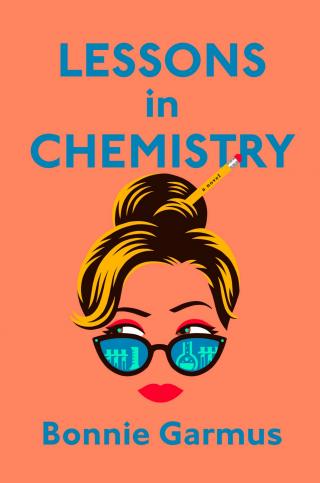
Lessons in Chemistry
- Автор: Garmus Bonnie
- Год: 2022
- Язык: английский
- Год: Doubleday Canada
- Жанр: Современная русская и зарубежная проза

Электронная книга - «Lessons in Chemistry». Краткое содержание книги:
“The problem, Calvin,” she asserted, “is that half the population is being wasted. It’s not just that I can’t get the supplies I need to complete my work, it’s that women can’t get the education they need to do what they’re meant to do. And even if they do attend college, it will never be a place like Cambridge. Which means they won’t be offered the same opportunities nor afforded the same respect. They’ll start at the bottom and stay there. Don’t even get me started on pay. And all because they didn’t attend a school that wouldn’t admit them in the first place.”
“You’re saying,” he said slowly, “that more women actually want to be in science.”
She widened her eyes. “Of course we do. In science, in medicine, in business, in music, in math. Pick an area.” And then she paused, because the truth was, she’d only known a handful of women who’d wanted to be in science or any other area for that matter. Most of the women she’d met in college claimed they were only there to get their MRS. It was disconcerting, as if they’d all drunk something that had rendered them temporarily insane.
“But instead,” she continued, “women are at home, making babies and cleaning rugs. It’s legalized slavery. Even the women who wish to be homemakers find their work completely misunderstood. Men seem to think the average mother of five’s biggest decision of the day is what color to paint her nails.”
Calvin pictured five children and shuddered.
“About your work,” he said, trying to redirect the battle. “I think I can fix it.”
“I don’t need you to fix anything,” she said. “I’m perfectly capable of fixing my own situation.”
“No, you’re not.”
“Excuse me?”
“You can’t fix it because the world doesn’t work that way. Life isn’t fair.”
This infuriated her — that he would tell her about unfairness. He wouldn’t know the first thing about it. She started to say something, but he cut her off.
“Look,” he said, “life has never been fair, and yet you continue to operate as if it is — as if once you get a few wrongs straightened out, everything else will fall into place. They won’t. You want my advice?” And before she could say no, he added, “Don’t work the system. Outsmart it.”
She sat silently, weighing his words. They made annoying sense in a terribly unfair way.
“Now here’s a lucky coincidence: I’ve been trying to rethink polyphosphoric acids for the last year and I’m getting nowhere. Your research could change that. If I tell Donatti I need to work with your findings, you’ll be back on it tomorrow. And even if I didn’t need your work — which I do— I owe you. Once for the secretarial remark, and again for the vomit.”
Elizabeth continued to sit silently. Against her better judgment, she felt herself warming to the idea. She didn’t want to: she didn’t like the notion that systems had to be outsmarted. Why couldn’t they just be smart in the first place? And she certainly didn’t like favors. Favors smacked of cheating. And yet she had goals, and dammit, why should she just sit by? Sitting by never got anyone anywhere.
“Look,” she said pointedly, as she brushed a strand of hair off her face. “I hope you won’t think I’m jumping to conclusions, but I’ve had trouble in the past and I want to be clear: I’m not dating you. This is work, nothing more. I am not interested in a relationship of any kind.”
“Nor am I,” he insisted. “This is work. That’s it.”
“That’s it.”
And then they gathered their cups and saucers and went off in opposite directions, each desperately hoping the other didn’t mean it.
Chapter 4
Introduction to Chemistry
About three weeks later, Calvin and Elizabeth were walking out to the parking lot, their voices raised.
“Your idea is completely misguided,” she said. “You’re overlooking the fundamental nature of protein synthesis.”
“On the contrary,” he said, thinking that no one had ever called any of his ideas misguided and now that somehow had, he didn’t particularly like it, “I can’t believe how you completely ignore the molecular struc—”
“I’m not ignoring—”
“You’re forgetting the two covalent—”
“It’s three covalent bonds—”
“Yes, but only when—”
“Look,” she interrupted sharply as they stopped in front of her car. “This is a problem.”
“What’s a problem?”
“You,” she said firmly, pointing both hands at him. “You’re the problem.”
“Because we disagree?”
“That’s not the problem,” she said.
“Well then, what?”
“It’s…” She waved her hand uncertainly, then looked off into the distance.
Calvin exhaled, and laying his hand on the roof of her old blue Plymouth, waited for the rebuff he knew was coming.
In the last few weeks, he and Elizabeth had met six times — twice for lunch and four times for coffee — and each time it had been both the high and low point of his day. The high point because she was the most intelligent, insightful, intriguing — and yes — the most alarmingly attractive woman he’d ever met in his life. The low point: she always seemed in a hurry to leave. And whenever she did, he felt desperate and depressed for the rest of the day.
“The recent silkworm findings,” she was saying. “In the latest issue of Science Journal. That’s what I meant by the complicated part.”
He nodded as if he understood, but he didn’t and not just about the silkworms. Each time they’d met, he’d gone out of his way to prove that he had absolutely no interest in her beyond a professional capacity. He hadn’t offered to buy her coffee, he hadn’t volunteered to carry her lunch tray, he hadn’t even opened a door for her — including that time when her arms were so full of books he couldn’t even see her head. Nor did he faint when she accidentally backed into him at the sink and he caught a whiff of her hair. He didn’t even know hair could smell like that — as if it had been washed in a basin of flowers. Was she to give him no credit for his work-and-nothing-more behavior? The whole thing was infuriating.
“The part about bombykol,” she said. “In silkworms.”
“Sure,” he answered dully, thinking of how stupid he’d been the first time he’d met her. Called her a secretary. Kicked her out of his lab. And then what about later? He’d thrown up on her. She said it didn’t matter, but had she ever worn that yellow dress again? No. It was obvious to him that even though she said she didn’t hold a grudge, she did. As a champion grudge holder himself, he knew how it worked.
“It’s a chemical messenger,” she said. “In female silkworms.”
“Worms,” he said sarcastically. “Great.”
She took a step back, surprised by his flippancy. “You’re not interested,” she said, the tips of her ears reddening.
“Not at all.”
Elizabeth took a short breath in and busied herself by searching in her purse for her keys.
—
What a huge disappointment. She’d finally met someone she could actually talk to — someone she found infinitely intelligent, insightful, intriguing (and alarmingly attractive whenever he smiled) — and he had no interest in her. None. They’d met six times in the last few weeks, and each time she’d kept it all business and so had he — although his was almost to the point of rudeness. That day when she couldn’t even see the door because her arms were full of books? He couldn’t be bothered to help. And yet each time they were together, she felt this practically irresistible urge to kiss him. Which was extremely unlike her. And yet after each meeting — which she ended as soon as she could because she was afraid she would kiss him — she felt desperate and depressed for the rest of the day.