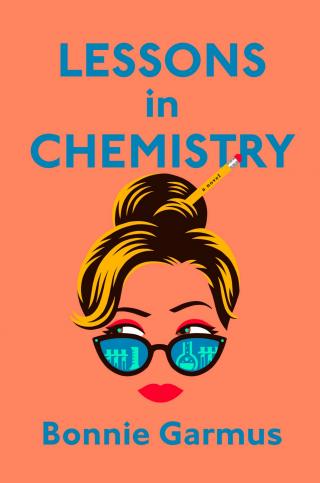
Lessons in Chemistry
- Автор: Garmus Bonnie
- Год: 2022
- Язык: английский
- Год: Doubleday Canada
- Жанр: Современная русская и зарубежная проза

Электронная книга - «Lessons in Chemistry». Краткое содержание книги:
“But we live together. This is just the next logical step.” When it came to Elizabeth, he knew logic ruled the day.
“That was an economic decision,” she reminded him. Which, on the surface, it was. Calvin had initiated the idea, saying that because they spent most of their free time together, it made financial sense to share living quarters. Still, it was also 1952, and in 1952 an unmarried woman did not move in with a man. So he was a bit surprised when Elizabeth didn’t hesitate. “I’ll pay half,” she’d said.
She removed the pencil from her hair and tapped it on the table awaiting his response. She hadn’t actually meant she’d pay half. Paying half was impossible. Her paycheck hovered just above ridiculous; half was out of the question. Anyway, the house was in his name — only he would receive the tax benefit. Therefore, half wouldn’t be fair. She’d give him a moment to do the math. Half was outrageous.
“Half,” he mused, as if considering it.
He already knew she couldn’t pay half. She couldn’t even pay a quarter. This was because Hastings paid her a penurious wage — about half what a man in her position made— a fact he’d encountered in her personnel file, which he’d peeked at illegally. Anyway, he didn’t have a mortgage. He’d paid off his tiny bungalow last year with the proceeds from a chemistry prize and had instantly regretted it. You know how people say, “Never put all your eggs in one basket?” He had.
“Or,” she’d said, brightening, “perhaps we could work out a trade agreement. You know, like nations do.”
“A trade?”
“Rent for services rendered.”
Calvin froze. He’d overheard all the gossip regarding the free milk.
“Dinner,” she said. “Four nights a week.” And before he could reply she said, “Fine. Five. But that’s my final offer. I’m a good cook, Calvin. Cooking is serious science. In fact, it’s chemistry.”
—
So they’d moved in together and it had all worked out. But the lab idea? She refused even to consider it.
“You were just nominated for a Nobel, Calvin,” she reminded him as she snapped the Tupperware lid closed on the remaining potatoes. “Your third nomination in five years. I want to be judged on my own work — not work people think you did for me.”
“Anyone who knows you would never think that.”
She burped the Tupperware, then turned to look at him. “That’s the problem. No one knows me.”
—
She’d felt this way her entire life. She’d been defined not by what she did, but by what others had done. In the past she was either the offspring of an arsonist, the daughter of a serial wife, the sister of a hanged homosexual, or the graduate student of a renowned lecher. Now she was the girlfriend of a famous chemist. But she was never just Elizabeth Zott.
And on those rare occasions when she wasn’t defined by others’ actions, then she was dismissed out of hand as either a lightweight or a gold digger based on the thing she hated most about herself. How she looked. Which happened to be just like her father.
He was the reason she didn’t smile much anymore. Before becoming an evangelist, her father had wanted to be an actor. He had both the charisma and the teeth — the latter, professionally capped. The only thing missing? Talent. So when it became clear that acting was out, he took his skills to revival tents where his fake smile sold people on the end of the world. That’s why, at age ten, Elizabeth stopped smiling. The resemblance faded.
It wasn’t until Calvin Evans came along that her smile reemerged. The first time was that night at the theater when he’d vomited all over her dress. She hadn’t recognized him at first, but when she did and despite the mess, she bent over to get a better look at his face. Calvin Evans! True, she’d been a little rude to him after he’d been rude to her — the beakers — but between the two of them there’d been immediate, irresistible pull.
—
“Still working on that?” she asked, pointing at a nearly empty container.
“No,” he said, “you eat it. You could use the extra fuel.”
Actually, he’d planned to eat it, but he was willing to forgo the extra calories if only she would stay. Like Elizabeth, he’d never been much of a people person; in fact, it wasn’t until he’d found rowing that he’d made any real kind of connection with others. Physical suffering, he’d long ago learned, bonds people in a way that everyday life can’t. He still kept in contact with his eight Cambridge teammates — had even seen one of them just last month when he’d been in New York for a conference. Four Seat — they still called one another by their seat names — had become a neurologist.
—
“You have a what?” Four Seat had said, surprised. “A girlfriend? Well, good for you, Six!” he said, slapping him on the back. “About bloody time!”
Calvin had nodded excitedly, explaining in detail Elizabeth’s work and habits and laugh and everything else he loved about her. But in a more somber tone, he also explained that although he and Elizabeth spent all of their free time together — they lived together, they ate together, they drove back and forth to work together — it didn’t feel like enough. It wasn’t that he couldn’t function without her, he told Four Seat, but rather that he didn’t see the point of functioning without her. “I don’t know what to call it,” he’d confided following a full examination. “Am I addicted to her? Am I dependent in some sick sort of way? Could I have a brain tumor?”
“Jesus, Six, it’s called happiness,” Four Seat explained. “When’s the wedding?”
—
But that was the problem. Elizabeth had made it clear that she had no interest in getting married. “It’s not that I disapprove of marriage, Calvin,” she’d told him more than once, “although I do disapprove of all of the people who disapprove of us for not being married. Don’t you?”
“I do,” Calvin agreed, thinking how much he would like to say those words to her in front of an altar. But when she looked at him expecting more, he added quickly, “I do think we’re lucky.” And then she smiled at him so earnestly that something inside his brain went haywire. As soon as they parted, he drove to a local jeweler, scanning the selections until he found the biggest small diamond he could afford. Sick with excitement, he kept the tiny box in his pocket for three months waiting for exactly the right moment.
—
“Calvin?” Elizabeth said, gathering the last of her things from the cafeteria table. “Are you listening? I said I’m going to a wedding tomorrow. Actually, I’m in the wedding if you can believe that.” She gave a nervous shrug. “So we should probably discuss that acid study tonight if that works.”
“Who’s getting married?”
“My friend Margaret — the Physics secretary? That’s who I’m meeting in fifteen minutes. For a fitting.”
“Wait. You have a friend?” He thought Elizabeth only had workmates — fellow scientists who recognized her skill and undermined her results.
Elizabeth felt a flush of embarrassment. “Well, yes,” she said awkwardly. “Margaret and I nod to each other in the hallways. We’ve spoken several times at the coffee urn.”
Calvin willed his face to look as if this were a reasonable description of friendship.
“It’s very last-minute. One of her bridesmaids is sick and Margaret says it’s important to have an even ratio of bridesmaids to ushers.” Although as soon as she said it, she realized what Margaret really needed: a size 6 without weekend plans.