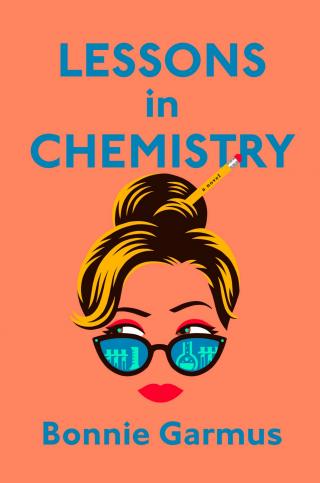
Lessons in Chemistry
- Автор: Garmus Bonnie
- Год: 2022
- Язык: английский
- Год: Doubleday Canada
- Жанр: Современная русская и зарубежная проза

Электронная книга - «Lessons in Chemistry». Краткое содержание книги:
“Tons.”
“You can’t have your beakers back.”
“So, you do remember me.”
“Yes. But not fondly.”
“I came to apologize.”
“No need.”
“How about lunch?”
“No.”
“Dinner?”
“No.”
“Coffee?”
“Listen,” Elizabeth said, her large mitts resting on her hipbones, “you should know you’re starting to annoy me.”
Calvin looked away, embarrassed. “I sincerely beg your pardon,” he said. “I’ll go.”
—
“Was that Calvin Evans?” a lab tech asked as he watched Calvin weave his way through fifteen scientists working elbow to elbow in a space a quarter the size of Calvin’s private lab. “What was he doing down here?”
“Minor beaker ownership issue,” Elizabeth said.
“Beakers?” He hesitated. “Wait.” He picked up one of the new beakers. “That big box of beakers you said you found last week. They were his?”
“I never said I found beakers. I said I acquired beakers.”
“From Calvin Evans?” he said. “Are you crazy?”
“Not technically.”
“Did he say you could take his beakers?”
“Not technically. But I had a form.”
“What form? You know you have to go through me. You know ordering supplies is my job.”
“I understand. But I’ve been waiting for more than three months. I’ve asked you four times, I’ve filled out five requisition orders, I’ve spoken to Dr. Donatti about it. Honestly, I didn’t know what else to do. My research depends on getting these supplies. They’re just beakers.”
The lab tech closed his eyes. “Listen,” he said, slowly reopening them as if to dramatize her stupidity. “I’ve been here a lot longer than you and I know things. You know what Calvin Evans is famous for, don’t you? Besides chemistry?”
“Yes. Having an excess of equipment.”
“No,” he said. “He’s famous for holding a grudge. A grudge!”
“Really?” she said taking interest.
—
Elizabeth Zott held grudges too. Except her grudges were mainly reserved for a patriarchal society founded on the idea that women were less. Less capable. Less intelligent. Less inventive. A society that believed men went to work and did important things — discovered planets, developed products, created laws — and women stayed at home and raised children. She didn’t want children — she knew this about herself — but she also knew that plenty of other women did want children and a career. And what was wrong with that? Nothing. It was exactly what men got.
She’d recently read about some country where both parents worked and took part in raising the children. Where was that, again? Sweden? She couldn’t remember. But the upshot was, it functioned very well. Productivity was higher; families were stronger. She saw herself living in such a society. A place that didn’t always automatically mistake her for a secretary, a place where, when she presented her findings in a meeting, she didn’t have to brace herself for the men who would invariably talk over her, or worse, take credit for her work. Elizabeth shook her head. When it came to equality, 1952 was a real disappointment.
“You have to apologize to him,” the lab tech was insisting. “When you take the damn beakers back, grovel. You put our entire lab at risk, and you made me look bad.”
“It’ll be fine,” Elizabeth said. “They’re beakers.”
But by the next morning, the beakers were gone, replaced by dirty looks from a few of her fellow chemists who now also believed she’d put them in jeopardy of Calvin Evans’s legendary grudge holding. She tried to talk with them, but each gave her the cold shoulder in their own way, and later, as she was walking by the lounge, she overheard the same few grousing about her — about how she took herself so seriously, how she thought she was better than any of them, how she’d refused dates from all of them, even the single men. And how the only way she could have possibly gotten her master’s from UCLA in organic chemistry was the hard way — the word “hard” being accompanied by rude gestures and tight laughter. Who did she think she was anyway?
“Someone ought to put her in her place,” said one.
“She’s not even that smart,” insisted another.
“She’s a cunt,” declared a familiar voice. Her boss, Donatti.
Elizabeth, accustomed to the first words but stunned by the last, pressed herself against the wall, overcome by a wave of nausea. This was the second time she’d been called that word. The first time — the first horrible time — had been at UCLA.
—
It had happened nearly two years ago. A master’s candidate with only ten days left before graduation, she was still in the lab at nine p.m., certain she’d found a problem with the test protocol. As she tapped a freshly sharpened number-two pencil against the paper, weighing her hunch, she heard the door open.
“Hello?” she called. She wasn’t expecting anyone.
“You’re still here,” said a voice free of surprise. Her advisor.
“Oh. Hello, Dr. Meyers,” she said, looking up. “Yes. Just going over the test protocol for tomorrow. I think I found a problem.”
He opened the door a little wider, stepping inside. “I didn’t ask you to do that,” he said, his voice edgy with irritation. “I told you it was all set.”
“I know,” she said. “But I wanted to give it one last look.” The one-last-look approach wasn’t something Elizabeth liked to do — it was something she knew she had to do to maintain her position on Meyers’s all-male research team. Not that she really cared about his research: his was safe stuff, not at all groundbreaking. Despite a notable lack of creativity paired with an alarming absence of new discoveries, Meyers was considered one of the top DNA researchers in the United States.
Elizabeth didn’t like Meyers; no one did. Except, possibly, UCLA, who loved him because the man published more papers than anyone in the field. Meyers’s secret? He didn’t write the papers — his graduate students did. But he always took full credit for every word, sometimes only changing the title and a few phrases here and there before passing it off as an entirely different paper, which he could do because who reads a scientific paper all the way through? No one. Thus his papers grew in number, and with them, his reputation. That’s how Meyers became a top DNA researcher: quantity.
Besides his talent for superfluous papers, Meyers was also famous for being a lecher. There weren’t many women in the science departments at UCLA, but the few there were — mostly secretaries — became the focus of his unwanted attention. They usually left after six months, their confidence shaken, their eyes swollen, citing personal reasons. But Elizabeth did not leave — she couldn’t, she needed the master’s. So she endured the day-to-day degradations — the touches, the lewd comments, the rank suggestions — while making it clear she had no interest. Until the day he called her into his office, ostensibly to talk about her admittance to his doctoral program, but instead shoving his hand up her skirt. Furious, she forcibly removed it, then threatened to report him.
“To whom?” he laughed. Then he admonished her for being “no fun” and swatted her bottom, demanding that she go fetch his coat from his office closet, knowing that when she opened the door she would find it lined with pictures of topless women, a few splayed, expressionless, on their hands and knees, a man’s shoe resting triumphantly on their backs.
—
“It’s here,” she said to Dr. Meyers. “Step ninety-one on page two thirty-two. The temperature. I’m fairly certain it’s too high, which means the enzyme will be rendered inactive, skewing the results.”