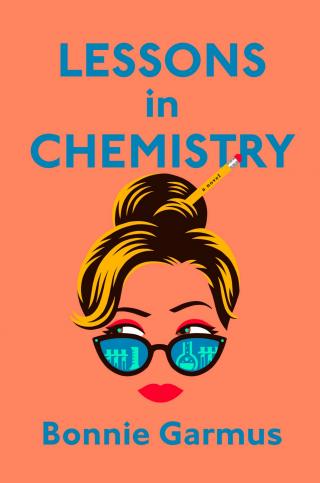
Lessons in Chemistry
- Автор: Garmus Bonnie
- Год: 2022
- Язык: английский
- Год: Doubleday Canada
- Жанр: Современная русская и зарубежная проза

Электронная книга - «Lessons in Chemistry». Краткое содержание книги:
—
Other than chemistry, rowing was the only thing Calvin had true passion for. In fact, rowing is why Calvin applied to Harvard in the first place: to row for Harvard was, in 1945, to row for the best. Or actually second best. University of Washington was the best, but University of Washington was in Seattle and Seattle had a reputation for rain. Calvin hated rain. Therefore, he looked further afield — to the other Cambridge, the one in England, thus exposing one of the biggest myths about scientists: that they’re any good at research.
The first day Calvin rowed on the Cam, it rained. The second day it rained. Third day: same. “Does it rain like this all the time?” Calvin complained as he and his teammates hoisted the heavy wooden boat to their shoulders and lumbered out to the dock. “Oh never,” they reassured him, “Cambridge is usually quite balmy.” And then they looked at one another as if to confirm what they had already long suspected: Americans were idiots.
—
Unfortunately, his idiocy also extended to dating— a big problem since Calvin very much wanted to fall in love. During all six lonely years he spent in Cambridge, he managed to ask out five women, and of those five, only one consented to a second date, and that was only because she’d thought he was someone else when she answered the phone. His main issue was inexperience. He was like a dog who, after years of trying, catches a squirrel and then has absolutely no idea what to do with it.
“Hello — uh,” he’d said, his heart pounding, his hands moist, his mind suddenly completely blank as his date opened the door. “Debbie?”
“It’s Deirdre,” his date sighed, taking the first of what would be many glances at her watch.
At dinner, the conversation lurched between the molecular breakdown of aromatic acids (Calvin), to what movie might be playing (Deirdre), to the synthesis of nonreactive proteins (Calvin), to whether or not he liked to dance (Deirdre), to look at the time, it was already eight thirty p.m. and he had to row in the morning so he would be taking her straight home (Calvin).
It goes without saying that there was very little sex after these dates. Actually, there was none.
—
“I can’t believe you’re having trouble,” his Cambridge teammates would tell him. “Girls love rowers.” Which wasn’t true. “And even though you’re an American, you’re not bad looking.” Which was also not true.
Part of the problem was Calvin’s posture. He was six feet four inches tall, lanky and long, but he slouched to the right — probably a by-product of always rowing stroke side. But the bigger issue was his face. He had a lonesome look about him, like a child who’d had to raise himself, with large gray eyes and messy blondish hair and purplish lips, the latter of which were nearly always swollen because he tended to chew on them. His was the kind of face that some might call forgettable, a below-average composition that gave no hint of the longing or intelligence that lay behind, save for one critical feature — his teeth — which were straight and white, and which redeemed his entire facial landscape whenever he smiled. Fortunately, especially after falling in love with Elizabeth Zott, Calvin smiled all the time.
—
They first met — or rather, exchanged words — on a Tuesday morning at Hastings Research Institute, the sunny Southern Californian private research lab where Calvin, having graduated from Cambridge with a PhD in record time and with forty-three employment offers to weigh, accepted a position partly because of reputation, but mostly because of precipitation. It didn’t rain much in Commons. Elizabeth, on the other hand, accepted Hastings’s offer because it was the only one she received.
As she stood outside Calvin Evans’s lab, she noted a number of large warning signs:
DO NOT ENTER
EXPERIMENT IN PROGRESS
NO ADMITTANCE
KEEP OUT
Then she opened the door.
“Hello,” she called over Frank Sinatra, who was blasting from a hi-fi that sat incongruously in the middle of the room. “I need to speak to whoever is in charge.”
Calvin, surprised to hear a voice, poked his head out from behind a large centrifuge.
“Excuse me, miss,” he called, irritated, a large pair of goggles shielding his eyes from whatever was bubbling off to his right, “but this area is off-limits. Didn’t you see the signs?”
“I did,” Elizabeth yelled back, ignoring his tone as she made her way across the lab to switch off the music. “There. Now we can hear each other.”
Calvin chewed his lips and pointed. “You can’t be in here,” he said. “The signs.”
“Yes, well, I was told that your lab has a surplus of beakers and we’re short downstairs. It’s all here,” she said, thrusting a piece of paper at him. “It’s been cleared by the inventory manager.”
“I didn’t hear anything about it,” Calvin said, examining the paper. “And I’m sorry, but no. I need every beaker. Maybe I’d better speak with a chemist down there. You tell your boss to call me.” He turned back to his work, flipping the hi-fi back on as he did.
Elizabeth didn’t move. “You want to speak to a chemist? Someone other than ME?” she yelled over Frank.
“Yes,” he answered. And then he softened slightly. “Look, I know it’s not your fault, but they shouldn’t send a secretary up here to do their dirty work. Now I know this might be hard for you to understand, but I’m in the middle of something important. Please. Just tell your boss to call me.”
Elizabeth’s eyes narrowed. She did not care for people who made assumptions based on what she felt were long-outdated visual clues, and she also didn’t care for men who believed, even if she had been a secretary, that being a secretary meant she was incapable of understanding words beyond “Type this up in triplicate.”
“What a coincidence,” she shouted as she went straight over to a shelf and helped herself to a large box of beakers. “I’m busy too.” Then she marched out.
—
More than three thousand people worked at Hastings Research Institute — that’s why it took Calvin over a week to track her down — and when he did finally find her, she seemed not to remember him.
“Yes?” she said, turning to see who had entered her lab, a large pair of safety glasses magnifying her eyes, her hands and forearms wrapped in large rubber mitts.
“Hello,” he said. “It’s me.”
“Me?” she asked. “Could you be more specific?” She turned back to her work.
“Me,” Calvin said. “Five floors up? You took my beakers?”
“You might want to stand back behind that curtain,” she said, tossing her head to the left. “We had a little accident in here last week.”
“You’re hard to track down.”
“Do you mind?” she asked. “Now I’m in the middle of something important.”
He waited patiently while she finished her measurements, made notations in her book, reexamined yesterday’s test results, and went to the restroom.
“You’re still here?” she asked, coming back. “Don’t you have work to do?”