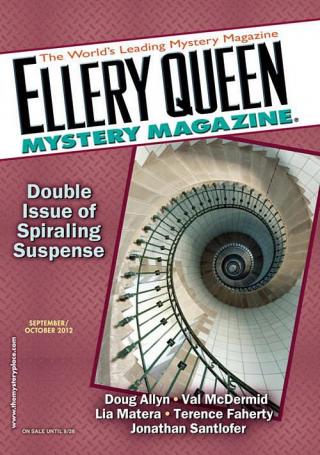
Ellery Queen’s Mystery Magazine. Vol. 140, Nos. 3 & 4. Whole Nos. 853 & 854, September/October 2012
- Автор: Макдермид Вэл, Манфредо Лу
- Год: 2012
- Язык: английский
- Год: Dell Magazines
- ISBN: 0013-6328
- Жанр: Другие детективы

Электронная книга - «Ellery Queen’s Mystery Magazine. Vol. 140, Nos. 3 & 4. Whole Nos. 853 & 854, September/October 2012». Краткое содержание книги:
She thought of Nicky in a hovel in Mexico because he refused to kill poor men like himself to settle rich men’s quarrels.
The marshal watched her carefully. “I believe in this war — the Germans saw to that.”
“What about your Quaker beliefs?”
“Our convictions are individual, not institutional — there’s no high church to tell us what to do. We find our own ways to stay firm in our four tenets, and we leave it at that.” He flushed a little.
“I see.” She made herself smile. While he was talking, she was spared the effort. “What are the tenets?”
He looked surprised by her interest. “Simplicity, equality, tolerance, peace. But again, it’s different when war’s forced on you. When there’s no peace without a fight.”
Nicky had said to her, before he left for Mexico, “It’s not just me who doesn’t understand this war, Ella. There’s no one on earth who can find the bone under the skin. It’s senseless grudges by men who’ll never win treasure enough to satisfy them. They send their countrymen to spill innocent blood, including their own, and get nothing in return.” He’d been gone almost two years and still the carnage continued, and still no one understood why.
“And any day,” the marshal said, “we’ll learn we’ve done it. Won the war and brought the peace. Armistice any day now, they say. There’s a rumor it might be tonight. But lately, there’s always a rumor.”
“No peace without a fight,” Ella repeated. “Do you Quakers introduce paradox into all four tenets? Your friend is the Fighting Quaker? Do you also have Klansman Quakers?”
“Never that.” He flashed a smile that seemed different from those previous. Because he’d shaken her close to showing her true feelings? “And Mitchell Palmer, well, however a person may judge his views on war, he’s kept to the tenets. Served three terms in Congress, working for an end to child labor, a tariff system to protect the poorest workers. That’s why I helped put him in office. I worked on his first campaign and ran the next two.”
Ella squirmed in her seat. She had the sense this was, for him, turning into a real conversation. Was that to her benefit, or did it merely protract this ordeal?
“I first heard Palmer speak when I was at Penn. Years ago, studying history, like yourself.” His tone softened and so did his smile. If she didn’t know he was a marshal, she’d think he was flirting. “He was a determined young progressive. And I found we spoke the same language. Right down to the rare ‘thee’ and ‘thou’ if we aren’t careful.”
Could it be he really knew Palmer? Was it possible he had seen her walking past? It wouldn’t change the fact that he’d removed his nickel star. Or that he seemed intent on coaxing her to offer... what? An admission she’d lived on R Street? Why not confront her with it, pat her down if he was after Mrs. Kingston’s jewels?
She heard the door at the other end of the car slide open. The marshal twisted toward the aisle to glance over his shoulder.
While his attention was elsewhere, she looked him over. He was an attractive man, square-shouldered and lean at the waist. His profile under the thick ginger hair, clipped short along the sides and combed straight on top, showed a strong brow and firm jaw. She noticed too, though it was silly to do so, that he smelled of bay rum aftershave. When he turned back, his eyes widened from a squint. She looked away, but not before she caught his pleasure at having found himself examined.
“It wasn’t the porter,” he said. “If you’re waiting for one.”
She shook her head to show she wasn’t.
“If you’re thinking of whiling away some time inside the terminal, you ought to walk through the train. Leave it where the platform’s enclosed. Even a mild November night in Chicago is enough to make someone from Washington weep. But perhaps you grew up in a raw climate? Where is it you go home to now?”
Had he searched her coat pockets and seen her tickets?
“Oh, I don’t mind the cold,” she said. Mrs. Kingston would have raised her brows and pinched her lips to show she found the question impertinent. But Ella’s features weren’t trained to it.
“And so Georgetown’s on break already, then? Earlier than usual, isn’t it?”
“The flu.” She was on comfortable footing here, at least. “The mayor outlawed public meetings, and so the schools have closed.”
“Ah yes, of course,” he said. “But if they keep you longer into the summer to compensate, you may dislike the heat and mosquitoes. Or do you go home to worse?”
“It was wise of them to do it, I think.”
If he was here to find her, he’d know her destination from her ticket. So why did he keep asking where she lived? In case someone came to meet her train and take her on by car?
Beyond the marshal and across the aisle, windows framed a sky shingled with wet clouds. The last traces of daylight were fading over acres of ground covered in curved and crossing tracks. In the distance, a canal was overspread with a rust-streaked railroad bridge. She watched a train flash across it while others moved slowly alongside the narrow waterway. She struggled to say something about it, or to find another innocuous topic, but the words wouldn’t come.
“Your history classes?” The marshal shifted so his knees touched her coat on the seat between them. She saw that his pale blue eyes were made intense by dark rings around the iris. “Have they influenced your view of this war?” His brows were raised attentively, as if he were sincerely interested in her answer.
Ella felt herself go cold. The Sedition Act made criticizing the war a crime punishable by $10,000 and twenty years in prison. Enforcement was literal and Draconian. She’d read about a filmmaker sentenced to ten years at hard labor for a harsh portrayal of the British in his movie about the Revolutionary War. They were our allies now, and it was sedition to defame them (or the President) in any context. It wasn’t possible, these days, to be careful enough.
“I agree with you,” she said. “Sometimes peace has to be won.”
“And your professors concur?”
“Of course. Why wouldn’t they?”
“I understand that some at Georgetown, Harvard and Yale too, draw supposed contrasts between our laws and our Constitution.”
“Really?” This turn of conversation seemed very bad to her. Sounding her out about the war and now the Sedition Act?
“They talk of starting a civil liberties league. To challenge the Alien and Sedition Acts, the Anarchist Exclusion Act.” He watched her unblinkingly. “Deportations under the Immigration Act.”
“I didn’t know that.”
She couldn’t make sense of this. She felt sure he was looking for her in particular — why else would he keep bringing up R Street? She’d supposed it had to do with the stolen jewels. But he’d have no reason to care about the politics of a thief, would he?
She heard the blood roar in her ears. Had she done something to make a marshal suspect her of sedition? Every alien knew someone who’d been dragged onto a boat. If the government bothered with hearings at all, they were closed-door, one immigration officer and no translator.
She was glad the marshal was speaking again. She couldn’t have constructed a coherent sentence.
“Civil liberties,” he said. “I don’t begrudge lawyers and courts their roles. But except in extreme cases, I say leave the law to those who write it.” He paused for her reply. When none came, he added, “And if they overstep, then vote for different men. Better that than putting it in the pockets of appointees with grudges and personal stakes. Or do you take the opposite view?”