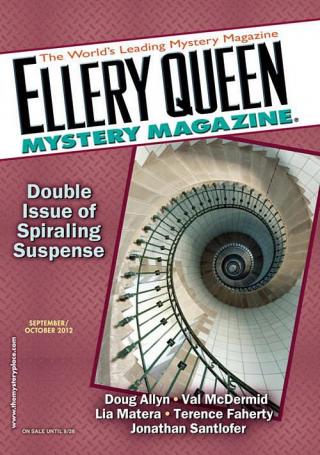
Ellery Queen’s Mystery Magazine. Vol. 140, Nos. 3 & 4. Whole Nos. 853 & 854, September/October 2012
- Автор: Макдермид Вэл, Манфредо Лу
- Год: 2012
- Язык: английский
- Год: Dell Magazines
- ISBN: 0013-6328
- Жанр: Другие детективы

Электронная книга - «Ellery Queen’s Mystery Magazine. Vol. 140, Nos. 3 & 4. Whole Nos. 853 & 854, September/October 2012». Краткое содержание книги:
For six hundred miles, Ella tried to stop reliving that night. She tried to focus on the scenery — forest and flatland glittering under frost, Pittsburgh, Akron, Cleveland spiked with girders of new buildings. But on every platform of every train station, some paperboy, cotton mask over his nose and mouth, waved the latest edition. Two hundred newly dead in one city, a thousand in the next, then four thousand, five thousand. The Philadelphia Inquirer screamed 50,000 SICK OF SPANISH FLU, 12,000 PERISH.
Now the train was pulling into Chicago, where Ella would transfer to another terminal. People around her were getting up and gathering their things. But she had only what she wore, a traveling suit and coat from Mrs. Kingston’s tallboy, and the contents of her pockets. So she stayed in her seat, watching the station’s bricks and arches come into view.
She noticed three men standing on the frozen mud beside the tracks. They were a few steps from a platform that eventually disappeared into the terminal tunnel. They were well dressed and hatless, puffs of breath visible as they talked. When her window passed closer to them, she felt a shiver of paranoia. They stood with chests out and heads high, every gesture self-pleased and full of swagger. In her experience, when men looked like they owned the whole world, they had badges and guns to justify it. Were these lawmen? She twisted in her seat, looking for — and seeing, she thought — the bulge of shoulder holsters under their jackets. Was railroad security preparing to come aboard? They’d been rousting draft dodgers and Reds since the war began. And Ella had no papers. The Kingstons had burned her things in case sickness clung to them.
She’d gone to them two years ago with little enough — a few dresses and books, her precious letters from Nicky. But she’d left with nothing. Nothing of her own but guilt: She’d brought home the flu that killed them all. Muriel Kingston, only six years old. Eight-year-old John. Baby Annie. The cook, the maid — kind women who risked their health to nurse her after she survived that night outside.
Her hand slid into the pocket of her — that is, Mrs. Kingston’s — suit jacket. She’d needed money to get back home, to rent a small apartment there and recover in body if not in spirit. He fingers closed over the cold facets of diamonds and rubies, the smooth gold of their settings. It wasn’t as if Mrs. Kingston would ever wear her jewelry again.
That wouldn’t matter to the police. If Ella couldn’t show identification, they’d search her. Every day headlines screamed that Bolsheviks from Russia were here to foment revolution. Not long ago, a girl Ella’s age — just nineteen — was pulled from a Chicago train, her carpetbag filled with dynamite. Aliens under suspicion were put straight onto boats “home” even if, like Ella, they’d arrived as babes in arms. And if she gave a false (not foreign-sounding) surname, her pocketful of rings and brooches might mean years at hard labor. Who’d believe they rightfully belonged to a young woman without protectors or even luggage?
She grabbed her coat from the seat beside her and hurried toward the back. She kept her eyes on the windows, on the three men at platform’s end. The train was moving at a crawl now. She was able to keep pace, keep watching, by pushing through one compartment after another.
The train came to a full stop as she reached the last passenger car. Dodging the elbows of people straightening their hats and cotton masks, she took a window seat. She angled for a better look at the men outside. There was a glint of nickel on the lapel of the tallest. He was ginger-haired and broad-shouldered. When he turned to point to the back of the train, she saw he wore a large six-pointed star. A U.S. Marshal.
Ella felt as if the flu, having noticed her edging toward health, had suddenly yanked her back. Her face went hot, her stomach jumped, it was a struggle to breathe. The marshal waved toward the front of the train. The other men nodded, one climbing to the platform while the other started over muddy sleet to the mail cars.
Seeing the aisle was clear now, she hurried to a tiny bathroom. She closed the door and leaned against it. Whatever or whomever the marshals were looking for, if they searched her, she was ruined. Hands shaking, she spread toilet tissue in the small sink and emptied her pocket into it. She broke one hairpin and twisted another prying open gold prongs. She released two large diamonds and an emerald from their settings. Other pieces were smaller and more common — teardrop ruby earrings, a fire opal stick-pin, pearl studs. She pulled a thread in the hem of her (or rather, Mrs. Kingston’s) blouse and worked the gems and jewelry into it. Her hands shook as she pulled the tissue around the larger more distinctive settings. Then, ignoring a sign asking people not to flush while in the station, she sent the small bundle through the Hopper toilet’s opening to the tracks. When her foot came off the lever, she heard footsteps stop at the other side of the door.
She froze, feeling hunted. She remembered stories Nicky used to love. When he was in his early teens and she was a little girl, he spent hours telling her about tigers. Newspapers then were full of articles about man-eaters, how they stalked villagers by following from a distance of ten or twenty feet, blending invisibly into the jungle. Their huge feet, Nicky said, were as silent as clouds across the sky.
When she opened the door, she found herself face-to-face with the marshal who’d gestured his men to go forward and back. His ginger hair was exactly the shade of tiger fur. He blocked the aisle between her and the seat where (she realized) she’d left her coat.
She drew herself to her full height, such as it was, striving for the look of chilly indignation Mrs. Kingston used to wear in public. But it was a challenge even to appear calm. U.S. Marshals were the enforcement arm of the Justice Department, the anti-sedition police who rounded up aliens like Ella, draft dodgers like Nicky, and anarchists like their friends.
This one wasn’t wearing his star anymore. And there was no bulge, nor anything in the way he held his arm, to hint at a holstered gun. Did he hand it off to his deputies before boarding? To pretend he was a passenger?
“Sorry to disturb you,” he said. “I hope you’re well? There’ve been quite a few cases of the flu between Washington and Chicago.”
“Are you a doctor?”
“No, just... a good Samaritan, if you need one, miss. Are you getting off here, waiting for a porter to help with your luggage?”
“No.” She realized her tickets — nearly ninety dollars’ worth — were in her coat. Had he seen them there, had he looked through her pockets? She’d have to be careful not to lie (but not to name a town either) if he asked her destination.
“If you’re catching the transfer train to Grand Central or North Western, it’s been delayed. A porter just told me. They’ve left the dining car open for anyone who wants to wait here.”
“I see.” Mrs. Kingston’s tone would have ordered him to step aside, but Ella couldn’t duplicate it. She wasn’t in the habit of being obeyed.
The man was giving her an appraising look instead of letting her pass. It was bolder than the looks men gave Mrs. K. Was it so apparent, even in clothes taken from a rich woman’s tallboy, that Ella was rabble?
“Say, though, I know you, don’t I?” The marshal smiled, showing good teeth and a single dimple. “Did you board in Washington?”
She thought again of the tickets in her coat pocket. “You too?” If he said yes, perhaps she’d see a tic or squint and know it when he lied again.
“Actually, I think I saw you walking past a friend’s house there.” He gave her another head-to-toe look. “Or rather, the little girl who lives there saw the children who were with you. I don’t remember their names, but I heard about them in some detail — prowess at jump rope, if they’d tried ice cream inside of cones yet. That sort of thing. My friend’s daughter is at the age where she thinks whatever interests her must interest everyone.”