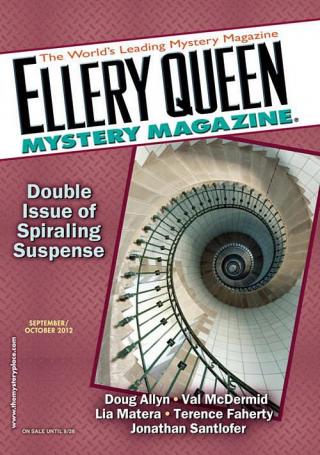
Ellery Queen’s Mystery Magazine. Vol. 140, Nos. 3 & 4. Whole Nos. 853 & 854, September/October 2012
- Автор: Макдермид Вэл, Манфредо Лу
- Год: 2012
- Язык: английский
- Год: Dell Magazines
- ISBN: 0013-6328
- Жанр: Другие детективы

Электронная книга - «Ellery Queen’s Mystery Magazine. Vol. 140, Nos. 3 & 4. Whole Nos. 853 & 854, September/October 2012». Краткое содержание книги:
“Maybe we’re all that age,” Ella said.
The man laughed. “Yes, I am proving it at the moment, aren’t I? You were with a girl Mary’s size and a boy a little older, I think. I was more taken up in watching their... sister, are you?” He showed his dimple again.
If she didn’t know he was a marshal, she might believe he’d seen her walking with Muriel and John. Anyone might have spotted them on their frequent meanders to Rock Creek or the zoo.
But that wouldn’t include a marshal from Chicago. Her stomach knotted around the fact. What did it mean?
“Children and dogs always notice each other, whatever else is going on,” Ella managed. She’d never again get dragged across a street by John or laugh at Muriel’s excited chatter. She’d never again pry baby Annie’s sticky fingers from her hair.
“Do you know my friends, the Palmers, on R Street?” he asked. Ella tried not to show her shock. The Kingstons lived a block from them. “They have a sweet girl, Mary. Well, a wild girl,” he spoke it like a compliment, “but I don’t doubt she’ll be sweet someday.”
Ella knew little Mary Palmer, all right. She’d done all she could, in timing the children’s outings, to make sure Muriel didn’t befriend the pie-faced daughter of the Alien Property Custodian. She hated the man who, with the war as his excuse, robbed immigrants of their factories and patents, handing them to political cronies.
“I’m sorry,” she said, “I don’t know anyone on that street.”
How did he come to bring up R Street at all? It couldn’t be a coincidence, and it might be a disaster.
The marshal didn’t move. He seemed to expect more. In a panic to say anything, she added, “I’m at school, I don’t get out much.”
“School in the District?”
Perhaps if she wasn’t cornered, she could think. Mrs. K. would never have let a strange man trap her in the aisle of a train. But Ella didn’t know how to get past him without answering. She nearly said Howard University because she’d strolled its campus once. Her olive skin and thick head of curls, some escaping the coil at her neckline, might let her pass for mixed race. But Mrs. Kingston’s expensive suit might not. It seemed less risky, in this finery, to say, “Georgetown.”
A hint of smugness on the marshal’s face made her realize she’d admitted to living, not just boarding a train, in Washington.
“Really? And what do you study?”
Would he quiz her to see if she was lying? Just in case, she said, “American history.”
Her studies were buttressed (sometimes corrected) at the Anarchist Hall. It was the immigrants’ social club and night school. They’d seen plays about the labor movement, the Constitution, abolition. They’d heard speakers like Luigi Galleani, Emma Goldman, Margaret Sanger. They’d discussed books and philosophy, they’d laughed and eaten and sung union songs. These days, though, it was as dangerous to wish for utopia as it was to call for insurrection. First the Hall was torched by vigilantes. (That’s when Nicky insisted she find a job far away.) Then the war started, and so did the arrests and deportations.
“American history? Good college for it,” he said.
“Yes.” Ella had read that Georgetown charged $600 tuition. That was more than she would ever earn in a year.
She jittered to step past this man, but she forced herself to stillness. There’s a tiger in India, Nicky once told her, in a place called Champawat. It will track villagers for mile after mile. Invisible in the jungle, barely rustling the leaves. Taking its time, only ten or twenty feet away, waiting to pounce. Unless a person runs. Tigers are like alley cats that way, Ella. You’ve seen how a cat will just watch a mouse... until it tries to get away. Then instinct makes it chase. And kill.
“History,” the man repeated. “Yes, that’s grand. You know who Mitchell Palmer is, then, my friend on R Street? He works for President Wilson, though not where the President first intended. He was first asked to be Secretary of War. Turned that down, though.”
What did it mean that he kept bringing up Palmer and R Street? Even if it was true this marshal had noticed her walking past, he’d have seen a girl in a cheap, usually mud-spattered, suit. On Sundays, Palmer’s neighbors might stroll to display the family in full regalia. But no one dressed as Ella was now, no rich woman like Mrs. K., ever staggered home from the river with a jar full of pollywogs and a sleeping child on piggyback.
No, he was trying to get confirmation that Ella lived there. That she was the person he was on this train to find. Had a relative of Mrs. Kingston’s noticed the missing jewelry? Sent the police to check the train station, to see if any servant purchased a ticket? If so, why not just ask Ella for identification, why not just detain and search her? His pretense was terrifying her.
“I’m a rude lout, though, to keep you standing.” He backed up to let her pass.
Her hand went of its own accord to her skirt, to the spot where the tucked-in hem of her blouse was threaded with the stolen jewels. She held them tight against herself while she skimmed past him. She found her wrapover and sat in that row by the window. She pulled the coat to the middle space and turned away to show she was done conversing.
To her chagrin, the man sank into the aisle seat. “Pardon me for saying so, but you look a bit peaked. Would you like some water? I can send a porter to get some.”
She shook her head.
“You’re not wearing a mask like so many on the train. You’ve had the flu already, I guess? Perhaps recently? It’s left you pale.”
“I’m all right,” she said.
“Please don’t misunderstand me. I don’t mean that you look — Only that after so long a train ride... But let me not remove one foot from my mouth to insert the other. I’ve had the flu myself. It got hold of me in Philly,” he said, “the week it took five thousand there. Did you lose anyone to it?”
She thought again of her fellow servants, of the children. She’d used Cook’s money to pay the wagon men to take away their bodies. Then she’d left Mrs. K. alone in the house, bleeding through her tear ducts, her face the color of old liver. Ella had tried to make her comfortable. She’d done all she could to keep it from her, about Muriel and John and baby Annie. But when the dying woman realized the truth, there’d been no helping her.
Ella said, “Everyone’s lost somebody, I think.”
“It’s not easy to survive these days, is it, between the war and the flu,” he said. “And a hard time after, if you do.”
Why didn’t this marshal pounce: search her, interrogate her, take her away? Why did he stalk her with conversation?
To change the subject to something else, anything else, she said, “Why did your friend turn down being Secretary of War?”
“Well, he’s a Quaker. Not fully a pacifist — they call him the Fighting Quaker. He’s in favor of this war because it was thrust upon us. But he feared his faith could complicate initiating another. And the day may come when we have to strike first. So he took a different post.”
She nodded, unsure what to reply.
“I’m a Quaker as well,” he said. “We’re supposed to be Catholics, we Irish. But my mother was a Friend, and she took pity on the besotted fellow who became my dad.”
“Did the draft board assign you to a farm camp? That’s where they send Quakers, isn’t it?”
“On the contrary, most Friends who object are shipped straight to the battlefield. Ordered to carry stretchers if we won’t carry guns. But not all of us object. I didn’t get called, but I’d have gone. I don’t believe in shirking. It only leaves the dirty work to others.”