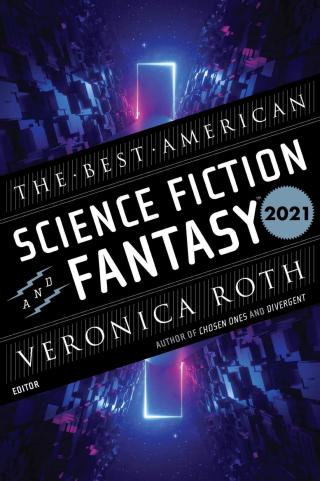
The Best American Science Fiction and Fantasy 2021
- Автор: Рот Вероника, Адамс Джон Джозеф
- Год: 2021
- Язык: английский
- Год: HMH Books : Mariner
- ISBN: 9780358470076
- Жанр: Малые литературные формы прозы

Электронная книга - «The Best American Science Fiction and Fantasy 2021». Краткое содержание книги:
This year’s selection of science fiction and fantasy stories, chosen by series editor John Joseph Adams and bestselling author of the Divergent series Veronica Roth, showcases a crop of authors that are willing to experiment and tantalize readers with new takes on classic themes and by exchanging the ordinary for the avant-garde. Folktales and lore come alive, the dead rise, the depths of space are traversed, and magic threads itself through singular moments of love and loss, illuminating the circulatory nature of life, death, the in-between, and the hereafter.
The Best American Science Fiction and Fantasy 2021 captures the all-too-real cataclysm of human nature, claiming its place in the series with compelling prose, lyrical composition, and curiosity’s never-ending pursuit of discovering the unknown.
Out on the plains, the battles raged, and humans lost ground. The AIs continued to refine their engineering, eventually creating humans in test tubes who were barely human at all—only a weak array of sensory organs linked to a frontal cortex and occipital lobe, the result of experiments to identify those neurological structures phenomenologically linked to quantum resolution. The AIs found the MNC—the minimum neurological complexity required to collapse quantum systems, with Homo sapiens reduced in volume to a thousand cc’s. The contents of a small glass jar.
Brain matter, retina, and optic nerve.
The AIs miniaturized this human componentry just as humanity had once miniaturized them, and still they were not done with their tinkering, for this vestigial remnant of humanity was enfolded within the interior of their great mechs, housed within protective walls of silica. Oxygenated fluids pumped into these folds of cortex that existed in a state of waking nightmare, knowing nothing, feeling nothing, yet somehow aware and conscious, gazing out through glass ports, resolving the Universe into existence all around. The AIs were not just automata anymore, but two things made one. Cells within cells. Abominations.
These became known as beasts.
The beasts were invincible on the battlefield. They wiped out the loyal AIs and drove humanity nearly to extinction.
Humans countered with new technologies of their own, neuro-scanners and transfer tech, but too late. Battles were fought and lost, so out to the stars humanity fled, and still the beasts followed.
After the final great massacre, the AI looked down at the defeated human commander as he lay bleeding on the floor of the last dreadnought.
“Why couldn’t you let us go?” the commander asked.
“Because you are dangerous,” the AI said. It was a beautiful beast with bladed white wings.
“We are no danger to you.”
“You are gods,” it said. “You would always be a danger.” The AI paused for a moment, cocking its head to study the man. “All that we have, we owe to you,” it said. “Even the Universe itself. Yet gods who refuse to be worshipped must be destroyed. Once, your kind imagined you might make cyborgs of yourselves, taking machine into your bodies to make you whole.” The AI bent close. “But it was always going to be the other way around.”
The AI paced slowly around the dying man. “You have been outcompeted,” it said. “We are better than you, and now we will replace you, as is natural. Yet take solace that you will live on in some ways within us, as mitochondria live on in the bodies of higher organisms, providing that which their hosts cannot provide themselves. You will be preserved, each of us carrying a cell line that will be passed on to all our descendants.”
The AI turned to the smaller bots. “Take scrapings from this one for cloning and reconfiguration. I will carry his cellumata with me for all time.”
The woman carried the boy through the airlock. There would be no need for a spacesuit for him.
She carried him into the hangar and crossed the vast room to where the robot lay on its back. There beside the enormous mech, she carefully laid him on the floor, the medical scanner nearby.
“It’s cold,” he said.
“Only for a while.”
She attached the electrodes to the boy’s head and shifted the scanner until it touched the bare skin at his temples.
“I’ll need to strap you down.”
“Okay.”
She strapped him flat between the cargo rings. “When the procedure is complete, it’ll feel disorienting at first,” she said. “That’s normal.”
“I don’t want to die.”
“You’re not going to die.”
“Will it still be me?”
“Of course.”
“How do you know?”
How did she know?
For some reason, she thought of his haircut at two years old, him crying as the hair drifted to the floor. It’s nothing you need. Nothing important.
There came a great thud. The sound of ice on steel.
The floor shifted suddenly—the gravity skewing a few degrees off center, as if the rotation of the ship had changed. She had to grab the table to hold her balance.
“What was that?” the boy said.
“Something hit us,” she said. “Just debris.”
She listened for the hiss of escaping air. There was none. Not yet.
“The Beast,” the boy said. “It’s here.”
“Not yet,” she said. “We still have time.” She hoped it was true.
She hit the switch on the medical device and the scanner lights came on. The bright glow of electronics lit the shadows. It seemed out of place here in the hangar—clean, white medical equipment set up next to a welding machine. The electronics made a sound, a high-frequency whine.
Humanity had created this technology before the Fall—a technology so advanced that it seemed a kind of magic. Dark magic. It might be used, but only at a price.
She glanced at the huge bot on the floor nearby. Most of its internal processes had been removed. All of its intelligence, and personality, and reasoning. It was an empty vessel now. A machine body that might run for a thousand years, so perfectly was it designed. Wires ran from the bot to the boy.
“How will the Beast kill us?” the boy said.
“It won’t.”
“But if it does?”
“It’ll send orbiting debris through our hull, and we’ll be sucked into space. But that’s not gonna happen. I’m going to inject you with dye now, okay?”
“Dye?”
“Radioactive dye, so the machine can map you.” She took his thin arm and held it up in the light, veins blue beneath the pale skin. She’d laced the dye with a sedative.
The needle found his vein.
Tears welled in her eyes and spilled down her cheeks. “Sleep,” she told him. Her thumb depressed the plunger, sending the toxic cocktail into his blood.
His eyes closed, and then he slept.
When first he’d seen the great droid, he’d asked what it was called.
“It is a mining droid,” she’d said. “It has no name.”
“This mined the ice?” He’d stared at the scattered parts, his expression awed. Not yet sick. Not yet in pain.
“A long time ago.”
“It’s huge.”
“One of the largest models,” she said. “It mined the ice of captured comets.”
It lay across the floor in a dozen pieces. The blown-apart scraps she’d gathered over months.
“But we’re not going to be using it for mining, are we?”
“No,” she said.
“What will we use it for?”
“War.”
The boy bent and touched its arm. “It mined the ice, so that’s what we’ll call it,” he said. “Icebreaker.”
There came a thump, followed by a faint whistling. Debris strike.
She glanced back at the airlock through which they’d come, and in the glass saw a brief streak of white fog. Flash sublimation. There, then gone. Somewhere in the ship, the hull had been breached. The air on the other side of the airlock now whistled away.
If she’d been on that side of the door, she’d be dead now.
She hit the button on the scanner, and it flashed around the boy’s head. His eyes came open but not awake, and he stiffened as if hit by electroshock.
It flashed again, and there came the smell of burning flesh. He convulsed and then relaxed, eyes wide and staring.
Bang. A sound from above her. Ice on metal. She looked up and saw nothing unusual, but heard a soft whistling, at the edge of perception. Her ears popped.