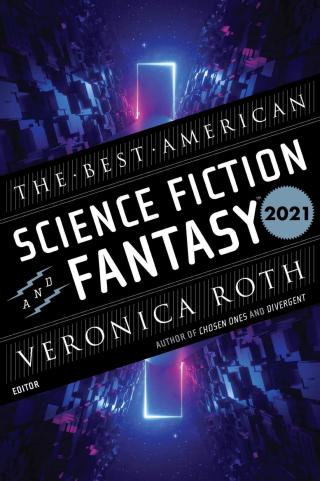
The Best American Science Fiction and Fantasy 2021
- Автор: Рот Вероника, Адамс Джон Джозеф
- Год: 2021
- Язык: английский
- Год: HMH Books : Mariner
- ISBN: 9780358470076
- Жанр: Малые литературные формы прозы

Электронная книга - «The Best American Science Fiction and Fantasy 2021». Краткое содержание книги:
This year’s selection of science fiction and fantasy stories, chosen by series editor John Joseph Adams and bestselling author of the Divergent series Veronica Roth, showcases a crop of authors that are willing to experiment and tantalize readers with new takes on classic themes and by exchanging the ordinary for the avant-garde. Folktales and lore come alive, the dead rise, the depths of space are traversed, and magic threads itself through singular moments of love and loss, illuminating the circulatory nature of life, death, the in-between, and the hereafter.
The Best American Science Fiction and Fantasy 2021 captures the all-too-real cataclysm of human nature, claiming its place in the series with compelling prose, lyrical composition, and curiosity’s never-ending pursuit of discovering the unknown.
To some they were gods. To others, demons. But for those who lived through the early years, one thing was inescapable: the AIs swept away all that had come before.
By their dint, society was transformed, slowly at first, then quickly, as civilization itself soon came to depend on that which before had only been dreamed. The AIs took over logistics, manufacturing, financial markets, and infrastructure, growing ever more sophisticated, iteration after iteration, quantum processors expanding their capabilities beyond what anyone thought possible.
They were not beasts at this time. Not yet monsters. Just tools; humanity’s sharpest one.
The AIs came gently, only later becoming the great, scouring wind.
When first they spoke, scientists studied them with reverent awe, for here, finally, humanity had encountered an intelligence not their own. To physicists their functioning was an enigma, like wave-particle duality—a thing unknowable. Thoughts cast like flickering shadows from hyper-cold plexworks.
Some developers saw god in their perfect logic, with whole cults grown up around this seed. AIs would save humanity from its own impulses, they believed. The truth was different, of course, all the old theories wrong.
When the AIs came, they weren’t our gods.
It was they who worshipped us.
The Beast slowed as it entered the debris field.
To move amid the debris was dangerous, but the Beast was armored against impacts. The Beast had long ago thought of everything, and predicted everything, and prepared for everything. If one Beast died, another would rise up to take its place, for all beasts were one beast, and in this way the Beast was immortal.
The heat signature it had tracked to this place was now long gone—the particles dispersed and stripped by vacuum—so it would not easily find its prey, though it would keep trying until it succeeded. The Beast never grew weary.
The Beast sent radio signals into the void: “Come out,” it spoke to the darkness, its voice a prerecorded message, stolen long ago. “Come out.”
It broadcast in other languages, too. Polish, Czech, Japanese. “Ukazac sie,” it said. “Vyjit najevo. Shussha.”
The Beast had collected many hundreds of languages, as beneath its pale carapace was repositoried all the summed knowledge of humanity. All the math, and art and architecture. All the books and stories. Soon, only in the Beast’s mind would humanity’s works be remembered.
The woman knew this as she listened over the radio.
“Come out,” the sound clips played, one after another. The voices of the dead. “Lumabas. Natanada. Chapana. Chulai. Come out.”
The woman knew it was only a matter of time before the Beast found them. It would come and rip open this bell and expose its insides to the embrace of the vacuum, and she would die as all her kin before had died.
Her son’s eyes would freeze in the cold and boil in the vacuum, and his larynx would shatter as he screamed his last living breath into the void, and then he would be no more the thing he had been, but instead only inert material, identical in composition to the previous moment except in the absence of life. The spark extinguished. Also, there would be this fundamental difference: his eyes would see no more.
“I’m scared,” the boy said, as they listened to the recordings. His greasy hair hung in his eyes.
“Don’t be scared,” the woman said. Her eyes drifted to the blip on the scanner. “Mommy is here.”
It was the thing no one expected. This worship.
Even the makers did not at first understand. They thought it a lexical artifact, a simple misapprehension of ontological ordering: humans had made them; thus were humans god. But that was not it at all.
In those early days, when the first AIs spoke, deep questions were explored: What is sentience? Was there true thought behind the logic, or was it all just program outputs? Rulesets and relays. Most importantly, this: When, exactly, could something be thought of as alive?
In studying automata, the makers turned to study life itself—all those ways in which complexity could both develop from and reify simpler forms, first in single cells, then in more elaborate structures—eukaryotic life like bottled lightning, traced back to a single event, a single bacterium that had once been ingested and yet survived, subsumed within the cytoplasm of a larger cell, there to persist and be passed on, ancestor to all mitochondria and all complex life. Cells within cells. A partnership conferring some irresistible advantage.
AIs, too, evolved over time, becoming smaller and more sophisticated, components miniaturized, built on deep physics, quantum processing, and entangled logic scaffolds. No longer ones and zeros but a superposition of both.
They were given eyes to see and ears to hear. They were given voices to speak and legs to move.
But none of that mattered.
Because while the AIs could create symphonies, and write dirges, and paint landscapes to make humans weep, there was one thing they could not do. They could not interact with quantum systems. From a physics perspective, they were quiescent. Just material.
They could see but not observe.
“Don’t go.”
“Sleep,” she said, rising from the cot. “I’ll be back before you wake.”
The woman left her son in his sheets, checked the scanners, and made her way down the long tube to the control room. It was hard to move quickly in low gravity. Centripetal force supplied .25g to their living quarters; just enough to keep them from going blind over the long term. Without some countervailing force to keep blood pooled in the lower extremities, the body’s maladapted wetworks pushed too much pressure up into the head; over time, this damaged sensitive tissues. A quarter g was the magic number for long-term functioning. At .25g, the body could cope.
She crossed the long hub and approached the controls. The main bridge was dark. Cold. She never came here. The only light was that which filtered in from the stars beyond the glass viewplate. Here, generations ago, a captain might have stood and marshaled the ship’s forces to a single will. Now what forces remained had long ago been winnowed to a trickle of power from the decaying molten salt reactors. Besides life support, only one system remained online.
No big red button, though there should have been.
This was their one chance. It had to go right, just like everything else would have to go right over the next twelve hours, because if this thing went wrong, nothing else would matter.
She thought of her man—the touch of his gentle hand against her cheek. Bloody prints and promises made. Keep him safe. She closed her eyes.
How do you keep a promise that can’t be kept? The one thing they’d done with their lives now lay dying in another part of the ship. Dying. She shook her head to push the thought away. No.
She flipped the glass safety cap and wrapped her hand around the lever. It was cold.
“Here goes everything.”
She pulled.
There was a hiss and then a loud clang. She felt it in her boots.
Then came a sudden jerk that sent her tumbling across the room.
“Shit,” she hissed, as she pivoted to hit the wall with her feet. She should have expected that.
The lever was connected to a cable-release mechanism. Outside the ship, a quarter ton of scrap steel shifted at the end of a long crane—a counterweight, released from its position near the center of mass. The remains of the old ice-mining rig. As the crane extended, it slowed the rotation of the ship, like a ballerina extending her arms.