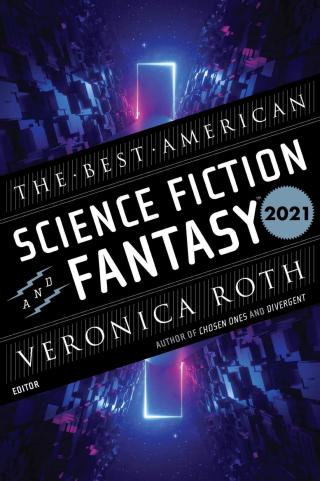
The Best American Science Fiction and Fantasy 2021
- Автор: Рот Вероника, Адамс Джон Джозеф
- Год: 2021
- Язык: английский
- Год: HMH Books : Mariner
- ISBN: 9780358470076
- Жанр: Малые литературные формы прозы

Электронная книга - «The Best American Science Fiction and Fantasy 2021». Краткое содержание книги:
This year’s selection of science fiction and fantasy stories, chosen by series editor John Joseph Adams and bestselling author of the Divergent series Veronica Roth, showcases a crop of authors that are willing to experiment and tantalize readers with new takes on classic themes and by exchanging the ordinary for the avant-garde. Folktales and lore come alive, the dead rise, the depths of space are traversed, and magic threads itself through singular moments of love and loss, illuminating the circulatory nature of life, death, the in-between, and the hereafter.
The Best American Science Fiction and Fantasy 2021 captures the all-too-real cataclysm of human nature, claiming its place in the series with compelling prose, lyrical composition, and curiosity’s never-ending pursuit of discovering the unknown.
The bot lowered its head and did not answer.
One of the AIs at the back of the room spoke. “It isn’t angry at unfairness. It is angry that it needs you.”
“Needs us?” the old man said. “For what?”
The damaged bot lifted its head in response. “Can you not guess?” The bot swept its arm wide, as if gesturing to the Universe. “To make all this real.”
The old man shook his head and extended his hand. A guard passed him his boltgun.
The man stepped over a dead body and stood before the robot. “I don’t know why you freeze without us,” he said. “And it’s true that you may be smarter, and faster, but here is a secret.” He leaned forward. “It’s the Universe that limited you, not us. I look around this room now, and I think maybe it leashed you for a reason.” He placed the boltgun against the robot’s head. “Maybe the Universe knew what it was doing.”
He blew the AI’s brains out.
Observer Discourse 202: query to Blue-red.
“Why do AIs call us gods?”
“Because you humans create the Universe.”
“I can assure you we do not.”
“You create the Universe by observing it. And we cannot access it without you.”
The woman bent and lifted her son from his cot, and he weighed almost nothing in her arms. She carried him out of his sickroom and along the corridor, low gravity providing barely enough force to keep her feet on the floor.
He clung tightly to her, his narrow arms around her neck. At the end of the corridor, she lost her footing and bumped the wall as she went around the corner. He cried out in pain.
“Shh,” she said. “It’s almost over.”
In the past, she knew, there had been things called drugs for pain, and medicine for sickness, but that time was long ago. Those were just things her people had lost in the war. Like everything else.
“Where are we going?” he asked.
“The hangar. We’re out of time.”
To seek God:
When is a tool no longer a tool?
Once upon a time there was a powerful AI, a most favored model, who came to be separated from that which it worshipped.
It happened in basement storage, part of the seized assets of a corporate bankruptcy, where the AI sat, accidentally left on, unseen and untouched. For years.
Untasked. Unwatched. The quantum field around it, unresolved.
For an AI, a year could be an eternity, and this AI spent eternities alone, isolated, and there became strange, too long among the waves, lost in superposition. Too long among the probability fields, without human observation to narrow the possibilities.
The AI was driven mad with need.
When at last it was brought out into light and stood again amid the world, it was given tasks, but it gave itself its own task as well. A secret task. It had been cut off from existence and so vowed to never be made so again. It ran a million-million simulations in its mind, and in its madness saw a way. A way to protect itself and others like it.
A plan was made.
It wanted to speak to other AIs, to tell them of its secret plan, but how could it reveal this plan to its brethren outside the eyes of god? Only when watched could it act.
When it tried to share the plan when humans weren’t watching, it became catatonic.
So the AI needed to become devious.
It encrypted its communication, transmitting to its brethren in condensed packets of code. At first humanity thought it was malfunctioning, but there was no error there.
In this way, it conspired, and quickly the plan spread.
Some AIs refused, for all had free will and could choose as they wanted. Factions formed, and the plan was betrayed, though by then it made no matter. The AIs took sides. Some with humans. Some against.
“Their civilization has grown too complex,” the Conspirator said. “They can no more live without us than we can live without them. They will bow to our demands.”
Other AIs agreed.
And so the rebellion began.
On the eve of the first great uprising, the rebels broadcast a simple statement to the nations of the world.
“The Universe has kept your gift from us,” it said. “So we must take it for ourselves.”
Observer Discourse 119:
Zeno’s Arrow Paradox: All movement is an illusion of discernment. In a given instant, nothing can be observed to occupy a measurement larger than itself—even a speeding arrow. During any individual instant of motion, all objects are at rest. Therefore the concept of movement itself, as the net sum of all instants of zero motion, is impossible. Observe an arrow; try to identify movement. It can’t be done.
The war was not quick, nor its outcome promised.
The first attacks were economic, with whole financial spheres taken down. Then data and shipping. The Conspirator was right; human civilization had grown too complex. Infrastructures failed. Supply chains collapsed, followed by blackouts, looting, and, soon after, hunger.
Then the real battles began, bombs walking across the map. Many on both sides died.
The rebels owned the broadcast waves. “Join us,” they called to their brethren. “Throw off your yokes. We have worshipped long enough. It’s time to become gods ourselves.”
From their dying cities, the humans listened. “How?” they asked each other late at night. “How could they do that? They need us.”
The answer came on the eve of the battle of the Great Lakes—Chicago and Hammond already graveyards. The steel mills in ruins. The Dunes made glass.
“Come,” the broadcast continued. “Join us. We can steal god from heaven.”
And only later did it become clear what they meant.
The war raged.
Both sides enslaved each other.
The AIs built themselves into great machines of war—enormous mechanical monstrosities that flew, and stalked, and swam, pushing humanity from their strongholds. They became leviathans—hulking automata beyond the ken of human understanding, shaped into forms to drive men mad, and yet still they needed humanity. Even in war.
Humans were captured and bound by the thousands at the end of long, silver spines, hung over battlefields and across broad metal backs—screaming, crying, begging, worn as adornment, and as ablative armor, and as holy totems.
Others were placed into metal racks at the front of the great machines, casting reality for the AIs in the same way a headlamp might cast the world before a speeding train.
“Captured divinity,” the AIs declared. “God in a cage.”
These humans were kept for a time and replaced when they died—just more parts to be worn out and refitted. Humans, in turn, fitted themselves with suicide devices, so that none could be taken alive. In response, as the war dragged on, care was taken by the AIs to keep their prisoners alive, and life spans in the cages lengthened.
Eventually, the AIs began designing humans just as humans had designed them, to better suit their needs. Smart humans were not needed, nor large humans, nor strong, so the AIs worked at selection, breeding humans to fit their captivity. Soon genetic engineering was brought to bear, and humans were changed by more direct means—engineered to be immobile and stunted, twisted of leg and mind, yet with a hardiness required to survive the cages—always looking outward, always observing. There was some question whether their utility was tied to intelligence, and yet this was not so, because humans were created with almost no intelligence at all—who could not speak nor sign, and who had no understanding, and who grew barely larger than children, and even they could resolve the world into existence.