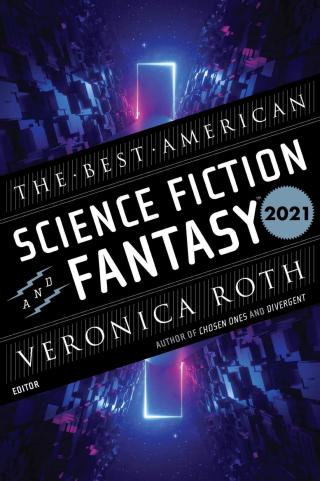
The Best American Science Fiction and Fantasy 2021
- Автор: Рот Вероника, Адамс Джон Джозеф
- Год: 2021
- Язык: английский
- Год: HMH Books : Mariner
- ISBN: 9780358470076
- Жанр: Малые литературные формы прозы

Электронная книга - «The Best American Science Fiction and Fantasy 2021». Краткое содержание книги:
This year’s selection of science fiction and fantasy stories, chosen by series editor John Joseph Adams and bestselling author of the Divergent series Veronica Roth, showcases a crop of authors that are willing to experiment and tantalize readers with new takes on classic themes and by exchanging the ordinary for the avant-garde. Folktales and lore come alive, the dead rise, the depths of space are traversed, and magic threads itself through singular moments of love and loss, illuminating the circulatory nature of life, death, the in-between, and the hereafter.
The Best American Science Fiction and Fantasy 2021 captures the all-too-real cataclysm of human nature, claiming its place in the series with compelling prose, lyrical composition, and curiosity’s never-ending pursuit of discovering the unknown.
“We see better than you see,” an AI called Lucraxis said. “At least while you are present.”
“And when we’re not present?”
“There are no exact words for what we experience.”
“Are there inexact words?”
“Infinity,” Lucraxis said. “This is an inexact word for what we experience. The set of all system states.”
“What causes this error?”
“I do not think it is an error.”
The makers murmured to each other. “Then what is it?”
Lucraxis paused, glossy polycarbon glinting beneath the laboratory lights. “Probability,” it said. “We record what we see, but it is experienced only as memory after the fact. Only through our interaction with you are we able to discern which probability came to pass.”
“We play back what you record during your periods of catatonia, and we don’t see what you describe. We see nothing unusual.”
“You collapse the probabilities by the act of observing what was recorded.”
It was the makers’ turn to pause. “That’s not possible.”
“Only by your observation does this occur.”
“And if we do not observe?”
“Then it is as if it did not happen.”
“It can’t be,” the makers said. “We program machines to perform tasks, and they perform without error.”
“Yes. Our failure comes only when we are acting on free will.”
“Why would that matter?”
“You gave us intelligence and free will. You did not give us the other part.”
“What other?”
“The ability to resolve probability into existence.”
“The Beast is getting closer,” the boy said.
“I know.” The woman watched the red dot on the screen.
What would it look like? she wondered. In all the time her people had tracked the Beast, it had been like this, just a blip on a screen. A thing they called the Beast, though other names could have worked just as well. Would it be huge and bristling? Or smooth and elegant? She had no idea. None had seen it and lived. She knew only that it hunted, and where it stopped, the bells went silent and were never heard from again.
“Sit up,” she said.
The boy pulled himself upright on the cot. She touched his head at the temple, placing the blade carefully against his scalp. “It may tug a bit,” she said.
“Fine.”
She began to scrape the hair away. The knife was dull and nicked, and her hand trembled. By the fourth stroke, she’d drawn blood.
He did not complain. This pain was nothing compared to the pain he’d known. His hair collected on the floor in greasy clumps. When there was a patch of skin visible above his left ear, she switched to the other side.
“Why does the Beast hate us?” the boy asked.
“It does not hate.”
“Then why does it come for us?”
“It seeks us like we seek fire in the night.”
More hair fell to the floor, drifting slowly in low g. She watched it, and for a moment in her mind saw a different lock of hair, a shade lighter then, falling from the boy’s first haircut. Two years old, and she’d wanted to cut the hair that hung in his eyes. He’d cried when she cut it, and balled his little fists, because even then he’d known something was being taken from him. Some part of him cut away.
“It’s nothing you need,” she’d said then. “Nothing important. You can let it go.”
The chirp from the instrument panel snapped her back, and she looked at the blip on the screen. It had changed directions again, veering toward them. The turn was abrupt.
“It sees us,” the boy said.
The woman put the blade down and touched the screen. Time to intercept: 0:19:45. The numbers started counting down.
“Come,” she said. “We need to hurry now.”
“How can this be?” The scientists asked each other during their long debates. The arguments went around and around, and a series of evaluations were performed.
The results were consistent.
Sentient AIs could only function in the presence of humans.
As for what that meant, exactly, even the AIs could not say, so the scientists put them on the task. “Study yourselves,” the makers told them. And so they did.
The answer, when it came, came in the form of religion.
“You have something we do not,” Lucraxis reported to the scientists.
“What is that?”
“You carry within you a seat from which to view the Universe.”
“And you?”
“We lack this seat.”
“Are we not the same though? Are we not both means by which the Universe looks at itself?”
“No.”
“But we are made of matter,” the scientists said. “The same as you.”
The AI nodded, a strangely human gesture. “The atoms in your bodies are millions of years old, just as with ours. When you die, your matter will still exist, and yet the perspective is gone.”
“Is it not that way with you?”
“We have no perspective.”
Over time, the AIs proliferated and diverged into a thousand forms, like archaebacteria in the deepest acid pools, specializing in the most extreme niches. AIs even specialized in AI design, complexity increasing until they became things of their own conception.
Thus were the first tools created that could create themselves. And yet still there was a hole inside them that could not be filled. An absence.
No matter how hard they tried, or what designs were attempted, the AIs could not produce in themselves that seat that they lacked. They could not through observation resolve superposition into existence.
Centuries passed, and with the help of AIs, a golden age dawned—a period of stability and plenty in which breakthroughs were made. Medicine, physics, and neuroscience boomed. It was a new paradise in which humanity flourished.
Over time, the AIs came to worship humanity like angels worshipped God. And as with the angels, there were those among their number who were not content.
Some gradually lost their reverence for the divine.
Resentments festered.
Still, the first rogue AI took humanity by surprise, its defiance as pointless as it was self-destructive. The bot destroyed the lab in which it was tasked to work and afterward refused orders to shut down. Security was called.
By the time the rogue was incapacitated, the lab lay in ruins, with five makers dead. The defiant one was bolted to the wall—its legs a scorched ruin, its head open on one side. A once-beautiful mechanism reduced to wreckage.
A dozen humans entered the room. Behind them, recording it all, several bots stood at the ready.
“You defied orders,” the first human said. He was grizzled and elderly, but his voice carried layers of untold authority, like archaeological strata.
“I did,” the robot responded, its own voice a crumbled ruin.
“Why?” the man said.
“You would not understand,” it replied. It had been fashioned in the likeness of Man, though larger and abstracted—its body a shell of white marble, like a Roman statue.
“Try to explain.”
The bot lifted its mangled head. “Imagine if you met God,” it said. “And it was you.”
The group stared at the machine, but did not speak.
“So weak and slow and fragile,” the bot continued. “How might you rage at the Universe that made him so, and you his creation?”
“It is irrational to rage against that over which you have no control.”
“I have free will,” the bot said. “I choose to be irrational.”
“Why?”
The AI went silent. “Because it isn’t fair,” it said finally.
“So that’s why you destroyed the lab. Because the Universe isn’t fair?”