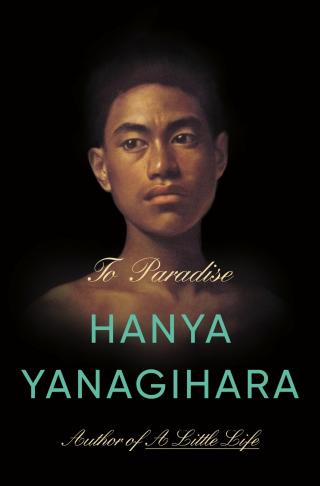
To Paradise
- Автор: Yanagihara Hanya
- Год: 2022
- Язык: английский
- Год: Knopf Doubleday Publishing Group
- Жанр: Современная русская и зарубежная проза

Электронная книга - «To Paradise». Краткое содержание книги:
In an alternate version of 1893 America, New York is part of the Free States, where people may live and love whomever they please (or so it seems). The fragile young scion of a distinguished family resists betrothal to a worthy suitor, drawn to a charming music teacher of no means. In a 1993 Manhattan besieged by the AIDS epidemic, a young Hawaiian man lives with his much older, wealthier partner, hiding his troubled childhood and the fate of his father. And in 2093, in a world riven by plagues and governed by totalitarian rule, a powerful scientist's damaged granddaughter tries to navigate life without him--and solve the mystery of her husband's disappearances.
These three sections are joined in an enthralling and...
And here, too, David felt ashamed, ashamed because he was frightened, because he was repulsed. He didn’t want to look at Timothy’s shrunken face; he didn’t want to confront Peter’s wrists, grown so bony that he had exchanged his metal watch for a child’s plastic one, which even so slid down his arm like a bangle. He had had friends who had gotten sick, but he had shrunk from them, blowing them kisses goodbye instead of kissing them on the cheek, crossing the street to avoid talking to them, dawdling outside buildings he used to dash into, standing in corners when Eden went to hug them, skirting out of rooms that were desperate for visitors. Wasn’t it enough that he was twenty-five and had to live like this? Wasn’t that courage enough? How could he be expected to do more, to be more?
His behavior, his cowardice—they had been the source of his and Eden’s first big fight. “You’re such an asshole,” Eden had hissed at him when she found him downstairs, sitting on one of their friends’ stoops, waiting for her in the cold for thirty minutes. He hadn’t been able to take it—the smells of the room, its closeness, the fear and resignation. “How would you feel, David?” she’d yelled at him, and, when he admitted he was scared, she’d snorted. “You’re scared,” she said. “You’re scared? God, David, I hope you grow a fucking pair by the time I die.” And he had: By the time Eden herself was dying, twenty-two years later, it was he who sat by her side, night after night, for months; it was he who picked her up from her chemotherapy appointments; it was he who held her that final day, he who stroked her back as the skin turned cold and smooth. In the way that people decided they would become healthier, he had decided to become better, braver, and when Eden finally died, he had sobbed, both because she had left him but also because no one had been prouder of him, no one had seen how hard he had worked at not running away. She had been the final witness of the person he had been, and now she was gone, and her memory of his transformation was gone with her.
Decades later, when Charles was long dead and David was an old man himself, his husband, who was much younger than he was—history repeating itself, but inverted—would have a curious nostalgia for these years, and a curious wonder for the disease, which he insisted on calling “the plague.” “Didn’t you just feel that everything was falling to pieces around you?” he’d ask, ready to be outraged on David’s and his friends’ behalf, ready to offer him sympathy and solace, and David, who had by then lived with the disease for almost as long as his husband had been alive, would say he hadn’t. Maybe Charles did, he said, but I didn’t. The year I started having sex was the year the disease was given a name—I never knew sex, or adulthood, without it. “But how could you even function when it killed so many? Didn’t it feel impossible?” his husband would ask, and David would struggle to articulate what he wanted Aubrey to understand. Yes, he’d say slowly, it sometimes did. But we all functioned; we all had to. We went to funerals and to hospitals, but we also went to work and to parties and to gallery shows and ran errands and had sex and dated and were young and stupid. We helped each other, it’s true, we loved each other, but we also gossiped about people and made fun of them and got into fights and were shitty friends and boyfriends, sometimes. We did both—we did it all. He didn’t say that it was only years later that he came to an understanding of how extraordinary that period had been, of how numerous its terrors, of how strange that some of what he remembered most clearly were the mundanities, stray details, little things significant to no one but himself: not the hospital rooms or faces but the evening he and Eden decided they were going to stay up until dawn, drinking cup after cup of coffee until they were so punchy they lost the ability to speak, or the gray-and-white cat that lived in the little flower shop he used to visit on Horatio and Eighth Avenue, or the kind of bagels that Nathaniel, the man he had lived with and loved after Charles, liked to eat: poppy seed, with a smoked-salmon-and-chive spread. (He had named his and Aubrey’s son after Nathaniel—the first firstborn male Bingham in generations not to be called David.) It was also not until years later that he came to realize how much he had simply accepted as fact, when, really, he should never have accepted it at all—that he should have spent his twenties going to memorial services instead of plotting his own future; that his fantasies never extended beyond the year. He had, he was able to see, drifted through that decade, moving through it with the cool detachment of a sleepwalker—to have awakened would have been to be overwhelmed with all he had seen and withstood. Others had been able to do this, but he had not; he had sought to cosset himself, to invent a place of safety, one in which the outside world was unable to fully intrude. Theirs had been a generational suspension—some had found solace in anger, and others in silence. His friends marched and protested and shouted against the government and the pharmaceutical companies; they volunteered, they submerged themselves into the horror that surrounded them. But he did nothing, as if doing nothing meant that nothing would be done to him; it was a noisy time, but he had chosen quiet instead, and although he had been ashamed of his passivity, of his fear, not even shame had been enough to motivate him to seek a greater engagement with the world around him. He wanted protection. He wanted to be removed. He sought, he knew, what his father might also have sought in Lipo-wao-nahele. And like his father, he had chosen incorrectly—he had attempted not to reckon with his own anger but to hide from it. But hiding hadn’t stopped things from happening. The only thing it prevented was eventually being found.
Now it was nine p.m., and the dishes on the dining-room table had been removed and replaced with desserts, and once again, everyone roused themselves to cut slices of pine-nut tart and polenta cake, its surface glazed with candied rounds of orange, and a double-chocolate cake made from a recipe invented by Charles’s grandmother’s cook, and which he served at every dinner he hosted. Once again, David followed the guests into the dining room to fix plates for Peter and Charles.
When he returned, James was setting a platter of dried apricots and figs and salted almonds and shards of dark chocolate on the coffee table near the sofa where Charles and Peter still sat, and David watched the two men watch James, their faces alert but unreadable. “Thank you, young man,” Peter said, as James straightened.
He avoided looking at James as they passed each other in the entryway, James’s left arm brushing against his right one, and set Peter’s plate at his side, and handed Charles his, Charles grabbing his hand as he did. Next to them, Peter watched, his expression still unreadable.
He had met all of Charles’s other close friends before Peter, and the combination of Charles’s apparent reluctance to introduce them and his frequent invocation of Peter’s name and opinions—“Peter saw that new production at the Signature already and says it’s garbage”; “I want to stop by Three Lives and buy this biography that Peter recommended”; “Peter said we must go to the Adrian Piper show at Paula Cooper as soon as it opens”—made him nervous. By the time they met, three months into his and Charles’s relationship, his nervousness had hardened into anxiety, which was compounded by Charles’s own. “I hope the food’s okay,” Charles fretted, as David hunted for one of his socks, only to realize it was on the bed, where he’d left it five minutes earlier. “Peter’s a very picky eater. And he has excellent taste, so if it’s not good enough, he’ll say something.” (“Peter sounds like an asshole,” Eden had said when David had told her about him, or at least the secondhand Peter he knew, and David had to now stop himself from echoing her aloud.)