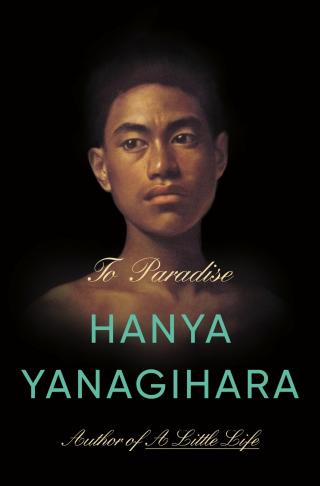
To Paradise
- Автор: Yanagihara Hanya
- Год: 2022
- Язык: английский
- Год: Knopf Doubleday Publishing Group
- Жанр: Современная русская и зарубежная проза

Электронная книга - «To Paradise». Краткое содержание книги:
In an alternate version of 1893 America, New York is part of the Free States, where people may live and love whomever they please (or so it seems). The fragile young scion of a distinguished family resists betrothal to a worthy suitor, drawn to a charming music teacher of no means. In a 1993 Manhattan besieged by the AIDS epidemic, a young Hawaiian man lives with his much older, wealthier partner, hiding his troubled childhood and the fate of his father. And in 2093, in a world riven by plagues and governed by totalitarian rule, a powerful scientist's damaged granddaughter tries to navigate life without him--and solve the mystery of her husband's disappearances.
These three sections are joined in an enthralling and...
He was both fascinated and alarmed by this version of Charles, so flustered and discombobulated. It was something of a relief to see that even Charles could feel inadequate; on the other hand, they couldn’t both begin the evening feeling this insecure—he was counting on Charles to be his defender. Why are you so nervous? he asked Charles. This is your oldest friend.
“It’s because he’s my oldest friend that I’m nervous,” said Charles, stroking his razor beneath his chin. “Don’t you have a friend whose opinion matters more to you than anyone’s?”
No, he said, though he thought of Eden as he did.
“Well, you will someday,” said Charles. “Damnit.” He had nicked himself, and he grabbed a square of toilet paper and held it against his skin. “If you’re lucky, that is. You should always have a close friend you’re slightly afraid of.”
Why?
“Because it means that you’ll have someone in your life who really challenges you, who forces you to become better in some way, in whatever way you’re most scared of: Their approval is what’ll hold you accountable.”
But was that really true? He thought of his father, who definitely had been afraid of Edward. He had wanted Edward’s approval, that was true; and Edward had challenged him, that was also true. But Edward hadn’t wanted his father to become better—not smarter or more educated or more independent-minded. He had simply wanted his father to—what? Agree with him; obey him; keep him company. He had pretended that such obedience was in the service of a greater mission, but it hadn’t been—it had been about finding someone who might finally look up to him, which is all anyone seemed to want. The kind of friend Charles was describing was someone who wanted you to become more yourself. But Edward had wanted the opposite for David’s father. He had wanted to reduce him into something that didn’t think at all.
Well, he said, but isn’t your friend supposed to be nice to you?
“That’s what I have you for,” Charles said, smiling at him in the mirror.
When he finally did meet Peter, he was surprised by how mesmerizingly ugly he was. It wasn’t that any one feature was so disagreeable—he had large, light-colored eyes, like a dog’s, and a bony, confident nose, and long dark eyebrows that seemed to have grown as a single unit rather than as a collection of individual hairs—but the combination was unharmonious, if compellingly so. It was as if every aspect of his face was determined to be a soloist, rather than a member of an ensemble.
“Peter,” Charles said, hugging him.
“Charlie,” Peter replied.
For the first part of dinner, Peter talked. He was someone, it seemed, who had a strong and informed opinion on virtually any topic, and his soliloquy, fueled by small comments and questions from Charles, went from the repointing work on Peter’s building to the revival of certain nearly extinct squash varietals to the flaws of a highly acclaimed recent novel to the charms of an obscure, newly republished collection of brief essays by a fourteenth-century Japanese monk to the connections between anti-modernists and anti-Semites to why he would no longer holiday in Hydra but, rather, in Rhodes. David was ignorant about all of these subjects, yet through his mounting unease, he found himself intrigued by Peter. Not so much by what he said—he was unable to follow most of it—but by how he said it: He had a lovely, deep voice, and he spoke as if he enjoyed the feel of the words coming off his tongue, as if he were saying them only because he liked the sensation of doing so.
“So, David,” said Peter, turning to him as David knew he must. “Charles has already told me how you met. But tell me about yourself.”
There’s really not much to tell, he began, looking briefly at Charles, who gave him an encouraging smile. He recited the facts that Charles already knew, as Peter stared at him with his pale, wolfish eyes. He had expected Peter to be interrogatory, to start asking him the questions everyone always did—So your father never worked, ever? Never? You didn’t know your mother? Not even a little?—but he had only nodded, and then said nothing.
I’m boring, he’d concluded, apologetically, and Peter had nodded, slowly and gravely, as if David had said something profound. “Yes,” he said. “You are. But you’re young. You’re supposed to be boring.” He had been uncertain how to interpret this, but Charles had only smiled. “Does that mean you were boring when you were twenty-five, Peter?” he asked, teasingly, and Peter had nodded again. “Of course I was, and you too, Charles.”
“So when did we start becoming interesting?”
“That’s a big assumption to make, isn’t it? But I’d say in the last ten years.”
“That recently?”
“I’m just talking about myself now,” Peter said, and Charles laughed. “Bitch,” he said, fondly.
“I think that went well,” Charles had said that night in bed, and David had agreed, though he actually didn’t. Since that night, he had had to see Peter on only a few more occasions, and each time, there would be a pause in the conversation in which Peter would turn his large head in David’s direction and ask, “So what’s happened to you since I saw you last, young man?,” as if life was something that David wasn’t experiencing but was, rather, having bestowed upon him. And then Peter had gotten sicker, and David had seen him even less, and after tonight, he would never see him again. Charles had said that Peter was dying a disappointed man: He was a renowned poet, but for the past three decades he had been writing a novel, yet it had never found a publisher. “He had assumed it would be his legacy,” Charles said.
He couldn’t completely understand Charles’s and his friends’ interest in their legacy. Sometimes at these parties, talk would turn to how they might be remembered when they died, to the things they would leave behind. Sometimes their tone would be content, or defiant, or, more often, plaintive; it wasn’t only that some of them didn’t feel they were leaving enough but that what they were leaving was too complicated, too compromised. Who would remember them, and what would they remember? Would their children think of how they had had tea parties with them, or read to them, or taught them how to catch a ball? Or would they instead recall how they had left their mothers, how they had moved out of their houses in Connecticut and into apartments in the city that were never comfortable enough for children, no matter how hard they tried? Would their lovers think of them when they were so bright with health that they could walk down the street and men would literally turn around to look at them, or would they think of them as they were today, as old men who weren’t even old, from whose faces and bodies people shied? The knowledge and recognition of who they were in life had been hard-won, but they wouldn’t be able to control who they became in death.
And yet who cared? The dead knew nothing, felt nothing, were nothing. When he told Eden of Charles’s and his friends’ concerns, she had said that it was a very white male fixation to be concerned with legacy. How do you mean? he’d asked. “Only people who have a plausible hope of being immortalized in history are so obsessed about how they might get immortalized,” she said. “The rest of us are too busy trying to get through the day.” At the time, he’d laughed and called her melodramatic, and a reactionary man-hater, but that night, as he lay in bed, he had thought about what she said and wondered if she was correct. “If I had had a child,” Charles occasionally said, “I’d feel like I was leaving something behind—like I had left my mark on the world.” He knew what Charles meant by this, but he was also puzzled by his inability to see the assumptions inherent in that statement: How did having a child guarantee anything? What if your child didn’t like you? What if your child didn’t care about you? What if your child became a terrible adult, an association you were ashamed of? Then what? A person was the worst legacy, because a person was by definition unpredictable.