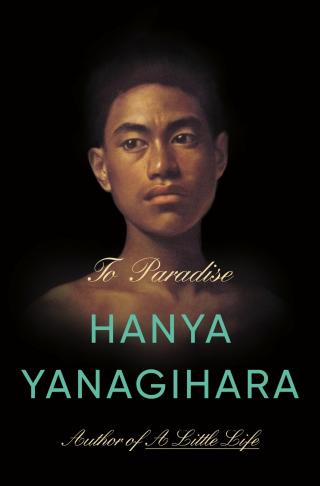
To Paradise
- Автор: Yanagihara Hanya
- Год: 2022
- Язык: английский
- Год: Knopf Doubleday Publishing Group
- Жанр: Современная русская и зарубежная проза

Электронная книга - «To Paradise». Краткое содержание книги:
In an alternate version of 1893 America, New York is part of the Free States, where people may live and love whomever they please (or so it seems). The fragile young scion of a distinguished family resists betrothal to a worthy suitor, drawn to a charming music teacher of no means. In a 1993 Manhattan besieged by the AIDS epidemic, a young Hawaiian man lives with his much older, wealthier partner, hiding his troubled childhood and the fate of his father. And in 2093, in a world riven by plagues and governed by totalitarian rule, a powerful scientist's damaged granddaughter tries to navigate life without him--and solve the mystery of her husband's disappearances.
These three sections are joined in an enthralling and...
“Spare us the details.”
“Jealous?”
“Uh, no.”
“Anyway, the next day, I’m walking down the street and there she is again, and back we go into the alley. And then, the day after that, I see her again, and I think: Huh. Something’s off here. And then I realize she’s wearing the exact same thing as the previous two times! Right down to the underwear. And also that she’s kind of smelly. Actually, let me correct that: She’s very smelly. Poor old girl. She didn’t have anywhere to go.”
“So did you leave?”
“Of course not! We were there, weren’t we?”
They all laughed, and then Timothy began singing: “La da dee la dee da, La da dee la dee da,” and Percival joined in: “She’s just like you and me, but she’s homeless; she’s homeless.” David left them, smiling—he liked watching the three of them together; he liked how no one else seemed to interest them as much as they did themselves. How would his father’s life have been different if Edward had been more like Timothy or Percival or John, if his father had had a friend who would make the stuff of their past into a story to entertain instead of to control? He tried to picture his father in Charles’s house, at this party. What would he think? What would he do? He imagined his father, his shy, slight smile, standing behind the staircase banister, looking at the other men but afraid to join them, assuming they would ignore him as he had been ignored almost all of his life. What would his father’s life have been like had he left the island, had he learned to ignore his mother, had he found someone to cherish him? It might have resulted in a future in which David might not exist. He stood there, conjuring this other life for him: His father, strolling alongside the arch at the north of the Square, a novel tucked under his arm, walking beneath the late-fall trees, their leaves as red as apples, his face lifted to the sky. It would be a Sunday, and he would be on his way to meet a friend for a movie and then dinner. But then the vision faltered: Who was this friend? Was it a man or a woman? Was theirs a romantic relationship? Where was his father living? How was he supporting himself? Where would he go the next day, and the day after? Was he healthy, and if he wasn’t, who was taking care of him? He felt a kind of despair steal over him: for how his father eluded him even in fiction, for how he was unable to construct a happy life for him. He had been unable to save him; he was unable even to summon the courage to learn of his fate. He had abandoned his father in life, and now he was abandoning him again, in fantasy. Should he not at least be able to dream him into a better existence, a kinder one? What did it say about him, as his son, that he was incapable of even that?
But maybe, he thought, maybe it wasn’t a lack of empathy that was to blame for his inability to project his father into a different life—maybe it was how childlike his father was, how his father had behaved like no other parent, like no other adult, he had known, then or since. There were, for example, their walks, which had begun when David was six or seven. He would be woken late at night by his father, holding out his hand, and David would take it, and together they would walk the streets of their neighborhood in silence, showing each other how familiar things became different in the nighttime: the bush dangling flowers that resembled upside-down cornets, the acacia tree on their neighbor’s property that in the dark appeared enchanted and malevolent and like something from a country far from their own, where they would be two travelers moving through snow that squeaked beneath their boots, and in the distance would be a farmhouse with a single window lit a smoky yellow by a single candle, and inside would be a witch disguised as a kindly widow, and two bowls of soup as thick as porridge, salty with cubes of fatback and sweet with chunks of roasted yam.
On those walks, there would always be a moment in which he realized that he could see, that the night, which had at first seemed a featureless screen of black, toneless and silent, was brighter than it appeared, and although he always promised himself that he would determine the exact moment when it happened, when his eyes adjusted themselves to this different, filtered light, he never could: It happened so gradually, so without his participation, that it was as if his mind existed not to control his body but to marvel at its abilities, its capacity for adaptation.
As they walked, his father would tell him stories from his childhood, would show him places where he had played or had hidden as a boy, and in the night, these stories wouldn’t seem sad the way they did when David’s grandmother had told them, but simply stories: about the other boys in the neighborhood, who threw avocados from one of their trees at his father as he walked home from school; about the time they had made him climb the mango tree in his own front yard and then had told him he couldn’t come down or they’d beat him, and for hours, until it turned dark, until the last of them finally had to leave his post to go home for dinner, his father had stayed in the tree, crouched in the flat, shallow space made by the limbs meeting the trunk, and when he had finally climbed down—his legs shaking from hunger and exhaustion—he had had to go inside his own house and explain where he’d been to his mother, who had been waiting for him at the dining-room table, silent and livid.
Why didn’t you just tell her then what had happened to you? he had asked his father.
“Oh,” his father had said, and then stopped. “She didn’t want to hear it. She didn’t want to hear that those boys weren’t really my friends after all. It was embarrassing for her.” He was silent, listening to him. “But that won’t happen to you, Kawika,” his father had continued. “You have friends. I’m proud of you.”
He had been quiet then, his father’s story and its sadness sinking into him, past his heart and down to his intestines, a leaden anvil, and, remembering this, he felt the same sorrow, this time spreading through his body as if it were something that had been injected into his bloodstream. He turned then, and was intending to go to the kitchen on some made-up pretense—to check on the plating of the food; to tell Adams that Percival would need more hot water soon—when he saw Charles descending the stairs.
“What’s wrong?” Charles asked, upon seeing him, his smile vanishing. “Did something happen?” No, no, nothing happened, he said, but Charles held out his arms anyway, and David walked into them, into Charles’s warm solidity, his reassuring bulk. “It’s all right, David, whatever it is,” Charles said, after a pause, and he nodded into Charles’s shoulder. It would be all right, he knew—Charles said so, and David loved him, and he was far from where he’d been, and nothing would happen to him that Charles wouldn’t be able to solve.
By eight, all twelve of the guests had arrived, Peter last of all—it was snowing by then, and Charles and David and John had carried Peter, in his heavy wheelchair, up the front steps: David and John on either side of him, Charles propping up the rear.
He had just seen Peter at Thanksgiving, and he was stunned by how much he had deteriorated in three weeks. The most noticeable evidence of this was the wheelchair—a high-backed one with a headrest—but also his weight loss, the way the skin on his face in particular seemed to have shrunk, so that his lips couldn’t quite close over his teeth. Or maybe it wasn’t that it had shrunk so much as it had been yanked, as if someone had gathered a fistful of scalp at the back of Peter’s skull and pulled, stretching the skin taut and painful and bulging his eyes out of their sockets. Once he was inside, Peter’s friends gathered around him, but David could tell they too were shocked by his appearance; no one seemed to know what to say.