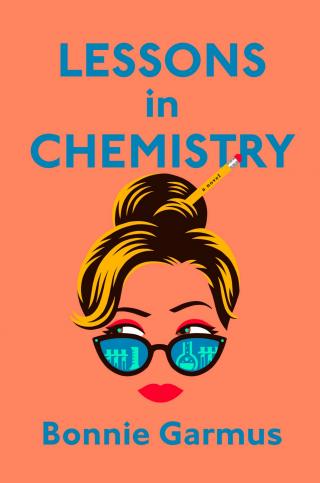
Lessons in Chemistry
- Автор: Garmus Bonnie
- Год: 2022
- Язык: английский
- Год: Doubleday Canada
- Жанр: Современная русская и зарубежная проза

Электронная книга - «Lessons in Chemistry». Краткое содержание книги:
“But why write to the boys home?” he asked. “Why not just ask your dad?”
“Because he’s dead, too.” She sighed.
“Good lord!” the reverend said, shaking his head. “I’m very sorry.”
“Thank you,” Madeline said in a serious way. “Some people think you can’t miss what you never had, but I think you can. Do you?”
“Absolutely,” he said, touching the back of his neck until he located the small chunk of hair that was slightly too long. When he went to visit a friend in Liverpool, they’d gone to see a brand-new musical group called the Beatles. They were British and they had bangs. It was nearly unheard of for men to have bangs, but he found he liked their look almost as much as he liked their music.
“What are you looking for in there?” she asked him, pointing to his book.
“Inspiration,” he said. “Something to move the spirit for Sunday’s sermon.”
“What about fairy godmothers?” she asked.
“Fairy—”
“My dad’s home had a fairy godmother. She gave the home money.”
“Oh,” he said. “I think you mean a donor. The home may have had several. It takes a lot of money to run those places.”
“No,” she said. “I mean a fairy godmother. I think you have to be a bit magical to give money to people you don’t even know.”
The reverend felt another jolt of surprise. “True,” he admitted.
“But Harriet says earning a paycheck is better. She doesn’t like magic.”
“Who’s Harriet?”
“My neighbor. She’s Catholic. She can’t get divorced. Harriet thinks I should fill the family tree with hodgepodge, but I don’t want to. It makes me feel like there’s something wrong with my family.”
“Well,” the reverend said carefully, thinking it did very much sound like there was something wrong with the child’s family, “Harriet probably only means some things are private.”
“You mean secret.”
“No, I mean private. For instance, I asked you how old you were and you correctly answered that it was private information. It’s not secret; it’s just that you don’t know me well enough to tell me. But a secret is something we keep because there’s a chance that if someone knew our secret, they would use it against us or make us feel bad. Secrets usually involve things we’re ashamed of.”
“Do you keep secrets?”
“Yes,” he admitted. “How about you?”
“Me too,” she said.
“I’m pretty sure everyone does,” he said. “Especially the people who say they don’t. There’s no way you go through life without being embarrassed or ashamed about something.”
Madeline nodded.
“Anyway, people think they know more about themselves based on these silly branches full of names of people they’ve never met. For instance, I know someone who’s very proud to be a direct descendant of Galileo, and another who can trace her roots back to the Mayflower. They both talk about their lineage as if they have a pedigree, but they don’t. Your relatives can’t make you important or smart. They can’t make you you.”
“What makes me me, then?”
“What you choose to do. How you live your life.”
“But lots of people don’t get to choose how they get to live. Like slaves.”
“Well,” the reverend said, chagrined by her simple wisdom. “That’s true, too.”
They sat quietly for a few moments, Madeline skimming her finger down the phone book pages, the reverend considering the purchase of a guitar. “Anyway,” he added, “I think family trees aren’t a very intelligent way to understand one’s roots.”
Madeline looked up at him. “A minute ago you said it would be fun to learn about my ancestors.”
“Yes,” he confessed, “but I was lying,” which made both of them laugh. From across the way, the librarian raised her head in warning.
“I’m Reverend Wakely,” he whispered, nodding an apology to the frowning librarian. “From First Presbyterian.”
“Mad Zott,” Madeline said. “Mad — like your magazine.”
“Well, Mad,” he said carefully, thinking “Mad” must be French for something. “If it’s not under Saint Vincent, try Saint Elmo. Or wait — try All Saints. That’s what they call places when they can’t decide on a single saint.”
“All Saints,” she said, flipping to the A’s. “All, All, All. Wait. Here it is. All Saints Boys Home!” But her excitement was short-lived. “But there’s no address. Just a phone number.”
“Is that a problem?”
“My mom says you only call long distance if someone dies.”
“Well, maybe I could call for you from my office. I have to call long distance all the time. I could say I was helping a member of my congregation.”
“You’d be lying again. Do you do that a lot?”
“It would be a white lie, Mad,” he said, slightly irritated. Would no one ever understand the contradictions of his job? “Or,” he said more pointedly, “you could follow Harriet’s advice and fill the tree with hodgepodge — which isn’t such a bad idea. Because quite often the past belongs only in the past.”
“Why?”
“Because the past is the only place it makes sense.”
“But my dad isn’t in the past. He’s still my dad.”
“Of course he is,” the reverend said, softening. “I just meant — in terms of me calling All Saints — that they might feel more comfortable talking with me because we’re both in religion. Like you probably feel more comfortable talking to the kids at school about school things.”
Madeline looked surprised. She’d never once felt comfortable talking to the kids at school.
“Or, I know,” he said, now wanting to extricate himself from the whole thing. “Ask your mother to call. It’s her husband; I’m sure they’d help. They might need proof of the marriage before they’d be willing to give her anything significant— a certificate, something like that — but that should be easy enough.”
Madeline froze.
“On second thought,” Madeline said, quickly writing two words on a scrap of paper, “here’s my dad’s name.” Then she added her phone number and handed it to him. “How soon can you call?”
The minister glanced down at the name.
“Calvin Evans?” he said, drawing back in surprise.
—
Back when he’d been at Harvard Divinity School, Wakely audited a chemistry course. His goaclass="underline" to learn how the enemy camp explained creation so he could refute it. But after a year of chemistry, he found himself in deep water. Thanks to his newly acquired understanding of atoms, matter, elements, and molecules, he now struggled to believe God had created anything. Not heaven, not earth. Not even pizza.
As a fifth-generation minister attending one of the most prestigious divinity schools in the world, this was a huge problem. It wasn’t just the familial expectations; it was also science itself. Science insisted on something he rarely encountered in his future line of work: evidence. And in the middle of this evidence was a young man. His name was Calvin Evans.
Evans had come to Harvard to sit on a panel made up of RNA researchers, and Wakely, having nothing better to do on a Saturday night, attended. Evans, who was by far the youngest on the panel, barely said anything. There was a lot of shop talk from the others about how chemical bonds were formed, broken, then re-formed following something called an “effective collision.” Frankly, the whole thing was a little boring. Still, one of the panelists continued to drone on about how real change only ever arose through the application of kinetic energy. That’s when someone in the audience asked for an example of an ineffective collision — something that lacked energy and never changed, but still had a big effect. Evans had leaned into his microphone. “Religion,” he said. Then he got up and left.