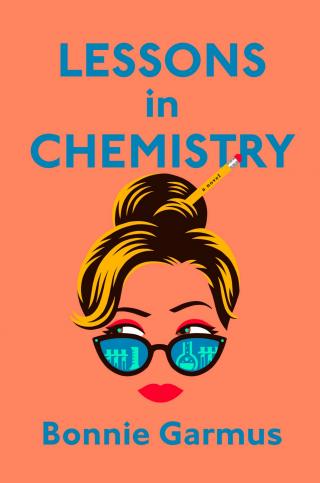
Lessons in Chemistry
- Автор: Garmus Bonnie
- Год: 2022
- Язык: английский
- Год: Doubleday Canada
- Жанр: Современная русская и зарубежная проза

Электронная книга - «Lessons in Chemistry». Краткое содержание книги:
Supper at Six had that same element of impossibility. Elizabeth opened every show by insisting that cooking wasn’t easy and that the next thirty minutes might very well be torturous.
“Cooking is not an exact science,” Elizabeth had said just yesterday. “The tomato I hold in my hand is different from the one you hold in yours. That’s why you must involve yourself with your ingredients. Experiment: taste, touch, smell, look, listen, test, assess.” Then she led her viewers through an elaborate description of chemical breakdowns, which, when induced by combining disparate ingredients in heat-specific ways, would result in a complicated mix of enzymatic interactions that would lead to something good to eat. There was a lot of talk about acids and bases and hydrogen ions, some of which, after weeks of hearing it, Harriet was, oddly, beginning to understand.
Throughout the process, Elizabeth, her face serious, told her viewers that they were up for this difficult challenge, that she knew they were capable, resourceful people, and that she believed in them. It was a very strange show. Not exactly entertaining. More like climbing a mountain. Something you felt good about, but only after it was over.
Nevertheless, she and Madeline watched Supper at Six together every day, holding their breath, certain each new episode would be the last.
—
Madeline had opened her book and was now studying an engraving of one man gnawing on the femur of another. “Do people taste good?”
“I don’t know,” Harriet said as she set a few cubes of cheese down in front of her. “I’m sure it’s all in the preparation. Your mother could probably make anyone taste good.” Except for Mr. Sloane, she thought. Because he was rotten.
Madeline nodded her head. “Everybody likes what Mom makes.”
“Who’s everybody?”
“Kids,” Madeline said. “Some of them bring the same lunch as me now.”
“Really,” Harriet said, surprised. “Leftovers? From the previous night’s dinner?”
“Yes.”
“Their mothers watch your mom’s show?”
“I guess.”
“Really?”
“Yes,” Madeline emphasized, as if Harriet was slow on the uptake.
Harriet had assumed Supper at Six had very few viewers, and Elizabeth had confirmed this by confiding that her six-month trial period was almost up; it had been a battle the entire time; she was fairly certain she would not be renewed.
“But surely you could meet them halfway?” Harriet had asked her, trying not to sound desperate. She loved watching Elizabeth on TV. “Maybe just try to smile.”
“Smile?” Elizabeth had said. “Do surgeons smile during appendectomies? No. Would you want them to? No. Cooking, like surgery, requires concentration. Anyway, Phil Lebensmal wants me to act as if the people I’m speaking to are dolts. I won’t do it, Harriet, I won’t perpetuate the myth that women are incompetent. If they cancel me, so be it. I’ll do something else.”
But nothing that would pay nearly as well, Harriet thought. Thanks to the TV money, Elizabeth had been true to her word: she now paid Harriet. It was Harriet’s very first paycheck, and she couldn’t believe how powerful it made her feel.
“You know I agree,” Harriet had said, treading carefully, “but maybe you could only pretend to do what they want. You know, play along.”
Elizabeth cocked her head to the side. “Play along?”
“You know what I mean,” Harriet said. “You’re smart. It might be off-putting to Mr. Pine, or that Lebensmal person. You know how men are.”
Elizabeth considered this. No, she did not know how men were. With the exception of Calvin, and her dead brother, John, Dr. Mason, and maybe Walter Pine, she only ever seemed to bring out the worst in men. They either wanted to control her, touch her, dominate her, silence her, correct her, or tell her what to do. She didn’t understand why they couldn’t just treat her as a fellow human being, as a colleague, a friend, an equal, or even a stranger on the street, someone to whom one is automatically respectful until you find out they’ve buried a bunch of bodies in the backyard.
Harriet was her only real friend, and they agreed on most things, but on this, they did not. According to Harriet, men were a world apart from women. They required coddling, they had fragile egos, they couldn’t allow a woman intelligence or skill if it exceeded their own. “Harriet, that’s ridiculous,” Elizabeth had argued. “Men and women are both human beings. And as humans, we’re by-products of our upbringings, victims of our lackluster educational systems, and choosers of our behaviors. In short, the reduction of women to something less than men, and the elevation of men to something more than women, is not biologicaclass="underline" it’s cultural. And it starts with two words: pink and blue. Everything skyrockets out of control from there.”
Speaking of lackluster educational systems, just last week she’d been summoned to Mudford’s classroom to discuss a related problem: apparently Madeline refused to participate in little girl activities, such as playing house.
“Madeline wants to do things that are more suited to little boys,” Mudford had said. “It’s not right. You obviously believe a woman’s place is in the home, what with your”—she coughed slightly—“television show. So talk to her. She wanted to be on safety patrol this week.”
“Why was that a problem?”
“Because only boys are on safety patrol. Boys protect girls. Because they’re bigger.”
“But Madeline is the tallest one in your class.”
“Which is another problem,” Mudford said. “Her height is making the boys feel bad.”
—
“So no, Harriet,” Elizabeth said sharply, coming back to the subject at hand. “I won’t play along.”
Harriet picked some dirt out from beneath a fingernail as Elizabeth harangued about women accepting their subordinate positions as if they were preordained, as if they believed their smaller bodies were a biological indication of smaller brains, as if they were naturally inferior, but charmingly so. Worse, Elizabeth explained, many of these women passed such notions down to their children, using phrases like “Boys will be boys” or “You know how girls are.”
“What is wrong with women?” Elizabeth demanded. “Why do they buy into these cultural stereotypes? Worse, why do they perpetuate them? Are they not aware of the dominant female role in the hidden tribes of the Amazon? Is Margaret Mead out of print?” She only stopped when Harriet stood up, indicating she did not wish to be subjected to another unabridged word.
—
“Harriet. Harriet,” Madeline repeated. “Are you listening? Harriet, what happened to her? Did she die, too?”
“Did who die?” Harriet asked distractedly, thinking about how she’d never read Margaret Mead. Was she the one who wrote Gone with the Wind?
“The godmother.”
“Oh, her,” she said. “I have no idea. And anyway, she — or he — wasn’t technically a godmother.”
“But you said—”