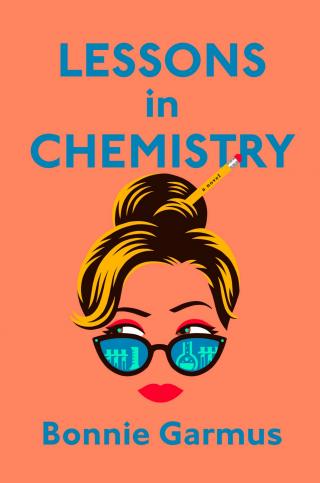
Lessons in Chemistry
- Автор: Garmus Bonnie
- Год: 2022
- Язык: английский
- Год: Doubleday Canada
- Жанр: Современная русская и зарубежная проза

Электронная книга - «Lessons in Chemistry». Краткое содержание книги:
From off in the distance, he heard Elizabeth Zott talking about the importance of work. She was sermonizing again, filling the funeralgoers’ heads with ideas of self-respect. “Take risks,” she was saying. “Don’t be afraid to experiment.”
Don’t be like Walter, she meant.
Weren’t people supposed to wear black to funerals?
“Fearlessness in the kitchen translates to fearlessness in life,” Zott claimed.
Who’d asked her to give his eulogy anyway? Phil? Rude. And rich considering that the only risk he, Walter Pine, had ever taken — hiring her — was turning out to be the reason for his premature death. Take-risks-don’t-be-afraid-to-experiment my ass, Zott. Who was dead here?
He continued to hear her voice in the background accompanied by the insistent thwack of a knife. Then after another ten minutes or so came her closing remarks.
“Children, set the table. Your mother needs a moment to herself.”
In other words, enough about dead Walter — back to me.
The mourners clapped enthusiastically. Time to hit the bar.
There wasn’t much after that. Unfortunately, his imagined death was a lot like his life. It occurred to him that “bored to death” might not just be a phrase.
—
“Mr. Pine?”
“Walter?”
He felt a hand touch his shoulder. “Should I call a doctor?” the first voice asked.
“Maybe,” the other voice said.
He opened his eyes to find Zott and Rosa standing next to him.
“We think you may have fainted,” Zott said.
“You were slumped over,” Rosa added.
“Your pulse is elevated,” Elizabeth said, her fingers on his wrist.
“Should I call a doctor?” Rosa asked again.
“Walter, have you eaten? When was the last time you ate?”
“I’m fine,” Walter said hoarsely. “Go away.” But he didn’t feel very good.
“He didn’t eat lunch,” Rosa said. “Took nothing from the cart. And we know he hasn’t had dinner.”
“Walter,” Elizabeth said, taking charge. “Take this home.” She placed a large baking dish in his hands. “It’s the spinach casserole I just made. Put it in the oven at three hundred seventy-five degrees for forty minutes. Can you do that?”
“No,” he said, sitting up. “I can’t. And anyway, Amanda hates spinach, so again, NO.” And then realizing he sounded like a petulant child, he turned to the hair and makeup woman (what was her name?) and said, “I’m so sorry to have worried you”—slurring a mixture of possible first names—“but I’m completely fine. You have a nice night, now.”
To prove how fine he was, he got up from his chair and walked unsteadily to his office, waiting until he was sure they’d both left the building before he left himself. But when he got to the parking lot, he found the casserole sitting on the hood of his car. Bake at 375 degrees for forty minutes, the note said.
When he got home, and only because he was tired, he stuck the damn thing in the oven, and not too long after that, sat down to dinner with his young daughter.
Three bites later, Amanda declared it to be the best thing she’d ever eaten.
Chapter 27
All About Me
MAY 1960
“Boys and girls,” Mrs. Mudford said the following spring, “we’re going to start a new project. It’s called All About Me.”
Mad took a sharp breath in.
“Please ask your mother to fill this out. It’s called a family tree. What she writes on this tree will help you learn about a very important person. Who knows who that person might be? Hint: the answer is in the title of our new project, All About Me.”
The children sat in a sloppy semicircle at Mrs. Mudford’s feet, chins cupped in hands.
“Who wants to guess first,” Mudford prodded. “Yes, Tommy,” she said.
“Can I go to the bathroom?”
“May I, Tommy, and no. School is almost over. You may go in a little bit.”
“The president,” said Lena.
“Could it be the president?” corrected Mrs. Mudford. “And no, that’s wrong, Lena.”
“Could it be Lassie?” said Amanda.
“No, Amanda. This is a family tree, not a doghouse. We’re talking about people.”
“People are animals,” said Madeline.
“No, they aren’t, Madeline,” Mrs. Mudford huffed. “People are humans.”
“What about Yogi Bear?” asked another.
“Could it be Yogi Bear?” Mrs. Mudford said irritably. “And of course not. A family tree is not filled with bears, and it is definitely not about TV shows. We’re people!”
“But people are animals,” Madeline persisted.
“Madeline,” Mrs. Mudford said sharply. “That’s enough!”
“We’re animals?” Tommy said to Madeline, his eyes wide.
“NO! WE ARE NOT!” shouted Mrs. Mudford.
But Tommy had already stuck his fingers into his armpits and started jumping about the classroom yowling like a chimpanzee. “E E!” he called to the other kindergartners, half of whom instantly joined in. “E E O O! E E O O!”
“STOP IT, TOMMY,” Mrs. Mudford shouted. “STOP IT ALL OF YOU! UNLESS YOU WANT TO GO TO THE PRINCIPAL’S OFFICE, STOP IT RIGHT NOW!” And the harshness of her voice combined with the threat of a higher authority sent the children back to their positions on the floor. “NOW,” she said tersely, “as I was saying, you’re going to learn some new things about a very important person. A PERSON,” she emphasized, glaring at Madeline. “Now who might this PERSON be?”
No one moved.
“WHO?” she commanded.
A few heads shook.
“Well, it’s YOU, children,” she shouted angrily.
“What? Why?” asked Judy, slightly alarmed. “What did I do wrong?”
“Don’t be dense, Judy,” Mrs. Mudford said. “For heaven’s sake!”
“My mom says she’s not giving the school another cent,” said a crusty-looking boy named Roger.
“Who said anything about money, Roger!” Mrs. Mudford shrieked.
“Can I see the tree?” asked Madeline.
“May I,” thundered Mrs. Mudford.
“May I?” asked Madeline.
“NO, YOU MAY NOT,” Mrs. Mudford screeched, folding the paper into quarters, as if the mere act of folding would make it Madeline-proof. “This tree is not for you, Madeline; it is for your mother. Now children,” she said, trying to find her way back to control, “organize yourselves into a single-file line. I will pin the paper to your shirts. Then it will be time to go home.”
“My mom wants you to stop pinning stuff on me,” said Judy. “Says you’re making holes in my clothes.”
Your mother is a lying whore, Mrs. Mudford wanted to say, but instead she said, “That’s fine, Judy. We’ll staple yours on instead.”
One by one, the children allowed Mrs. Mudford to affix the note to their sweaters and then filed out the door, where, just past the doorjamb, they instantly gained speed like small ponies that had been tethered for hours.
“Not you, Madeline,” she said. “You stay here.”
—
“Let me get this straight,” Harriet said as Mad revealed why she was late. “You had to stay behind because you told your teacher that people are animals? Why did you say such a thing, honey? It’s not very nice.”
“It isn’t?” Madeline said, confused. “But why? We are animals.”
Harriet wondered to herself if Mad was right—were people animals? She wasn’t sure. “My point is,” she said, “it’s sometimes better not to argue. Your teacher deserves your respect and sometimes that means agreeing with her even when you don’t. That’s how diplomacy works.”