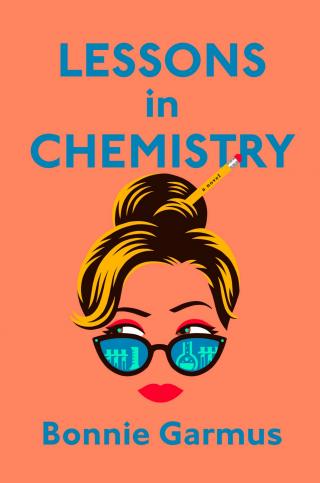
Lessons in Chemistry
- Автор: Garmus Bonnie
- Год: 2022
- Язык: английский
- Год: Doubleday Canada
- Жанр: Современная русская и зарубежная проза

Электронная книга - «Lessons in Chemistry». Краткое содержание книги:
“What did you say?” he hissed, batting her sponge away.
“Subsidized childcare.”
“No, the other—”
“Acetylsalicylic acid?”
“Aspirin,” he demanded hoarsely. “Here at KCTV, we call it aspirin. Bayer aspirin. Want to know why? Because Bayer is one of our sponsors. The people who pay our bills. Ring any bells? Say it. Aspirin.”
“Aspirin,” she said. “Back in a flash.”
“Walter?” Elizabeth’s voice came abruptly from above, causing him to jump.
“Jesus, Elizabeth!” he said. “Must you sneak up on me?”
“I wasn’t sneaking. Your eyes were closed.”
“I was thinking.”
“About the fire extinguishers? So was I. Let’s say three. Two will be sufficient, but three should almost completely eradicate any possibility of tragedy. Up to, or slightly beyond, ninety-nine percent.”
“My god,” he shuddered to himself as he wiped his damp palms on his pants. “Is this a nightmare? Why can’t I wake up?”
“You’re wondering about the other one percent,” Elizabeth said. “Well don’t. That tiny amount is mostly act-of-God stuff — earthquakes, tsunamis — things we can’t possibly anticipate because the science isn’t there yet.” She paused, straightening her belt. “Walter, don’t you find it interesting that people even use that term ‘act of God’? Considering that most want to believe that God is about lambs and love and babies in mangers, and yet this same so-called benevolent being smites innocent people left and right, indicating an anger management problem — maybe even manic depression. In a psychiatric ward, such a patient would be subjected to electroshock therapy. Which I don’t favor. Electroshock therapy is still largely unproven. But isn’t it interesting that acts of God and electroshock therapy share so much in common? In terms of being violent, cruel—”
“Sixty seconds, Zott.”
“—unforgiving, barbarous—”
“Jesus, Elizabeth, please.”
“Anyway, let’s say three. Every woman should know how to put out a fire. We’ll start with the smothering technique, then when that fails, go to nitrogen.”
“Forty seconds, Zott.”
“And what is with the trousers?” Walter said, his teeth clenched so tightly, the words barely emerged.
“What do you mean?”
“You know what I mean.”
“Do you like them? You must. You wear them all the time and I can see why. They’re very comfortable. Don’t worry; I plan to give you full credit.”
“No! Elizabeth, I never—”
“Here’s your aspirin, Mr. Pine,” Rosa interrupted, appearing at his side. “And Zott — let me take a quick look at your — good, good — turn your face the other way now — good — amazing, really. Okay, you’re all set.”
“Zott, in ten,” called the cameraman.
“Are you sick, Walter?”
“Have you seen the family tree project?” he whispered.
“Eight seconds, Zott.”
“You look pale, Walter.”
“The tree,” he barely eked out.
“Free? But I thought you said I couldn’t give things away anymore.”
Elizabeth climbed back up onstage and turning to the camera said, “And we’re back.”
“I don’t know what you think you gave me,” Walter snapped at Rosa, “but it’s not working.”
“It takes time.”
“Which I don’t have,” he said. “Give me the bottle.”
“You’ve already taken the max.”
“Oh really?” he snapped, shaking the bottle. “Then explain why there are still some in here.”
“Now pour your version of Sweden,” Elizabeth was saying, “into the starch, lipid, and protein molecule configuration you rolled out earlier — your piecrust — the one whose chemical bonds were enabled using the water molecule, H2O, and through which you created the perfect marriage of stability and structure.” She paused, her now-floured hands pointing at a piecrust filled with vegetables and chicken.
“Stability and structure,” she repeated, looking out at the studio audience. “Chemistry is inseparable from life — by its very definition, chemistry is life. But like your pie, life requires a strong base. In your home, you are that base. It is an enormous responsibility, the most undervalued job in the world that, nonetheless, holds everything together.”
Several women in the studio audience nodded vigorously.
“Take a moment now to admire your experiment,” Elizabeth continued. “You’ve used the elegance of chemical bonding to construct a crust that will both house and enhance the flavor of your constituents. Consider your filling one more time, then ask yourself: What does Sweden want? Citric acid? Maybe. Sodium chloride? Probably. Adjust. When you’re satisfied, lay your second crust on top like a blanket, crimping the edges to create a seal. Then make a few short slashes across the top, creating a vent. The purpose of the vent is to give the water molecule the space it needs to convert to steam and escape. Without that vent, your pie is Mount Vesuvius. To protect your villagers from certain death, always slash.”
She picked up a knife and made three short slits on top. “There,” she said. “Now pop it in your oven at three hundred seventy-five degrees Fahrenheit. Bake for approximately forty-five minutes.” She looked up at the clock.
“It looks like we have a little extra time,” she said. “Perhaps I could take a question from the studio audience.” She looked at the cameraman, who held a finger up to his throat as if to slit it. “NO, NO, NO,” he mouthed.
“Hello,” she said, pointing at a woman in the front row, her glasses perched atop a stiff hairdo, her thick legs swathed in support hose.
“I’m Mrs. George Fillis from Kernville,” the woman said nervously as she stood up, “and I’m thirty-eight years old. I just wanted to say how much I enjoy your show. I… I can’t believe how much I’ve learned. I know I’m not the brightest bulb,” she said, her face pink with shame, “that’s what my husband always says — and yet last week when you said osmosis was the movement of a less concentrated solvent through a semipermeable membrane to another more concentrated solvent, I found myself wondering if…well…”
“Go on.”
“Well, if my leg edema might not be a by-product of faulty hydraulic conductivity combined with an irregular osmotic reflection coefficient of plasma proteins. What do you think?”
“A very detailed diagnosis, Mrs. Fillis,” Elizabeth said. “What kind of medicine do you practice?”
“Oh,” the woman stumbled, “no, I’m not a doctor. I’m just a housewife.”
“There isn’t a woman in the world who is just a housewife,” Elizabeth said. “What else do you do?”
“Nothing. A few hobbies. I like to read medical journals.”
“Interesting. What else?”
“Sewing.”
“Clothes?”
“Bodies.”
“Wound closures?”
“Yes. I have five boys. They’re always tearing holes in themselves.”
“And when you were their age you envisioned yourself becoming—”
“A loving wife and mother.”
“No, seriously—”
“An open-heart surgeon,” the woman said before she could stop herself.
The room filled with a thick silence, the weight of her ridiculous dream hanging like too-wet laundry on a windless day. Open-heart surgery? For a moment it seemed as if the entire world was waiting for the laughter that should follow. But then from one end of the audience came a single unexpected clap — immediately followed by another — and then another — and then ten more — and then twenty more — and soon everyone in the audience was on their feet and someone called out, “Dr. Fillis, heart surgeon,” and the clapping became thunderous.