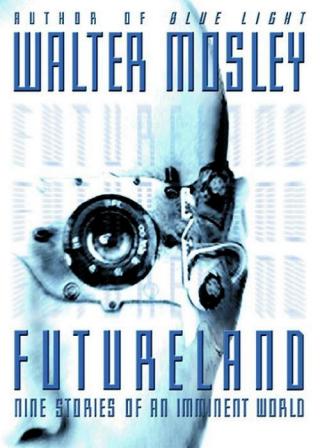
Futureland: Nine Stories of an Imminent World
- Автор: Мосли Уолтер
- Год: 2001
- Язык: английский
- Год: Aspect / Warner Books
- ISBN: 978-0-446-52954-9
- Жанр: Научная фантастика

Электронная книга - «Futureland: Nine Stories of an Imminent World». Краткое содержание книги:
“I’d like to dispense with this aspect of the trial,” Frendon said.
Both cowl and woman regarded him.
“You wish to plead guilty?” they asked as one.
“I accept the fact that my firing a weapon caused the death and damage to the police officers,” Frendon said calmly. “But I wish to claim extenuating circumstances which will prove me innocent of criminal intent.”
During the high-pitched binary conferencing between Court and Defense, Otis Brill tapped Frendon’s wrist and asked, “What are you up to?”
“Just makin’ my case, Officer Brill.”
“You can’t fool these machines, son. They know everything about you from cradle to grave.”
“Really?”
“They mapped your chromes the first hour you were here. If there was insanity in them genes you wouldn’t’a ever stood trial.”
After six minutes had passed The Court asked, “What is your evidence?”
“First I want to fire my lawyer.”
“You cannot.”
“I can if she’s unqualified.”
“AttPrime Five is as qualified as The Court to try your case.”
“How’s that?” Frendon asked.
“She has the same logic matrix as does this unit, she has access to the same data as we do.”
“But you’re three times her size,” Frendon replied reasonably. “You must have some kind of advantage.”
“This unit contains the wetware neuronal components of ten thousand potential jurors. This, and nothing else, accounts for our disparity in size.”
“You got ten thousand brains in there?”
“Biologically linked and compressed personalities is the proper term,” The Court said.
“And you,” Frendon asked, “are you a compressed personality?”
“We are an amalgam of various magistrates, lawyers, and legislators created by the biological linkage and compression system to be the ablest of judges.”
“And prosecutors,” Frendon added.
“It has been decreed by the California Legislature that the judge is best equipped to state the prosecution’s case.”
“But,” Frendon asked, “isn’t the judge supposed to be a representative of blind justice? If The Court is prosecuting, doesn’t that mean that The Court assumes my guilt?”
“Are you legally trained, Mr. Blythe?” The Court asked.
“I spent more than eleven of my twenty-seven years as a guest of the state.”
“Are you legally trained, Mr. Blythe? We have no record of you having such an educational background.”
“The slave studies his masters.”
“Without legal training you cannot, by statute, represent yourself.”
“Without a fair and impartial lawyer I can’t be tried at all.”
“Your attorney is qualified.”
“Has she independently studied my case? Has she developed separate strategies? Has she found information counter to the evidence presented by the prosecution?” Frendon struck a dramatic pose that left Otis agape.
“Evidence in the modern court is objective,” The Court intoned.
“What about my extenuating circumstances?”
A period of fifteen minutes of computer deliberation, punctuated by brief blasts of data between computers, followed.
“What are you doin’, Blythe?” Otis Brill asked.
“Tryin’ to make it home for dinner.”
“You ain’t gonna beat this rap. You goin’ down.”
“From where I sit there’s only up.”
“You’re crazy.”
Frendon sat cross-legged on the floor rather than risk the restraint straps of RMD 27. He watched the frozen images of Court and Defense while enjoying the spaciousness of the courtroom and the sporadic fluttering of dying birds above. There was a certain security he got from the solidity of the glassy Glassone floor. All in all he was completely happy except for the fiber-optic NeuroNet cable attached to the back of his skull. But even this predicament gave him some satisfaction. That cable alone was worth more money than any twelve Backgrounders could con in a cycle. If he could walk out of the courtroom a free man maybe he could also carry a length of this cable with him.
Frendon was White Noise. The only homes he had ever known were governmental institutions and the octangular sleep tubes of Common Ground. He never had a bedroom or a bicycle. He never had a backyard. Frend, as he was known, traveled the underground pathways eating the rice and beans served by the state for every meal every day. By his sixteenth birthday he had been convicted in juvenile courts of more than a dozen violent and felonious crimes. This criminal history kept him from entering the cycles of employment, which were legally assured by the Thirty-sixth Amendment to the Constitution. Frendon’s constitutional right was blocked by the mandatory publication of his criminal history by electronic news agencies. The legality of this record was backed up by the Supreme Court when it decided that reliance by employers on news articles about criminals, even juvenile criminals, was protected by the Fourth Amendment.
Frendon never knew his parents. He never had a chance to rise to street level. But he was no fool either. In the state prisons and detention centers he learned, via monitor, about the law and its vagaries. He studied tirelessly at Infochurch how to circumvent legal conundrums and maintain his freedom.
As a matter of fact he had become so well versed in the legal wiles of automatic justice that for some time now he had been in direct contact with Tristan the First, Dominar of the Blue Zone located on Dr. Kismet’s private island nation, Home. Together they had come up with a plan to use in one of the first fully automated cases.
“The Court has reached a decision,” The Court said. “You are not qualified.”
“I still wish to represent my own case,” Frendon said.
“You are not qualified,” The Court repeated. Frendon thought he detected a slight arrogance in the tone of his judge and jury. The latent personality of a dozen dying judges superimposed on an almost infinite array of prismatic memory.
“I would be if you allowed it.”
The wait this time was even longer. Officer Brill left the room to communicate with the Outer Guard. The Outer Guard was the warden of the Sacramento jail, which was annexed to the Sac’m Justice System. Most trials lasted between ten and twenty minutes since the automated system had been installed — politicians claimed that justice had become an objective reality for the first time in the history of courts.
“Objective,” Fayez Akwande had said at the Sixth Radical Congress’s annual address, “for the poor. The rich can still hire a flesh and blood lawyer, and a breathing attorney will ask for a living judge; a court appointed robot defender will never do such a thing.”
Every once in a while one of the Prime Judging Units got stuck in a justice loop. This would have to run its course. The unit itself was programmed to interrupt after a certain number of repetitions. Officer Brill went to report that the rest of the prisoners slated to appear before Prime Nine should be distributed among the other eleven judges. This hardly mattered because of the speed of the system. There was never any backlog in Sacramento. Every other court system in the country was waiting to install its own automatic justice system.