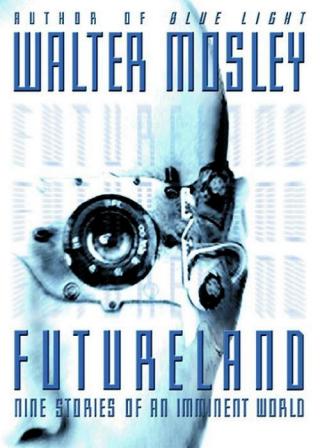
Futureland: Nine Stories of an Imminent World
- Автор: Мосли Уолтер
- Год: 2001
- Язык: английский
- Год: Aspect / Warner Books
- ISBN: 978-0-446-52954-9
- Жанр: Научная фантастика

Электронная книга - «Futureland: Nine Stories of an Imminent World». Краткое содержание книги:
But where? There were very few cities in the world still built from natural materials. Africa had taken to the inexpensive advantages of plasteel and Synthsteel like every other part of the world.
The sun was hot and Leon needed a toilet.
“So you’re up, Professor,” a woman said.
The yellow-eyed, dark-skinned woman stood in the doorway. Her beauty still charmed Leon in spite of the fact that she had obviously been party to his abduction.
“Where am I?” he demanded.
“In the north of Africa, as I am sure you have already realized, in the desert. That’s all you really need to know.”
“And why have you brought me here?”
“To complete the experiment.” Her smile was almost disarming. She wore a simple cotton dress that was nearly as yellow as her eyes.
“I do not wish to be a party to any experiments,” Leon said boldly. “And I demand that you take me home immediately.”
“I’m sorry, but we cannot stop the experiment, Professor Jones. It is much more important than any individual’s desires.”
“I have never willingly signed on to any experiment and I refuse to cooperate with anything you have in mind.”
“Would you like me to take you where you can freshen up and use the facilities?” the woman responded.
The toilet was a long barrackslike building with a bank of commodes across from a line of showers. A young boy showered at the opposite end from Leon. He was dark-skinned, Arabic, and very interested in Leon. He stole glances while he should have been washing.
“Hi,” Leon said, thinking that he needed friends and information. The boy smiled and said something that the professor did not understand.
“Where are we?” he asked the child.
He was answered by a grin and a nod.
Later that morning the same boy brought food to Leon’s room. It was a grainy flat bread with a creamy paste of grains and beans. There was sweet-tasting fruit juice that was yellowish and pulpy and figs that had been stewed in their own liquor.
“Talib,” the boy said, pointing at his own chest.
“Leon,” the professor replied, making the same gesture.
There were no guards. The yellow-eyed woman was gone. And so Leon went out to reconnoiter his prison.
The town was a curving street of small houses and shops, all constructed of the same light-colored stone. The women did not cover their faces. Neither were there any buildings that seemed to have a religious purpose. Leon tried to speak to a few shop owners but there was no one who spoke English. There was no communication booth or even a phone, or policemen, or a tourist service. People paid for food and other necessities with coins of various sizes. On vacation Leon would have marveled at a place that was so primitive that they didn’t use the universal credit system.
After an hour Leon was completely lost. The streets curved continually and rarely intersected. Buildings all looked the same. He had no idea if the town went on for miles or if it was just a few blocks that spiraled around. He might have walked past the building he awoke in many times because he couldn’t distinguish one doorway from another.
His head was hurting under the hot sun and he took a seat at what seemed to be an outside café. A woman wearing a lacy blue wraparound top and a deep scarlet skirt came out and put a ewer of water and a thick glass cup next to him. She smiled and disappeared back into the building.
Leon drank and then covered his eyes with his hands, hoping to block out the light that seemed to pierce his brain.
“You’re feeling poorly, Professor?” Axel Bel-Nan asked. He was sitting across the table, wearing the same white doctor’s smock.
“I was wondering if you’d be here.” Leon spoke softly to control the throbbing pain in his head.
“Have you had enough exercise?” the doctor said. “Because you know we have lots of work to do.”
“I don’t have any work with you.”
“You are mistaken, my friend. We have the soul to find. We have that river Styx to cross. We have a god to slay, a universe to conquer, and Father Time himself to visit in his highest tower.” Bel-Nan smiled his crooked smile.
“How did you find me at the library?”
“The frequency emitted by your microstitches. It’s fairly simple to monitor.”
Pain wrenched through the core of Leon’s head. He lost consciousness for a moment.
“Help him, won’t you?” Bel-Nan said.
Hands took Leon by his skinny arms and lifted him. They took him into a doorway. He could smell meat frying and was grateful for the darkness. When they stopped moving there came mechanical sounds and then the feeling of descent.
He opened his eyes just when the elevator had reached its destination. They entered a large room where many people, of all races, bustled back and forth. The center of the room was a depression at least thirty feet across. At the bottom of the depression were four operating tables. On each table lay a human cadaver. One skinless corpse had a spiderlike crown of gold and silver on its head. Whenever the woman sitting at the control panel next to the corpse moved her hand, it moved. When she brought both hands together like a conductor, the body stood up from the table and struck a rather debonair pose for a skinless cadaver.
Leon was dropped into a PAPPSI gravity chair and pushed down a long hall lit by painful fluorescence. He was taken into a room and left there. He was grateful that the light was dim and the air was cool. He didn’t get out of his floating chair or even look around. His pain and exhaustion were so deep that he was asleep almost immediately.
Sometime later he awoke to a green light emanating from somewhere that he couldn’t see. There was also a sound, almost musical, like the long and elastic notes of electronic music, but with clicks and buzzes, bass tones and something equivalent to song punctuating the drawn-out and undulating rhythm.
Leon wasn’t sure if it was the light or the music that had woken him. The room was empty except for a few long tables under cabinets that were shut and locked. Toward the back of the room there was a corner. It was from around this corner that the light and music came.
She was in a transparent coffin perfectly fit for a child her size. Tracie was definitely dead. Her cranberry dress was gone. She was totally nude; even her yellow hair had been shorn. In its place was a deep gash down the center of her skull, sewn back for a funeral that never took place. The music came from various-sized tuning sticks at the foot of the coffin. The green light came from underneath her in what seemed to be migrating waves of a multitude of microscopic life-forms.
Leon slid to the floor and wept until he passed out.
7
He awoke on the bench in Morningside Park. It was three forty-five by his watch and so he figured that it was still in December because the sun was already beginning to fade. Everything was as it had been. He was wearing his corduroy jacket and brown sneakers that looked like regular shoes. The air was a shade cooler. The cold gathered in his shoulders.
“Hi, mister,” she said.
“Hello, Tracie. How are you today?”
“You were sleepin’,” she said mischievously. “I thought you were gonna fall down, but every time you almost did you sat up just in time.”
“I did?”
“An’ you were talkin’ in your sleep, too,” Tracie said while nodding her head.
“And what did I say?”
“Harmonica’s cryin’.” Tracie labored over the correct pronunciation.
“Harmoni...” Leon said, and then he realized what the child had heard. “Harmonic cryonics?”
“That’s it,” Tracie agreed. “What does that mean?”
“It’s a way to keep living cells in their original condition by duplicating and isolating the material vibrations of their internal environments.”