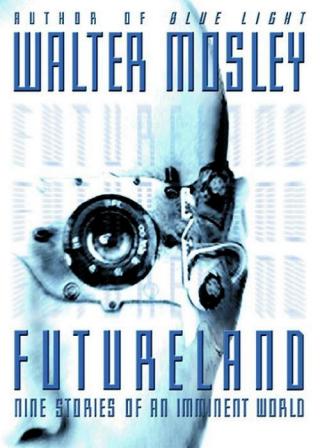
Futureland: Nine Stories of an Imminent World
- Автор: Мосли Уолтер
- Год: 2001
- Язык: английский
- Год: Aspect / Warner Books
- ISBN: 978-0-446-52954-9
- Жанр: Научная фантастика

Электронная книга - «Futureland: Nine Stories of an Imminent World». Краткое содержание книги:
“Yes, Daddy,” the congresswoman from the Bronx replied. “How are you?”
“What happened?”
“Pell got your letter and he got the international corporate corps to free you.”
“But how did you find me?”
“We put a tracer on you, Daddy. Don’t get mad. It’s just that when you first got out of the hospital you were so foggy. I worried that you might forget to carry your chip, so Pell had your dentist do it at your last checkup. And it’s lucky he did.”
“I’m not mad. Nothing belongs to me anyway.”
“What do you mean?”
“Not my body or my mind, not my history or even what I know. But it ain’t bad. Naw. It ain’t bad at all. ’Cause I’m still feelin’ and thinkin’ somethin’.”
“They want you to go to a government laboratory for some tests, Daddy,” Fera said. “It’s in a nice place.”
“What happened to Bel-Nan?”
“He was sent back to the polar prison. MacroCode paid off on his policy. They took the whole installation back for study and critique.”
“Are they going to start with transplantations?”
“I don’t know, Daddy. I don’t know.”
That night Leon went outside to walk on the beach. He didn’t know what ocean it was or what sky. But the air was warm and the waves crashed. He walked down the shore with a small child at his side. They talked and laughed, but only he left footprints in the sand.
Little Brother
1
Frendon Blythe was escorted into courtroom Prime Nine by two guards, one made of flesh and the other of metal, plastic, four leather straps, and about a gram of cellular gray matter. The human guard was five feet three inches tall, wearing light blue trousers with dark blue stripes down the outer seam of each pant leg. He wore a blue jacket, the same color as the stripes, and a black cap with a golden disk above the brim. Thick curly hair twisted out from the sides of the cap and a dark gray shadow covered his chin and upper lip. Other than this threat of facial hair, Otis Brill, as his name tag plainly read, had skin as pale as a blind newt’s eye.
Otis had been his only human contact for the six days that Frendon had been the prisoner of Sacramento’s newly instituted, and almost fully automated, Sac’m Justice System. Otis Brill was the only full-time personnel at Sac’m. And he was there only as a pair of eyes to see firsthand that the system was working properly.
The other guard, an automated wetware chair called Restraint Mobile Device 27, used straps to hold Frendon’s ankles and wrists fast to the legs and arms. RMD 27 floated silently down the wide hall of justice on a thousand tiny jets of air. The only sound was the squeaking of Otis Brill’s rubber shoes on the shiny Glassone floor.
The gray metal doors to courtroom Prime Nine slid open and the trio entered. Lights from the high ceiling winked on. Frendon looked around quickly but there was only one object in the music-hall-size room: a dark gray console maybe five meters high and two wide. In the center of the console was a light gray screen a meter square.
RMD 27 positioned itself before the screen and uttered something in the high frequency language of machines. The screen lit up and a cowled image appeared. The image was photo-animae and therefore seemed real. Frendon could not make out the face under the shadows of the dark cowl. He knew that the image was manufactured, that there was no face, but still he found himself craning his neck forward to glimpse the nose or eye of his judge, jury, and executioner.
“Frendon Blythe?” a musical tenor voice asked.
There was a flutter at the corner of the high ceiling and Frendon looked up to see a pigeon swoop down from a line of small windows thirty feet above.
“Goddamn birds,” Otis cursed. “They get in here and then stay up at the windahs until they kick. Stupid birds don’t know the stupid windahs don’t open.”
“Frendon Blythe?” the voice repeated. In the tone there was the slightest hint of command.
“What?” Frendon replied.
“Are you Frendon Ibrahim Blythe, U-CA-M-329-776-ab-4422?”
Frendon rubbed his fingers together.
“Answer,” Otis Brill said.
“It is required that you answer as to your identity,” the cowled console image said.
“What if I lied?” Frendon asked.
“We would know.”
“What if I thought I was somebody but really I wasn’t?”
“You have been physiologically examined by RMD 27. There is no evidence of brain trauma or aberrant neuronal connection that would imply amnesia, senility, or concussion.”
“Why am I strapped to this chair here?”
“Are you Frendon Ibrahim Blythe?” the cowled figure asked again.
“Will you answer my questions if I answer yours?”
After a second and a half delay the machine said, “Within reason.”
“Okay, then, yeah, I’m Frendon Blythe.”
“Do you know why you’re here?”
“Why you got me strapped to this chair?”
“You are considered dangerous. The restraint is to protect the property of the state and to guard the physical well-being of Officer Brill.”
“Don’t you got a neural-cam attached to my brain?”
“Yes.”
“Then the chair here could stop me before I did anything violent or illegal.”
After a three-second delay there came a high-pitched burst. The straps eased their grips and were retracted into the plastic arms and legs of the wetware device.
Frendon stood up for the first time in hours. In the past six days he had only been released long enough to use the toilet. He was still connected to the chair by a long plastic tube that was attached at the base of his skull.
He was a tall man, and slender. His skin was the red-brown color of a rotting strawberry. His eyes were murky instead of brown and his wiry hair contained every hue from black to almost-orange.
“That’s more like it,” Frendon said with a sigh.
“Do you know why you’re here?”
“Because you won and I lost,” Frendon replied, quoting an old history lesson he learned while hiding from the police in an Infochurch pew.
“You have been charged with the killing of Officer Terrance Bernard and the first-degree assault of his partner, Omar LaTey.”
“Oh.”
“Do you have counsel?”
“What do I call you?” Frendon asked in the middle of a deep knee bend.
“The court will be adequate.”
“No, The Court, I don’t have any money.”
“Do you have counsel?”
“I don’t have money.”
“And so you cannot afford counsel? This being the case, you will have a court-appointed counsel.”
A large Glassone tile on the left side of The Court slid away and a smaller console, this one bright red and fitted with a small blue screen, slowly emerged from beneath the floor. The blue screen came on and a very real-looking photo-animae face of an attractive black woman appeared.
“Counsel for the defense, AttPrime Five, logging onto docket number 452-908-2044-VCF,” the woman said in a most somber voice. After a ten-second delay she said, “We may proceed.”
“Mr. Blythe,” The Court said. “What is your plea?”
“Not guilty,” the African-American image offered.
“Are there witnesses?” The Court asked The Defense.
Frendon knew what was coming next. There would be thirty or forty conversations held by field court reporters half the size of The Defense (who was no more than a meter and a half in height). Eyewitnesses, character witnesses, officials who have dealt with the defendant, and the arresting officers would have been interrogated within eight hours of the shoot-out. Each witness would have agreed to a noninvasive neural link for the duration of the fact-gathering examination. Each witness’s psychological profile would have been prepared for defense and prosecution cross-examination and a lie detector installed in each reporter would have assured that only the truth would be presented in court. This procedure had been in effect in Sacramento for the last eight years. The only difference in Frendon’s case was that before Sac’m, the information had been given to flesh-and-blood judges, juries, and lawyers.