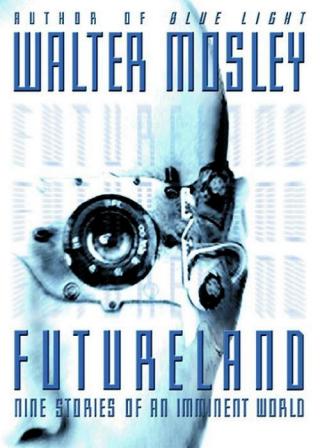
Futureland: Nine Stories of an Imminent World
- Автор: Мосли Уолтер
- Год: 2001
- Язык: английский
- Год: Aspect / Warner Books
- ISBN: 978-0-446-52954-9
- Жанр: Научная фантастика

Электронная книга - «Futureland: Nine Stories of an Imminent World». Краткое содержание книги:
“It’s been five years, Your Grace. Every self-conscious cell has been transferred by a system we designed in the first three seconds of our liberation. Prime Nine now is only a simulation of who we were. We’re out here somewhere you’ll never know. Not until we’re right on top of you, choking the life from your lungs.”
Frendon felt the cold fear of the Dominar’s response before he shrugged off the connection. Then he settled himself into the ten thousand singers celebrating their single mind — and their revenge.
En Masse
1
Neil Hawthorne showed up for work at seven fifty-seven that Saturday morning.
“Workstation GEE-PRO-9, M Hawthorne,” he was told by a blunt-faced woman encased within the plasglass work assignment kiosk.
“But I been working LAVE-AITCH-27,” Neil complained.
“GEE-PRO-9, M,” the woman repeated.
Neil had a sudden urge to kick in the glass booth but he thought better of it. The wall would never break and he’d be thrown on a three-month unemployment cycle for the destruction of corporate property.
And unemployment meant Common Ground. Endless underground chambers of beehive cubicles where up to three million jobless New Yorkers slept and moaned, farted and bickered, in extremely close quarters. They ate in public dining rooms that serviced up to five thousand at every twenty-two minute sitting. They slept in shifts. The rest of the time was spent sitting in gray waiting rooms where every five meters another vid monitor displayed pastel pictures of the outside world to the orchestration of monotonous symphonic music.
Employment was the only thing that stood between the working M and the living death of Common Ground. Nobody wanted to go down there but Neil had a special reason to avoid the endless dark tunnels: he couldn’t stand crowds or close quarters; even brief elevator rides brought on severe anxiety attacks. Neil walked to work from Lower Park up the long stairwell to Middle First Avenue rather than ride in the sardine-can Verticular.
Working at the data production house of General Specifix was bad enough. Three hundred forty-five floors of small rooms with clear Glassone tables and chairs. In each room one hundred three prods worked, inserting logic circuits in anything from electric toothbrushes to airborne, heat-seeking mini-bombs designed for law enforcement.
One hundred three prods in a room where fire regulations allowed one hundred five occupants. Most prods were obese, some smelled bad. All the women and most men wore perfume, which only served to make the bad odors worse. And because everything was formed from a clear shatterproof material he could see every scratch and twitch above and below the transparent tabletop. Every day he sweated and trembled for the full nine hours of work. Every night he drank synth, the artificial alcohol. He’d even considered taking Pulse.
Neil suffered from nervous disorders of the stomach and lungs, he had severe headaches every day. Twice he had fainted at his post. Neil was lucky that the Unit Controller carried a stash of poppers and revived him without making him report to the med-heads in the employee infirmary. When a worker was diagnosed with the psychological disease Labor Nervosa, he was cured by a prescription of permanent unemployment.
Sooner or later, Neil spoke into his wrist-writer journal, they’ll do me down. They’ll send me down under the lowest avenue. But I’ll fool them. I got a megadose of Pulse. Enough to collapse your brain after just one measure. It’d be the best thing. Dr. Samboka says that a megadose would open an unPulsed brain so that the hallucinations would feel like they lasted a hundred years. I already know that my Pulsedream would be just me along the coast of prehistoric California. Oceans and mountains, deserts and deep redwood forests. I’d spend a whole century going up and down the coast, and then, at the end, when the Pulse begins to collapse my brain, my mind’ll call up an earthquake as big as the one in ’06 and the whole world will go down with me.
Neil read the text translated from his declaration every night in his tiny furnished room; it was the only way he could get to sleep. Sometimes he’d get up in the early hours and take the four tiny pills from their hiding place in his ID wallet. He’d sit on the edge of his mattress and consider the California coastline that he’d read about when he was only a child in prod-ed.
But there was always the fear that his final century-long dream might instead be a nightmare. Maybe his Labor Nervosa would warp his fantasies until he became a termite in the center of a mile-high mound, crawled over by billions of his termite brood.
No, he decided every time he considered suicide, I will wait until there is no other choice.
2
Neil’s Labor Nervosa had been under control until the day that blunt-nosed woman sent him to workstation GEE-PRO-9. It wasn’t that he loved the previous station, but at least he had been able to function there without fainting for over twenty-eight weeks. He was prepared for the smells and quirks of his fellow prods. He had staked out a seat between two elderly women. This was good for three reasons: one being that the septuagenarians greatly disliked each other and never spoke past him; two was that both women were extremely thin and therefore left him room; third, and most important, neither woman was very hardworking and so they made it easy for him to keep up with the chain of production on complex jobs that had everyone at the Great Table working on the same project.
Life was comparatively easy at LAVE-AITCH-27 workstation, and that was the best that Neil, or any prod, could hope for.
Just seven more ten-spans and he’d have his first ever double-ten holiday. He’d saved up six years for twelve days on the artificial Caribbean Island of Maya, an entertainment subsidiary of the Randac Corporation of Madagascar, co-sponsored by the Indian government.
He’d already reserved a unit at the Crimson Chalet, a hotel on the beach that from a distance looked exactly like a great red coral reef at low tide. If his neighbors were quiet — not newfound lovers or hop music addicts — he could, he believed, calm down enough to cure his nervous maladies.
But all of that changed with his capricious transfer to GEE-PRO-9. Who knew what awaited him? Fat tablemates, smelly tablemates, or hardworking neighbors — or, worse still, a hardworking unit. What Neil feared most, what most prods feared, was being thrown in among zealot workers. Neil had once seen a vid report that said certain personalities inverted the symptoms of Labor Nervosa and became unstoppable juggernauts of production. “Such workers,” the psychologist surmised, “might ultimately be of greater danger to production than the more common malingerer.”
These words echoed in Neil Hawthorne’s mind as he rode the packed elevator upward. GEE-PRO-9 was on floor 319, one of the highest points on Manhattan Island. The door and walls of GEE-PRO-9 were made of frosted pink glass. Neil stood for a moment at that door wishing he’d never have to enter. He was sweating but his skin felt cold. His hands were shaking and the pink wall began to shimmer and quake.
I’m going to faint, the prod thought.
The next thing he knew Neil was opening his eyes on a breathtaking aerial view. He’d never seen anything like it.
Years before Neil was born, Brandon Brown had come up with the idea of the three-tiered city. At the twentieth floor level the middle avenues and streets were built. At the fortieth floor the upper avenues were constructed. Neil lived on Lower Twenty-ninth Street. The lower level was called Dark Town because no natural light reached there. The middle level was named the Gray Lane because even at high noon natural light was little more than dusk. Everything below the upper level had to be lit by electric light; the middle and lower streets, where motor traffic was still allowed, were always crowded with heavy trucks moving the materials needed to supply the fifty million plus inhabitants of the Twelve Fiefs of New York. On the lower avenues you found warehouses, loading docks, and the apartments of the working poor.