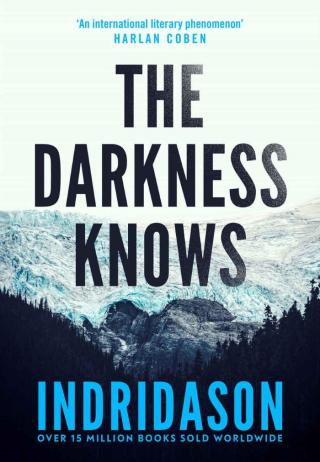
The Darkness Knows
- Автор: Indridason Arnaldur
- Серия: Detective Konrad #1
- Год: 2021
- Язык: английский
- Год: Harvill Secker/Penguin Random House UK
- ISBN: 978-1-78730-232-7
- Переводчик: Victoria Cribb
- Жанр: Криминальные детективы

Электронная книга - «The Darkness Knows». Краткое содержание книги:
The case: impossible to solve. Until now.
A frozen body is discovered in the icy depths of Langjökull glacier, apparently that of a businessman who disappeared thirty years before. At the time, an extensive search and police investigation yielded no results-one of the missing man’s business associates was briefly held in custody, but there wasn’t enough evidence to charge him.
Now the associate is arrested again and Konrád, the retired policeman who originally investigated the disappearance, is called back to reopen the case that has weighed on his mind for decades.
When a woman approaches him with new information that she obtained from her deceased brother, progress can finally be made in solving this long-cold case.
‘Polli?’
‘Yes, you remember him? Lost all his t... teeth. Claimed he’d fallen downstairs. Weren’t you in the same class?’
‘Yes, for one winter. Then he left. So he’s dead, is he? When did that happen?’
‘Ab... about two weeks ago. You two didn’t g... get on, did you?’
‘No.’ Konrád remembered Polli all right. He’d been a thug. ‘I suppose she’d have been by far the oldest resident left in the area?’ he said, bringing the conversation back to Vigga.
‘Yes, no d... doubt.’
‘Vigga and I didn’t exactly get on either,’ Konrád remarked.
‘No, she was a difficult woman,’ Maggi said, sniffing loudly, and Konrád had a flashback to him as a boy, standing in a back garden on Lindargata, eating that stolen onion for a ten-aurar bet while the tears streamed down his cheeks.
Come to think of it, Konrád was pretty sure Maggi had never actually got his ten aurar.
Finally, unable to restrain himself any longer, he asked: ‘Do you still drink Pepsi, Maggi?’
‘What, Pefsi?’ Maggi said. ‘Ah, you can’t b... beat it.’
40
That evening, Konrád found some music from the sixties that Húgó had downloaded onto a tablet for him at Christmas. While the songs echoed around the house, Konrád absent-mindedly took some bits and pieces out of the fridge and sat down at the kitchen table to eat them. He couldn’t stop thinking about Lindargata, about Maggi and the other friends of his youth, about his parents and old Vigga. Lindargata was never far from his heart and, whatever happened, the world of the Shadow District would always, in some indefinable sense, be his world. The calls from the abattoir, the smartly dressed theatre guests, the smell of sawdust from Völundur, the hustle and bustle of the city centre, the sailors on the docks, it all still existed in his head — the world of his childhood, always within reach, to be revisited whenever the mood took him. It didn’t matter how many high-rises they built, they would never be able to overshadow his memories.
Vigga was part of it. One winter evening, egged on by his friends, Konrád had decided to play a practical joke on her. He had crept up the icy steps to her front door, kicked it twice, then bounded back down the steps, quick as a flash, only to run slap into Vigga at the bottom. She’d been in her shed and had come round from the garden, catching Konrád in the act. He was so terrified he thought he might wet himself, thereby compounding his humiliation. Vigga had a torch in one hand but grabbed his shoulder with the other.
‘You little pest!’ she hissed.
He froze in terror and didn’t put up any resistance as she dragged him round the back of the house, opened the shed, threw him in and locked the door. It was pitch-black inside, and fear of the dark now assailed him on top of his other woes.
‘Right,’ he heard Vigga say angrily outside. ‘You can spend the night in there.’
Then she had left.
As a final humiliation, Konrád had felt something warm seeping from his crotch down his leg and into his shoe. He was seven years old, paralysed with fear and shaking like a leaf.
The other kids had hurried off to fetch his mother, who came and had a word with Vigga, rescued her son from his prison and gave him a long lecture about not tormenting the old woman because she had already suffered enough. She had lost her only child and, for her, life was like one never-ending attack, against which she felt she had to defend herself with tooth and claw.
‘Her child?’ Konrád had echoed.
‘Yes, she’s been unhappy ever since.’
Was it possible that Vigga had come across Villi lying in the street before another pedestrian found his body and notified the police? He had lived next door to her for a while. He’d known Magnús, from across the road, to speak to. Surely it was perfectly possible that Vigga had come outside after the accident? Konrád wondered if she had witnessed it. Seen the driver, maybe. She hadn’t called the police or an ambulance. If she had, the police would have known about her. And she hadn’t tried to get Villi into shelter. Konrád puzzled over the question of why, in that case, she had gone out to him.
Could Villi have died in Vigga’s arms?
The alternative was that it hadn’t really happened. That she had lied about it to Magnús. It had certainly escaped the notice of the investigating officers that Vigga was a possible witness. But then this didn’t come as any real surprise to Konrád, since Vigga had always minded her own business and other people had given her a wide berth in return. The old woman had been capricious. It was quite possible that the police had talked to her along with the other residents in the street but that she hadn’t told them. And even if she had, she probably wouldn’t have been considered a reliable witness. People who didn’t know Vigga generally didn’t want to spend any more time with her than was necessary.
Konrád decided to call his sister. Beta answered after a few rings and he told her about his visit to the Shadow District and that Vigga had passed away.
‘Oh, the poor woman’s died, has she?’ Beta had always defended Vigga and never taken part in teasing her. Even as a child she had felt sorry for the reclusive woman and had tried her best to stop the other kids from picking on her.
‘There’s a chance she may have been the last person to see Villi alive — you know, the man I told you about the other day.’
‘The one who was knocked down on Lindargata?’
‘That’s the one. It seems she may have seen what happened and gone out to him. At least, she told Maggi she’d found him on the pavement. You remember him — Maggi Pefsi?’
‘Maggi? Does he still live there?’
‘Yes. He stayed in touch with Vigga. The old girl would have been well into her nineties at the time.’
‘Does he believe that Vigga witnessed Villi being hit by the car?’
‘She could have done.’
‘So she might have seen the person who did it?’
‘It’s possible, but you know what she was like — not quite all there.’
‘Vigga was OK. She was always nice to me, even if she made you wet yourself with fright.’
‘She locked me in her shed,’ Konrád pointed out.
‘Wasn’t that Villi full of conspiracy theories about the Sigurvin case?’
‘Yes, and he told them to anyone who would listen. He was a witness. Not a particularly good one, but a witness all the same, and if he was rattling on about what he’d seen to complete strangers in sports bars, it could well have had repercussions.’
‘Are you suggesting that someone implicated in Sigurvin’s disappearance could have run him down?’
‘That’s what I’ve been wondering,’ Konrád said, ‘though I doubt we’ll ever know.’
‘Wouldn’t that be a sign of desperation? Resorting to something that drastic?’
‘Yes, I imagine you’d have to have tipped over the edge to do something like that.’
‘It’s not exactly healthy having a death on your conscience.’
‘No, quite. Keeping a secret like that for thirty years must take a lot of energy and would probably cause a lot of distress.’
‘Are you hoping he’ll give himself up in the end? Give in to his conscience? It wouldn’t be unheard of.’
‘Well, there are some types out there who’d have no problem coping with that kind of guilt. But others would be constantly tortured by it.’
‘Then again, Villi’s death might not have had anything to do with Öskjuhlíd,’ Beta cautioned. ‘You just want it to. You want to believe in a conspiracy, in tenuous links. In coincidences. Words accidentally blurted out in a sports bar that resulted in a man’s death. That’s how your mind works. You think like a cop.’