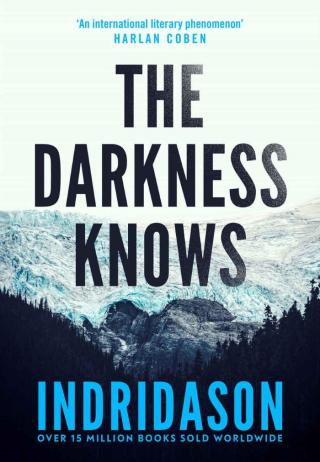
The Darkness Knows
- Автор: Indridason Arnaldur
- Серия: Detective Konrad #1
- Год: 2021
- Язык: английский
- Год: Harvill Secker/Penguin Random House UK
- ISBN: 978-1-78730-232-7
- Переводчик: Victoria Cribb
- Жанр: Криминальные детективы

Электронная книга - «The Darkness Knows». Краткое содержание книги:
The case: impossible to solve. Until now.
A frozen body is discovered in the icy depths of Langjökull glacier, apparently that of a businessman who disappeared thirty years before. At the time, an extensive search and police investigation yielded no results-one of the missing man’s business associates was briefly held in custody, but there wasn’t enough evidence to charge him.
Now the associate is arrested again and Konrád, the retired policeman who originally investigated the disappearance, is called back to reopen the case that has weighed on his mind for decades.
When a woman approaches him with new information that she obtained from her deceased brother, progress can finally be made in solving this long-cold case.
Erna gave up work and Konrád had been close to retirement anyway, so they were able to spend all their time together. He drove her out to the countryside, where they stayed in good hotels or comfortable farmhouses. They went to places they had always wanted to see but never got round to visiting. She refused to go into one of the palliative care wards, preferring to spend her last hours at home in Árbær. Their bedroom was converted into a hospital room and Konrád and Húgó took it in turns to care for her, day and night, controlling her morphine intake so she wouldn’t suffer too much.
The days of mourning following her death stretched out into weeks and months, and they taught Konrád above all just what a rock he had in his son. Although Húgó was coping with his own grief, he dedicated himself to looking out for his father, but he did so as unobtrusively as possible.
At a stroke, Konrád found himself alone at home with nothing to do. No longer working, no longer a husband, no longer supporting a family. No longer anything. In a short space of time, his life had undergone such a transformation that he sometimes felt he no longer existed. He wandered aimlessly through the rooms where reminders of Erna were all around him. All the photographs, paintings, books and furniture had belonged to her; every object evoked memories of their life together. He wouldn’t have had it any other way, but as the months went by Húgó began to suggest making changes, perhaps even selling the house and starting again in a new environment. But Konrád wouldn’t hear of it, and Húgó didn’t raise the subject again, sensing that his father needed more time. There was no more talk of change.
It wasn’t any one specific thing that got Konrád moving again, apart from the passing of time, but he slowly began to gather up the shattered pieces of his life and rearrange them into some kind of shape. The pieces didn’t necessarily fit together and some of the most important ones were missing, so the picture would never be entirely whole and there would always be a large gap that could never be filled. But among the pieces a pattern began to emerge of what his life would be like now that Erna was gone. Nothing could take away the grief and loss, but he could learn to live with them. His thoughts remained inextricably tied to Erna. There were times when he forgot and picked up the phone to ring her at work, only to remember at the last minute. And in the moments when he missed her most powerfully, he could almost sense her presence and imagine what she would have to say about the matters that were troubling him. He longed to have her with him, longed to talk to her, to feel her close to him; longed more desperately than anything else to be with her, if only for one last time.
Konrád sat there staring at their wedding picture. He had a clear memory of that kiss in front of the church. Of all their kisses. He reached up into the cupboard for another bottle of wine, this time an Australian Shiraz called The Dead Arm. Erna had read about it in some gourmet magazine, and when it turned out not to be available at the state off-licence, she had ordered it specially. She hadn’t been able to resist it when she discovered that the vine that produced the grapes had an unusual handicap that it managed to turn to its advantage. One of its branches would wither and drop off once the vine had reached a certain size. This had the effect of channelling more energy into the remaining branches and fruit, resulting in an unusually robust and flavourful grape.
‘I just had to buy it for you,’ Erna had said, laughing.
39
It had been a while since Konrád had last walked down Lindargata. Once, he had been a frequent visitor, not only because it had been his childhood home but because there used to be a Ríki — one of the very few state off-licences in Reykjavík — on the street, and he had regularly shopped there. In those days, self-service had been unheard of; instead the alcohol had been kept behind the counter and the place used to be packed with a heaving throng on Friday afternoons, before it closed for the weekend. An orderly queuing culture was something that Icelanders knew only from pictures taken abroad. The crowd used to spill out onto the pavement, and people would push and shove until the crush at the counter was almost unbearable. The assistants would be flat out, taking orders from the harried customers and dashing back and forth with their bottles. In those days the sale of beer was illegal, and the idea of fine wine for the discerning palate was virtually unknown. Even if a wine culture had existed, the melee wouldn’t have allowed for any pretentiousness of that kind as closing time approached. The only demand was for quick service. ‘Two vodkas!’ would come a cry, and notes would be passed across the counter. ‘Icelandic brennivín!’ ‘Two bottles of gin!’ Notes would be waved in the air. ‘What kind?’ ‘Any kind! And one of brennivín!’ In comparison, the clamour of the New York Stock Exchange would have seemed positively restrained.
Konrád’s first memories were of the Shadow District. The house he was born in had been torn down, like so many others from those days, as the area hadn’t been spared the treacherous economic upswing of the boom years. The world of his childhood had been concreted over with high-rise apartment blocks — symbols of the financial crisis, which had been standing empty ever since, exposed to the chill northerly blasts. At the height of the bubble, these derelict blocks had been the most expensive real estate per square metre in the entire city. And now things were threatening to go the same way again.
Konrád halted by the spot where Villi had been run over, and looked down the street at the sheltered housing for senior citizens that now towered over the site where the abattoir had once stood. The area between Lindargata and the sea used to be his playground. When it snowed in winter, the kids would sledge on the mound at Arnarhóll. In summer, they would play hide-and-seek by Broadcasting House on Skúlagata, or sneak into the Völundur timber yard to climb the vertiginous stacks of wood. To him, these childhood haunts seemed no less remarkable than any idyllic valley or mountainside, just because they happened to be in the city. Whenever he walked down Lindargata he was filled with the sense of coming home from some infinitely long journey.
A stone’s throw from where Villi used to live, ranks of tower blocks loomed against the sky like a forbidding wall of cliffs. The young man had only been a few metres away from his front door when the car hit him. Lindargata was a one-way street, and the vehicle had approached from the west. If the driver had been the man Villi was talking to in the sports bar, he must have lain in wait for him and seen him leaving the bar and heading home on foot through the snowstorm. He could have shadowed Villi from the city centre, his car crawling after him, probably up Hverfisgata first, then down one of the side streets — Ingólfsstræti perhaps — as Villi turned off towards Lindargata. Once he reached these quieter backstreets, Villi’s pursuer must have seized his chance to stamp on the accelerator and run the young man down.
In spite of the poor visibility and the size and power of the vehicle, it was hard to credit the notion that the driver could have failed to notice the impact. No, it was much easier to believe that Villi had been deliberately knocked down. Yet the alternative possibility remained, niggling at the back of Konrád’s mind: that Villi hadn’t in fact been followed from the bar. That the driver, whether drunk or sober, had simply been speeding down Lindargata and, failing to spot Villi in the thickly falling snow, had collided with him, then fled the scene.