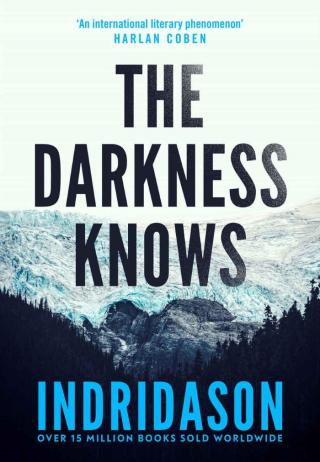
The Darkness Knows
- Автор: Indridason Arnaldur
- Серия: Detective Konrad #1
- Год: 2021
- Язык: английский
- Год: Harvill Secker/Penguin Random House UK
- ISBN: 978-1-78730-232-7
- Переводчик: Victoria Cribb
- Жанр: Криминальные детективы

Электронная книга - «The Darkness Knows». Краткое содержание книги:
The case: impossible to solve. Until now.
A frozen body is discovered in the icy depths of Langjökull glacier, apparently that of a businessman who disappeared thirty years before. At the time, an extensive search and police investigation yielded no results-one of the missing man’s business associates was briefly held in custody, but there wasn’t enough evidence to charge him.
Now the associate is arrested again and Konrád, the retired policeman who originally investigated the disappearance, is called back to reopen the case that has weighed on his mind for decades.
When a woman approaches him with new information that she obtained from her deceased brother, progress can finally be made in solving this long-cold case.
She was terribly weak when he helped her out to the car. He had left the heater running first, to keep the piercing December cold at bay. A north wind had been blowing for the last few days and frost had settled like a crystalline blanket over the city’s streets and squares. The frozen ground squeaked under his boots. The night sky was clear and, as they drove down the hill at Ártúnsbrekka, they got a good view of the full moon sailing high in the heavens to the west. The Earth’s shadow had already begun its passage across it, and by the time they drove into the gloom at the end of the Seltjarnarnes Peninsula, the glowing disc had been veiled with a peculiar reddish darkness.
Konrád left the engine ticking over so they could keep the heater on, but switched off the lights. They weren’t the only people out there. Several other cars had headed to the point to experience the eclipse away from the glare of the city lights. One man had set up a small telescope, angled towards the moon. Other figures, ignoring the cold, were standing on top of the shore ridge in front of them. The wind whistled around the car. The longer they sat there, their eyes adapting to the dark, the better they could make out the vast starry vault of the sky, with its sea of lights reaching them from far back in time.
‘I want to get out,’ Erna said.
‘Erna...’ Konrád objected.
‘I have to get out.’
‘It’s too cold, Erna. I shouldn’t have brought you here.’
‘For a little while. Please. Just for a little while. It’s no good trying to watch a lunar eclipse through the windscreen.’
Despite his reservations, he gave in to her wishes and got out of the car. He was wearing a thick down jacket and a woollen hat. Erna was similarly well wrapped up in a warm coat, a hat with ear flaps, a big scarf and thick gloves. Konrád walked round the front of the car, opened the passenger door, took Erna in his arms and lifted her out, taking her weight with his good arm. He carried her up to the top of the gravel bank, where he put her down, using his body to shelter her from the stripping cold of the wind. They could hear the waves breaking on the shore in the darkness. Erna gazed for a long time at the moon, now no more than a dim rose in the night sky. For the first time since she had told him she was ill, he saw that she was crying.
He took her in his arms again and carried her weak, exhausted body back to the car. It was warm and cosy inside as he laid her down with infinite care in the passenger seat.
‘Thank you, Konrád, for everything,’ she whispered, so quietly he could hardly make out the words.
They sat there in the car with the wind whistling outside, as more people arrived on the peninsula to watch the heavenly bodies sailing along their ancient orbits. Gradually the shadow lost its dark red tint and became a deeper black as it passed across the moon. The round shape of the Earth sank with infinite slowness, down over the glowing disc until only a tiny curved rim remained, then it vanished and the moon was whole again.
When they’d left home in the early hours, Erna had told him there hadn’t been a lunar eclipse on the solstice since the seventeenth century, and it wouldn’t happen again for a hundred years. She was glad they could share this moment, when time became both present and eternity at once.
Konrád reversed out of the parking space. Erna was sleeping peacefully; the morphine had taken effect. He drove slowly home, careful not to jolt her, but by the time he parked in front of their house in Árbær and prepared to take her inside, she had gone. Konrád sat there for a long time without moving, before gently freeing her from the seat belt and carrying her into the house, where he laid her in bed and told her what he had forgotten to tell her in the car on the way home: about how the moon was described somewhere in a poem. That it was the brooch of the night. The old friend of lovers.
It was the shortest day of the year and the longest in Konrád’s life.
It lasted only four hours and twelve minutes.
And went on for eternity.
45
Her name was Pálína, she used to work as a taxi driver, and she’d been picked up for drunk driving on Frakkastígur the evening Villi was killed. Two years later she had lost her licence after knocking down a pedestrian and leaving him lying injured in the road. Shortly afterwards, she had been caught at home by the police and confessed to the whole thing. Her blood alcohol level had turned out to be way over the limit. As a result, she had gone into rehab and hadn’t touched a drop since.
This was the story she told Konrád, sounding proud that it had taken only this one kick for her to conquer her addiction, pretty much on her own. She had never gone to AA meetings — well, to a couple at most — and had hardly any contact with her sponsor during that time. Admittedly, she still got the odd craving — which was only human — but it had never seriously occurred to her to start drinking again.
Despite her willingness to talk, she didn’t go into what had caused her alcohol use to spiral out of control in the first place, but then it wasn’t any of Konrád’s business. No doubt time and habit had combined to undo her. But she did describe the drinking culture she had grown up with, back when beer was illegal and there had been nothing on offer but strong spirits. The streets of Reykjavík used to be heaving with people smashed out of their skulls at weekends.
‘Of course, it wasn’t healthy,’ Pálína said, thinking back. ‘Our Icelandic drinking culture.’
‘It’s not exactly healthy now,’ Konrád replied.
‘I always thought I had it under control — thought I was in charge — but the first thing you learn when you go into rehab is that drinking is completely out of your control. You’re not in charge of anything. I mean, I drove a taxi! You know? Sometimes under the influence. I just thought I could get away with it. Christ, what idiots we can be!’
Pálína was the fourth person Konrád had spoken to since Marta had rung him with the information he had requested about Leó’s investigation. She had compiled a list of the people who had been seen in the vicinity of the Shadow District the night Villi was killed. Konrád had promised to keep it absolutely hush-hush and thanked her from the bottom of his heart. He hadn’t updated Marta on his enquiries recently, conscious that she had enough on her plate and unwilling to bother her with every minor detail he unearthed. All he had promised her was that he would let her know if he came across anything really significant.
The first man Konrád went to see had stolen his son’s car on the evening in question and narrowly avoided an accident on Hverfisgata. The other vehicle had been driven by a couple returning from a party, who had been forced to swerve onto the pavement to avoid a collision. Despite the thickly falling snow, they had managed to get his registration and reported him for dangerous driving. The man, whose name was Ómar, had continued on his way without stopping, but had been picked up later that night at the central bus station. He had no memory of having driven along Lindargata.
He had demanded to know why Konrád was raking up the incident all these years later. But as soon as Konrád tried to explain, Ómar refused to listen, angrily retorting that it was a load of bloody nonsense and slamming the door in Konrád’s face. Konrád was almost sure he’d caught a whiff of booze on his breath.