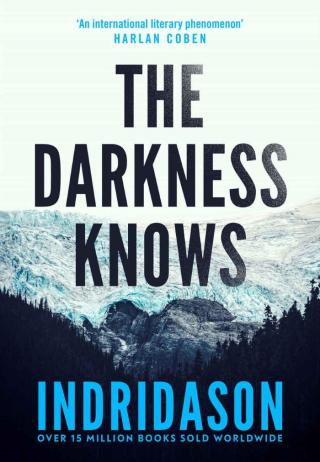
The Darkness Knows
- Автор: Indridason Arnaldur
- Серия: Detective Konrad #1
- Год: 2021
- Язык: английский
- Год: Harvill Secker/Penguin Random House UK
- ISBN: 978-1-78730-232-7
- Переводчик: Victoria Cribb
- Жанр: Криминальные детективы

Электронная книга - «The Darkness Knows». Краткое содержание книги:
The case: impossible to solve. Until now.
A frozen body is discovered in the icy depths of Langjökull glacier, apparently that of a businessman who disappeared thirty years before. At the time, an extensive search and police investigation yielded no results-one of the missing man’s business associates was briefly held in custody, but there wasn’t enough evidence to charge him.
Now the associate is arrested again and Konrád, the retired policeman who originally investigated the disappearance, is called back to reopen the case that has weighed on his mind for decades.
When a woman approaches him with new information that she obtained from her deceased brother, progress can finally be made in solving this long-cold case.
‘Who am I working for?’ Konrád asked, taken aback. ‘No one. I’m here on my own behalf. Isn’t that enough?’
‘What are you intending to do with the information?’ Frosti demanded bossily.
‘Nothing in particular. I just need some information about weather conditions during a specific period. I didn’t realise they were a state secret. Perhaps I should bother someone else with my request.’
‘Weather conditions during a specific period,’ Frosti echoed impatiently. ‘Have you tried online? You can find information about weather conditions for every month going back to 1997. Don’t you have the internet?’
‘The period I’m interested in is earlier.’
‘Earlier?’
‘Look, do you want me to pay you? It’s no problem if you do.’
‘No,’ Frosti sighed with a put-upon air as he sat there in his cramped, stuffy office. He started muttering about members of the public who thought they could just wander in off the street, expecting to find out anything they wanted, free of charge. ‘What period are you talking about?’ he asked grudgingly.
Konrád was on the verge of telling Frosti to go and stick his head where the sun don’t shine, but another part of him was rather tickled by the man’s grumpiness. It wasn’t often that he encountered a professional who couldn’t care less what other people thought of them and behaved exactly as they liked.
Konrád gave him the date of Sigurvin’s disappearance and Frosti entered it into the computer.
‘I could look it up in our weather logbooks but it’s probably been put on the system by now,’ Frosti said, more to himself than Konrád. ‘You are talking about Reykjavík, aren’t you?’
‘Yes,’ Konrád said. ‘To start off with.’
‘What, is there more?’
‘Have you got the information?’
‘Good weather for February,’ Frosti said. ‘Minus three, gentle wind — almost a calm, very good visibility, no precipitation. Excellent winter weather, in other words. Is that enough for you?’
‘What about the Langjökull area? Could you check that for me?’
‘Langjökull?’
‘Yes, that day and the following one. No, let’s say for the next couple of days.’
‘Which stations would those be?’ Frosti muttered to himself, frowning as he tried to remember the locations of the observation stations around the ice cap. After a moment’s thought, he entered the information into the computer, then sighed and tutted. ‘I don’t know why they had to adopt metres per second for measuring wind speed,’ he said suddenly. ‘Why go and change a perfectly good system?’
Konrád didn’t know what to say. It was many years since the new metric system had replaced the Beaufort scale in Iceland. He vaguely remembered some criticism of the decision at the time but didn’t feel qualified to comment.
‘Dire,’ Frosti said.
‘Dire?’
‘Yes.’
‘You mean the decision to go over to metric?’
‘No.’ Frosti gave Konrád a look of profound irritation. ‘Conditions on the glacier were dire,’ he enunciated slowly and clearly, as if talking to an idiot.
38
When he got home from his meeting with the meteorologist, Konrád prepared a simple supper for himself and opened a good Chianti, which had been one of Erna’s favourite wines. He fetched the photo of their wedding kiss from the sitting room and put it on the kitchen table beside him, lighting a stub of candle in front of it. Then he put on a CD of Icelandic hits from the 1970s. As the air filled with soft music, he sat there sipping his wine.
Erna had hidden her concerns at first. She wanted to be absolutely sure before breaking the news to Konrád and Húgó. It was relatively straightforward for her to get her diagnosis confirmed, as she was a doctor with a wide circle of medical friends — including several oncologists. She went to a consultant she trusted implicitly, got a second opinion from a doctor she didn’t know, then a third from an acquaintance who was a specialist. After that, she didn’t bother seeking any further opinions.
Konrád hadn’t noticed the change. He hadn’t paid any attention when she started taking rests during the day and lost a few kilos. Didn’t notice her anxious expression when he came across her alone in the bathroom or kitchen. She wasn’t sure what was happening until she had seen the specialist. Once that was over and she received her prognosis, she came home, opened a bottle of wine and waited for Konrád. She had been around death ever since she started in medicine. She knew what had to be done and what she would have to endure; knew how her nearest and dearest would react, and how grief would descend on her home and the lives of her loved ones until it was all over and they would begin their new life without her. She thought about her child and her grandchildren and about Konrád, and wept quietly over her fate.
When he got home that day, Konrád realised at once that something was wrong. She was sitting alone in the darkened sitting room and asked him not to turn on the lights but to come and sit down beside her. She poured him a glass of wine and told him what was happening. She could have surgery to remove the largest tumour, could try chemo and radiotherapy, but that would only delay the inevitable. The cancer had already spread. It was already out of control.
She didn’t want to give him false hope, so she stated the facts bluntly, keeping nothing back. Instead of trying to reassure him or allay his fears, she was realistic and described the situation in unemotional, clinical terms. She would have liked to spare him, but that was impossible. The sooner they accepted the inevitable, the longer they would have to make the most of the time they had left.
‘We mustn’t waste time on unnecessary things,’ she said. ‘We can’t afford to.’
He wasn’t able to take it in at first. He kept asking questions, demanding to know how they could cure her and what they could do; what about doctors in America, the latest research? But with every answer she gave him, the reality sunk in, until at last he was forced to confront the truth: Erna had only a few months left to live; perhaps a year, if they were lucky.
‘I can’t believe it,’ he groaned at last. ‘I refuse to believe it.’
‘Darling Konrád.’
‘How can you be so calm about it?’
‘I’ve had a good life,’ Erna said. ‘I’ve got you, Húgó, the twins. I’ve enjoyed my job. I’ve got lots of friends. I’ve lived to a reasonable age. I would love to have twenty more good years with you but it’s not to be. Really, I have nothing to complain about. It’s all a question of attitude, Konrád. That’s my attitude, and I want it to be yours too.’
‘Attitude?’ Konrád said. ‘I’m just supposed to accept it, am I? You’re just supposed to accept it?’
‘It’s the only way.’
‘There must be other ways, Erna. It must be possible to beat this.’
‘No,’ Erna said. ‘It’s not. The only way you can conquer death is by accepting it.’
He often thought of the darkness in the sitting room as they’d sat there discussing Erna’s devastating news, and remembered her courage as she’d tried to alleviate his grief and anxiety, as if her own feelings didn’t matter. It must have been something she had learnt over the years as a doctor, in constant proximity to death. Or perhaps she had learnt it as a mother, always putting others first.
After that, everything had happened extraordinarily fast. They summoned Húgó and explained the situation to him. Although he received the news with the cool detachment of a medical man, underneath he was shattered to hear the details of his mother’s diagnosis and the fact there was no hope of a recovery.