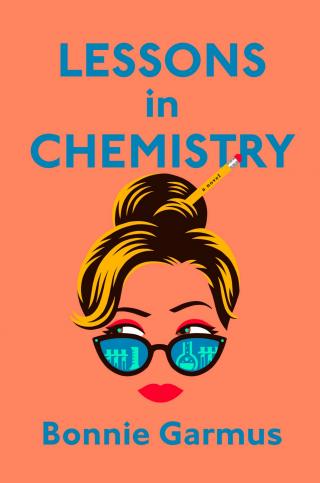
Lessons in Chemistry
- Автор: Garmus Bonnie
- Год: 2022
- Язык: английский
- Год: Doubleday Canada
- Жанр: Современная русская и зарубежная проза

Электронная книга - «Lessons in Chemistry». Краткое содержание книги:
“And the fact that she pretends to be Madeline’s friend to get her lunch,” she continued, “is absolutely reprehensible.”
“Wh-who are you again?” stammered Walter.
“Elizabeth Zott!” she barked back. “Madeline Zott’s mother!”
Walter nodded, trying to understand. As a longtime producer of afternoon television, he knew drama. But this? He continued to stare. She was stunning. He was literally stunned by her. Was she auditioning for something?
“I’m sorry,” he finally said. “But all the nurse roles have been cast.”
“I beg your pardon?” she snapped.
There was a long pause.
“Amanda Pine,” she repeated.
He blinked. “My daughter? Oh,” he said, suddenly nervous. “What about her? Are you a doctor? Are you from the school?” He leapt to his feet.
“Good god, no,” Elizabeth replied. “I’m a chemist. I’ve come all the way over here from Hastings on my lunch hour because you’ve failed to return my calls.” And when he continued to look baffled, she clarified. “Hastings Research Institute? Where Groundbreaking Research Breaks Ground?” She exhaled at the vacuous tagline. “The point is, I put a great amount of effort into making a nutritious lunch for Madeline — something that I’m sure you also strive to do for your child.” And when he continued to stare at her blankly, she added, “Because you care about Amanda’s cognitive and physical development. Because you know such development is reliant on offering the correct balance of vitamins and minerals.”
“The thing is, Mrs. Pine is—”
“Yes, I know. Missing in action. I tried to contact her but was told she lives in New York.”
“We’re divorced.”
“Sorry to hear, but divorce has little to do with lunch.”
“It might seem that way, but—”
“A man can make lunch, Mr. Pine. It is not biologically impossible.”
“Absolutely,” he agreed, fumbling with a chair. “Please, Mrs. Zott, please sit.”
“I have something in the cyclotron,” she said irritably, glancing at her watch. “Do we have an understanding or not?”
“Cyclo—”
“Subatomic particle accelerator.”
Elizabeth glanced at the walls. They were filled with framed posters advertising melodramatic soap operas and gimmicky game shows.
“My work,” Walter said, suddenly embarrassed by their crassness. “Maybe you’ve seen one?”
She turned back to face him. “Mr. Pine,” she said in a more conciliatory manner, “I’m sorry I don’t have the time or resources to make your daughter lunch. We both know food is the catalyst that unlocks our brains, binds our families, and determines our futures. And yet…” She trailed off, her eyes growing narrow as she took in a soap opera poster featuring a nurse giving a patient some unusual care. “Does anyone have the time to teach the entire nation to make food that matters? I wish I did, but I don’t. Do you?”
As she turned to leave, Pine, not wanting her to go or fully understanding what he was about to hatch, said quickly, “Wait, please just stop—please. What — what was that thing you just said? About teaching the whole nation how to make food that — that matters?”
Supper at Six debuted four weeks later. And while Elizabeth wasn’t entirely keen on the idea — she was a research chemist — she took the job for the usual reasons: it paid more and she had a child to support.
—
From the first day Elizabeth donned an apron and walked onto the set, it was obvious: she had “it,” the “it” being that elusive, entirely watchable quality. But she was also a person of substance — someone so forthright, so no-nonsense that people didn’t know what to make of her. While other cooking shows featured good-natured chefs gleefully tipping back the sherry, Elizabeth Zott was serious. She never smiled. She never made jokes. And her dishes were as honest and down-to-earth as she was.
Within six months, Elizabeth’s show was a rising star. Within a year, an institution. And within two years, it had proven its uncanny power not only to unite parents with their children, but citizens with their country. It is not an exaggeration to say that when Elizabeth Zott finished cooking, an entire nation sat down to eat.
Even Vice President Lyndon Johnson watched her show. “You want to know what I think?” he said as he waved off a persistent reporter. “I think you ought to write less and watch TV more. Start with Supper at Six—that Zott, she knows what she’s doing.”
And she did. You’d never find Elizabeth Zott explaining how to make tiny cucumber sandwiches or delicate soufflés. Her recipes were hearty: stews, casseroles, things made in big metal pans. She stressed the four food groups. She believed in decent portions. And she insisted that any dish worth making was worth making in under an hour. She ended every show with her signature line: “Children, set the table. Your mother needs a moment to herself.”
But then a prominent reporter wrote an article entitled “Why We’ll Eat Whatever She Dishes Out” and, in passing, referred to her as “Luscious Lizzie,” a nickname that, because it was both apt and alliterative, stuck to her as quickly as it did the paper it was printed on. From that day forward, strangers called her Luscious, but her daughter, Madeline, called her Mom, and although she was just a child, Madeline could already see that the nickname belittled her mother’s talents. She was a chemist, not a TV cook. And Elizabeth, self-conscious in front of her only child, felt ashamed.
Sometimes Elizabeth lay in bed at night and wondered how her life had come to this. But the wonder never lasted long because she already knew.
His name was Calvin Evans.
Chapter 3
Hastings Research Institute
TEN YEARS EARLIER, JANUARY 1952
Calvin Evans also worked at Hastings Research Institute, but unlike Elizabeth, who worked in crowded conditions, he had a large lab all to himself.
Based on his track record, maybe he deserved the lab. By age nineteen, he had already contributed critical research that helped famed British chemist Frederick Sanger clinch the Nobel Prize; at twenty-two, he discovered a faster way to synthesize simple proteins; at twenty-four, his breakthrough concerning the reactivity of dibenzoselenophene put him on the cover of Chemistry Today. In addition, he’d authored sixteen scientific papers, received invitations to ten international conferences, and had been offered a fellowship at Harvard. Twice. Which he turned down. Twice. Partly because Harvard had rejected his freshman application years earlier, and partly because — well, actually, there was no other reason. Calvin was a brilliant man, but if he had one flaw, it was his ability to hold a grudge.
On top of his grudge holding, he had a reputation for impatience. Like so many brilliant people, Calvin just couldn’t understand how no one else got it. He was also an introvert, which isn’t really a flaw but often manifests itself as standoffishness. Worst of all, he was a rower.
As any non-rower can tell you, rowers are not fun. This is because rowers only ever want to talk about rowing. Get two or more rowers in a room and the conversation goes from normal topics like work or weather to long, pointless stories about boats, blisters, oars, grips, ergs, feathers, workouts, catches, releases, recoveries, splits, seats, strokes, slides, starts, settles, sprints, and whether the water was really “flat” or not. From there, it usually progresses to what went wrong on the last row, what might go wrong on the next row, and whose fault it was and/or will be. At some point the rowers will hold out their hands and compare calluses. If you’re really unlucky, this could be followed by several minutes of head-bowing reverence as one of them recounts the perfect row where it all felt easy.