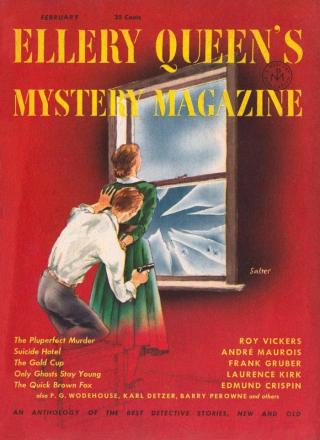
Ellery Queen’s Mystery Magazine. Vol. 19, No. 99, February 1952
- Автор: Грубер Фрэнк, Кемельман Гарри
- Год: 1952
- Язык: английский
- Год: American Mercury
- Жанр: Другие детективы

Электронная книга - «Ellery Queen’s Mystery Magazine. Vol. 19, No. 99, February 1952». Краткое содержание книги:
All except what I did the day after I returned the gold cup. I wanted to get some things off my mind and I took the train back to Grand Central. In the washroom on the lower level I went up to the bootblack. Before I could say anything he grabbed up a couple of brushes and backed away.
“Don’t you bother me, Mister, or I’ll call the police!” he yelled.
I shook my head and put a dollar bill on one of the seats. Then I took three steps away from it. “That dollar’s yours,” I told him, “if you tell me exactly what you saw here yesterday when I had my shoes shined.”
The bootblack looked at the dollar, and then at me. He shook his head, mumbled in his throat, then said: “Well, sir, you and the gent’man with you had a couple drinks too many, I guess. You started for the door, then all of a sudden you bust out like you’d seen a ghost.”
I nodded. “You’re sure there wasn’t another man here at the time?” The bootblack took another step back. “No, sir.”
I went out, took the Fifth. Avenue bus and rode down to the Village, then walked to the café on Sixth Avenue.
The bartender recognized me right away and reached for a bung-starter. “Get out of here! I don’t want no hop-heads in my place.”
“I’m sorry,” I said, “but would you mind telling me exactly what happened here yesterday?”
His eyes rolled; but he said, “I’ll tell you. You and some other dope came in here, ordered a couple of beers, then started cutting up, pretending there was someone else here too. That partner of yours acted like a wild man...”
“I guess he did. But you’re sure there wasn’t anybody else in here at the time — a tall, dark man?”
“There wasn’t no one else in here.”
I spent the rest of the day and evening at the Public Library...
[Editors’ query: How do you account for the strange happenings in this story? Pause for a few moments, before finishing the story, and consider the unusual implications of Mr. Gruber’s tale of an ancient gold cup...]
As I say, I spent the rest of the day at the Public Library. First, I dug up some old newspapers from the time of the World’s Fair, and before. I read all the arguments about the authenticity of Professor Halleck’s gold cup. There was no question that he had found the cup in Asia Minor, near a place called Antioch, which had been the capital of the Eastern Roman Empire for a hundred years or so. Halleck claimed the cup dated back to the first century, A.D., but other archeologists insisted that the cup was of more recent origin. The issue was debated for many months and took up a lot of newsprint.
Then I came across, in an encyclopedia, several pages of pictures — reproductions of old religious paintings. One of the pictures was supposed to go back to the first century, having been found in the Catacombs near Rome. It showed Christ and his Disciples at the Last Supper, and on the table I clearly saw Christ’s wine cup — the Golden Chalice, the Holy Grail.
They’re still arguing about Professor Halleck’s gold cup, but I’m not. I know. And I’m sure there’s no mistake.
You see, the stranger didn’t have a beard, but with a beard he would have looked very much like the tall, dark-complexioned man in the first-century religious painting...
The Sensation Club
by L. J. Beeston
Another story by that zestful English tale-spinner, L. J. Beeston... Those of you who read Mr. Beeston’s previous stories, “The Pipe” and “Volturio Investigates,” will know what to expect — or will you? No, on second consideration, this third story is altogether different. It is not a tale of ingenious deduction, like “The Pipe”; nor a tale of pure suspense, like “Volturio Investigates.” Rather, it is a real oldtime thriller — a tale of murder, danger, and unrelieved melodrama.
The author has written nearly one thousand short stories. Picture him in a small room — the smaller the better, he tells us — gazing at the ceiling and reaching out for plots, plots, and more plots; and catching them with the long tentacles of his mind — intangible webs, to quote the author, floating in the silence of that small room...
“Landlord,” said Garman, finishing his bottle of claret, “I believe that I passed in my car, two miles north of here, that lonely house on a hill-top where an old man was brutally murdered a week ago.”
The landlord of The Nine Bells, who had looked in to see if his visitor was enjoying his dinner, set his face to a grave expression.
“You mean the crime at Windy Oaks?” said he. “Yes, you would pass the place, coming that way. ’Twas terrible. Mr. Tracer was well known about here, sir. They found him in his bedroom one morning, cruelly battered, dead as that salmon in the glass case on the wall.”
“A forceful simile,” murmured the middle-aged, robustly-built guest, feeling for a cigar. “A shocking affair, and still not cleared up, you say?”
“Nothin’ material done. All we hear is that the police are looking for a man in a brown suit: a man between thirty and forty, with black hair. That don’t amount to much — lacking further particulars. Such a man was seen near the house on the night of the murder.”
“Well, I hope they get him,” said Garman, rising.
“Strange enough,” went on the landlord of the inn, rubbing his blue chin up the wrong way, “the very last time I saw Mr. Tracer was in this ’ouse, taking his dinner in this very room. A square-built man, sir, with a blue reefer-cut coat, brown beard turning to yellow, and gold spectacles. I little thought—”
“Well, I must be off,” interrupted Garman, preparing to pay. “I shall have to push my little car along to get to town by nine o’clock. And there’s a moaning sou’-west wind about that may mean rain.”
Garman left the cosy inn a minute later. Its cheerful light showed his car waiting by the roadside. Garman was driving it himself. After bestowing a tip or two he got in, buttoned up well, and glided off into the absolutely dark night. There was no moon, the stars were obscured, and the only sound to be heard was the whining plaint of the wind to the telegraph wires.
Garman had scarcely got going, and The Nine Bells was about fifty yards behind, when a figure leaped into the middle of the road and waved its arms for him to stop. The car carried good headlights for its size, and in the searching glare Garman, as he applied his brakes, saw that the interrupter of his progress was a man of about thirty-seven, who was wearing a brown suit.
A voice, husky with entreaty, called to him — “If you are going to London, sir, or only a part of the way, I beg of you to give me a lift.”
The car came to a stop. The man’s face looked deathly white in the headlights’ glare.
Garman was a man of swift consideration. He fixed a penetrative gaze upon the man, and he reflected. He did not like that brown suit and those thirty-seven years. But Garman was a man without fear, and very well able to take care of himself. Also he never jumped to a conclusion.
“What’s the trouble?” he inquired.
“I am stranded here,” answered the other, with beseeching. “No train-stops here for hours, and I want to get to London at the earliest moment. I cannot say how grateful I should be—”
“All right, get in,” invited Garman, curtly.
With a hurried outburst of thanks the stranger climbed into the car and took the only other seat — on Garman’s left.
Away hummed the automobile, skimming beautifully to the crest of a long ascent. The white road streamed under the hood; sheer pace gave a whistle to the wind, and a raw, chilling breath.