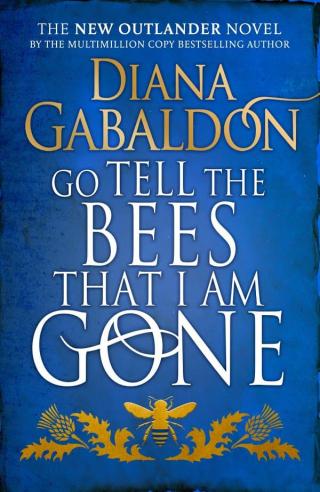
Go Tell the Bees That I Am Gone
- Автор: Гэблдон Диана
- Серия: Outlander #9
- Год: 2021
- Язык: английский
- Год: Delacorte Press
- ISBN: 978-1-473-51900-8
- Жанр: Исторические приключения

Электронная книга - «Go Tell the Bees That I Am Gone». Краткое содержание книги:
The past may seem the safest place to be . . . but it is the most dangerous time to be alive. . . .
Jamie Fraser and Claire Randall were torn apart by the Jacobite Rising in 1746, and it took them twenty years to find each other again. Now the American Revolution threatens to do the same. It is 1779 and Claire and Jamie are at last reunited with their daughter, Brianna, her husband, Roger, and their children on Fraser’s Ridge. Having the family together is a dream the Frasers had thought impossible. Yet even in the North Carolina backcountry, the effects of war are being felt. Tensions in the Colonies are great and local feelings run hot enough to boil Hell’s teakettle. Jamie knows loyalties among his tenants are split and it won’t be long until the war is on his doorstep. Brianna and Roger have their own worry: that the dangers that provoked their escape from the twentieth century might catch up to them. Sometimes they question whether risking the perils of the 1700s—among them disease, starvation, and an impending war—was indeed the safer choice for their family. Not so far away, young William Ransom is still coming to terms with the discovery of his true father’s identity—and thus his own—and Lord John Grey has reconciliations to make, and dangers to meet . . . on his son’s behalf, and his own. Meanwhile, the Revolutionary War creeps ever closer to Fraser’s Ridge. And with the family finally together, Jamie and Claire have more at stake than ever before.
Little Davy had been a great help. The tiny boy had brightened everyone’s heart, and Jamie loved to sit with him and say things in Gaelic to him that made Fanny laugh when she heard them.
Still … there was something missing in him. I glanced back at the unmade bed. He hadn’t felt up to making love for more than two months after we’d come home—little wonder—and while I had been able to rouse him physically as he healed … there was something missing.
“Patience, Beauchamp,” I said to the mirror, and picked up my hairbrush. “He’ll mend.” I normally brushed my hair by feel, but was still looking into the glass as I raised the brush—and stopped.
“Well, bloody hell,” I said. My hair was white. Jamie had told me my hair was the color of moonlight, once, but then it was no more than streaks of white around my face. It was not entirely white now; the mass of curls that foamed around my shoulders was still a mix of brown and blond and silver—but the newer growth above my ears was a pure and simple white that shimmered in the morning sun.
I set down the brush and looked at my hand, turning it back and forth. It looked quite as usuaclass="underline" thin and long-fingered, with strongly marked tendons and blue veins visible …
I remembered Nayawenne then, and what she’d said to me: “When your hair is white … that is when you will find your full power.” I hadn’t thought of it in some time and felt a tingle down my spine now. The memory of holding Jamie’s soul on that mountaintop, calling him back to his body … Roger had said to me, quietly, when no one was nearby to hear, that he thought he had seen a faint blue light come and go in my hands as I touched Jamie, flickering like swamp fire.
“Jesus H. Roosevelt Christ,” I said, very quietly.
IN THE AFTERNOON, I went up to my garden. The air was still chilly, but patches of bare earth were beginning to show through the melting snow, and it was time to prepare trenches for the early peas and bean vines. Jamie came with me, saying he could do with air, and we walked—slowly, to accommodate his knee—up the slope.
The two lieutenants, Gilbert and Oliver, had dug good trenches for me the year before—before all hell broke loose, and I said a brief prayer for them, and for Agnes (which one did she marry? I wondered), and for Elspeth and Charles Cunningham. Were they all back in England now?—for sweet peas and pole beans and edible peas, these all carefully saved from last year’s harvestings. Jamie obligingly dumped the manure into one trench and set about the job of shoveling earth in and mixing it well with the manure, merely hissing through his teeth when his bad knee twinged.
This trench ran behind the beehives. There were eleven hives now: One swarm had divided before Kings Mountain and I had been in time to catch a departing new queen and install her in a new hive with her followers, and Young Ian had found a wild swarm and gone with Rachel and Jenny to capture them and bring them back. All of them had survived the winter, and a few bees would now and then come out and cruise slowly round the garden before going back in. Jamie looked cautiously behind him, to make sure he wouldn’t knock against the hives with his spade, then glanced at me in surprise.
“I hear them!” he said. “Or at least I think I do …” He advanced cautiously, putting his ear close to the woven straw of the skep.
“Yes, you do,” I said, amused at his expression. “Honeybees don’t die in the winter and they don’t really hibernate, either—so long as they have enough honey stored up to last them ’til spring. They cluster together and shiver to generate warmth, but otherwise they just eat and … sleep, I suppose.”
“I can think o’ worse ways to pass the winter,” he said, and smiled. “Holdin’ your feet.”
The interesting question as to just what parts of him I would like to hold while sleeping was obliged to wait, as we heard the rustlings and shuffle of heavy footsteps coming up the path.
I wasn’t surprised to see John Quincy Myers—he routinely stopped at Fraser’s Ridge when he came back from the Cherokee villages where he usually spent the winter—but I was very pleased.
“How are you?” I asked, standing back to look up at him after greetings and embraces had been exchanged. He had apparently left his pack at the house and looked much as usual, but thin from the winter, like everyone else.
“Sprightly, Missus, sprightly,” he said, giving me a wide smile that had one or two fewer teeth than it had when last seen. “And I see your bees are thrivin’, too.”
“Yes, they seem to be—and thank you again for giving them to me. We were just talking about what bees do in the winter. Eat and sleep, I imagine.”
“Oh, I’m sure they do that,” he said, and reached delicately to put his hand on one of the hives. He smiled, feeling the faint hum on his skin. “But I think they pass the time much as we do in the cold, tellin’ each other stories through the long nights.”
Jamie laughed at that, but came cautiously closer, putting his hand on one of the hives as well. “What sorts of stories d’ye think bees tell, a charaid?”
“Tales of bears and flowers, I reckon. Though a queen maybe dreams of other things.”
“If you mean laying thousands of eggs, that sounds more like a nightmare,” I said. John Quincy laughed, but tilted his head to and fro in equivocation.
“It’s not for a man to say, but I think she maybe dreams of flyin’ free and high with a hundred drones in a cloud o’ mad desire. Oh—” He stopped, feeling in his pouch. “I ’most forgot, Missus. I’ve summat here for you.” He drew out a small package, wrapped in a piece of grimy pink calico.
“Who is it from?” I asked, taking it. It was light, no more than a few ounces, and something crackled faintly inside.
“That, I don’t rightly know, Missus Claire,” he said. “’Twas given me by a woman keeps a tavern down near Charlotte, in January. She said it was a black man left it, sayin’ it was for the conjure-woman what lived at Fraser’s Ridge, and would she kindly pass it on when someone was to be headin’ up this way. I do suppose he meant you,” he added with a smile. “Ain’t that many conjure-women in this neck o’ the woods.”
Puzzled, I opened the little parcel to find a sheet of thick paper, carefully folded around a hard object. I unfolded it and a rock the size of a hen’s egg—and roughly the same shape—fell out into my hand. It was a mottled gray in color, with white and green splotches. It was smooth and felt remarkably warm, considering the chilliness of the air. I handed it to Jamie and unfolded the large sheet of paper it had been wrapped in. The note was written with quill and ink, the writing a little straggly but quite legible.
I have left the army and returned to my home. My grandmother sends this for you, in thanks. It is a bluestone from an old place and she says it will heal sickness of spirit and of body.
I read this, astonished, and was about to tell Jamie that it must be from Corporal—evidently now ex-Corporal—Sipio Jackson, when he suddenly reached over and took the paper out of my hand.
“A Mhoire Mhàthair!”
John Quincy craned his neck to see, interested.
“I be damned,” he said. “That there’s your name, ain’t it, Jamie?”
It was substantially battered; it was torn at one corner, rubbed and dirty, some of the ink had evidently got wet and run, and the red wax seal had fallen off, leaving a round red stain behind—but there was no doubt at all what it was.