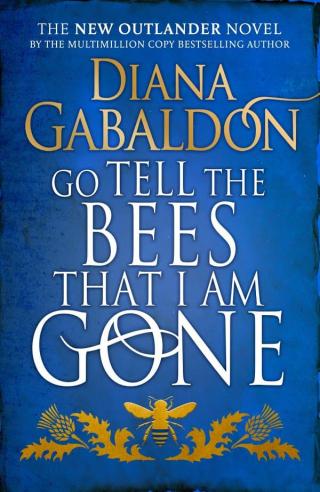
Go Tell the Bees That I Am Gone
- Автор: Гэблдон Диана
- Серия: Outlander #9
- Год: 2021
- Язык: английский
- Год: Delacorte Press
- ISBN: 978-1-473-51900-8
- Жанр: Исторические приключения

Электронная книга - «Go Tell the Bees That I Am Gone». Краткое содержание книги:
The past may seem the safest place to be . . . but it is the most dangerous time to be alive. . . .
Jamie Fraser and Claire Randall were torn apart by the Jacobite Rising in 1746, and it took them twenty years to find each other again. Now the American Revolution threatens to do the same. It is 1779 and Claire and Jamie are at last reunited with their daughter, Brianna, her husband, Roger, and their children on Fraser’s Ridge. Having the family together is a dream the Frasers had thought impossible. Yet even in the North Carolina backcountry, the effects of war are being felt. Tensions in the Colonies are great and local feelings run hot enough to boil Hell’s teakettle. Jamie knows loyalties among his tenants are split and it won’t be long until the war is on his doorstep. Brianna and Roger have their own worry: that the dangers that provoked their escape from the twentieth century might catch up to them. Sometimes they question whether risking the perils of the 1700s—among them disease, starvation, and an impending war—was indeed the safer choice for their family. Not so far away, young William Ransom is still coming to terms with the discovery of his true father’s identity—and thus his own—and Lord John Grey has reconciliations to make, and dangers to meet . . . on his son’s behalf, and his own. Meanwhile, the Revolutionary War creeps ever closer to Fraser’s Ridge. And with the family finally together, Jamie and Claire have more at stake than ever before.
The house was quiet; my assistants had all scattered: Fanny was walking out somewhere with Cyrus, and the rest of them had all gone up to the Murrays’ cabin to drink apple cider and milk the goats. I was therefore somewhat surprised to see Jenny in the kitchen, sitting alone on the settle, gazing contemplatively at the big cauldron, steaming gently on the fire.
“Your brother’s doing well,” I said casually, and opened the pie safe to see what was available.
“Good,” she said, absently, but then sharpened into attention. “I mean—aye, that’s very good. Will he walk easy, d’ye think?”
“Not for some weeks, probably,” I said. “But he’ll certainly walk, and it will get easier, the more he does it.” I found three-quarters of a dried-peach pie and brought it back to the table. “Will you have a bit of this with me?”
“No,” she said automatically, but then noticed what it was. “Och. I will, thanks.”
I sliced the pie, fetched milk from the cooling cistern Bree had built in the corner of the kitchen floor, and set out the food. She rose slowly and came to sit opposite me.
“The Sachem came to my house this morning, to say it’s time for him to be away back north,” she said.
“Oh?” I took a forkful of the pie—delicious. Probably Fanny had made it; she was the best of the family bakers. Jenny said nothing, and while she had a fork in her hand, she hadn’t yet stuck it into the pie.
“And?” I said.
No answer. I took another bite and waited.
“Well,” she said at last. “He kissed me.”
I raised an eyebrow at her.
“Did you kiss him back?”
“Aye, I did,” she said, sounding astonished. She sat for a moment, contemplating, then looked at me sideways. “I didna mean to,” she said, and I smiled.
“Did you like it?”
“Well, I’ll no lie to ye, Claire. I did.” She let her head fall back and stared at the ceiling. “Now what?”
“You’re asking me?”
“No, I’m askin’ me,” she said, adding a small Scottish snort for emphasis. “He’s goin’ north, back to his nephew. To tell him what-all he’s learnt about the war, so he can decide whether to stick wi’ the British or …” Her voice trailed off. “He’ll need to go before the weather turns.”
“Did he ask you to go with him?” I asked, gently.
She shook her head. “He didna need to ask and I didna need to answer. He wants me, and I … well, if it was only him and me, that would be one thing, but it’s not, and so it’s the other thing. I canna go and leave my family here, especially when I ken all the things that might happen to all of ye. And then there’s Ian …”
The softness in her voice told me that it was Ian Mòr she meant; her husband, rather than her son.
“I ken he wouldna mind,” she said, “and no just because the Sachem told me so,” she added, giving me a direct blue look. “But he sees Ian with me, and I didna need to hear it; I know he’s with me. He always will be,” she said, more softly. “One day, it may be different. Not that Ian will leave me, but … it may be different. I said so, and the Sachem says he’ll come back. When the war is over.”
When the war is over. I felt a huge lump in my throat. I’d heard that before, long ago, caught in the jaws of another war. Spoken in that same tone of longing, of anticipation, of resignation. Knowledge that if the war should ever end—it never truly would end. Things would be different.
“I’m sure he will,” I said.
150
And What of Lazarus?
I FELT JAMIE WAKE beside me. He stretched, then made a horrible noise and froze. I yawned and rose up on one elbow.
“I don’t know why it should be the case,” I remarked, “but with injuries of the knee and foot, lying down actually makes them hurt more badly than standing up.”
“It hurts when I stand up, too,” he assured me, but he shrugged off my offer of a helping hand and gingerly swung his bad leg off the edge of the bed with no more than a hiss of pain and a muffled “Mother of God.” He used the chamber pot and sat gathering his strength before he pushed himself up with a hand on the bedside table and stood swaying like a flower in the breeze.
I hopped out of bed, fetched his stick from the corner where he’d thrown it last night, and put it into his hand, wondering just what life had been like for Mary and Martha after their brother, Lazarus, came back from the dead. Then—watching Jamie struggle into his clothes—I wondered what it had been like for Lazarus.
Whatever his state of mind when he died, the poor man would presumably have left his body with the notion that he was finished with the world. Being unceremoniously reinserted into said body was one thing—returning to a life that you never expected to lead again was something else.
Jamie cast a bleak glance at himself in the looking glass, rubbed a hand over his stubble, muttered something in Gaelic, rubbed the same hand through his hair, shook his head, and made his way downstairs for breakfast, his passage marked by the thump of his stick on every other step.
Beginning to dress myself, I thought that in fact such a thing happened to a hell of a lot of people, who perhaps hadn’t come as close to physical death as Jamie had but had still lost the life they were accustomed to. I realized, with a small shock, that I’d had exactly that experience myself—and more than once. When I’d come through the stones the first time, yanked away from Frank and a new life that we’d just begun, after the war—and then again when I’d had to leave Jamie before Culloden.
I hadn’t revisited those memories in a long time. I didn’t want them back now, either—but it was actually a small comfort to remember that they’d happened … and that I’d survived being uprooted, losing everything I’d known and loved—and yet, I’d bloomed anew.
That was a comfort, and I comforted myself further by considering Jenny, who’d lost the greater part of her life when Ian had died, and then courageously turned her back on what was left of it, to come to America with Jamie.
The Provincial prisoners from the battle had been disarmed, rounded up, and marched away; I didn’t know where. But the militias had all disbanded, essentially as soon as the shooting stopped, men making their ways home in small groups, looking for the pieces of their lives that they’d lost along the way.
How long would it be, I wondered, before we might be compelled to do it again? It was 1781. In October, the Battle of Yorktown would be fought—and won. The war would be over—or as over as wars ever are.
There would be more fighting between now and then. Much of it in the South, but not near us. Or so Frank’s book said.
“He’ll be all right, then,” I said to my reflection in the looking glass. Jamie had healed well, physically; his knee would improve with use—and he was back in the house he loved. Most of his militia had survived the battle with mostly minor injuries, though we had lost two men: Tom McHugh’s second-eldest son, Greg, and Balgair Finney, a single man in his fifties from Ullapool who had lived on the Ridge less than a year. If Jamie was inclined to sit in his study and stare pensively into the fire, or to set out for the still and turn back—he hadn’t yet gone all the way there, and I didn’t know whether he couldn’t bear to see it deserted and in disrepair, or couldn’t yet face the job of getting it back into production—I had faith that he would come all the way back.