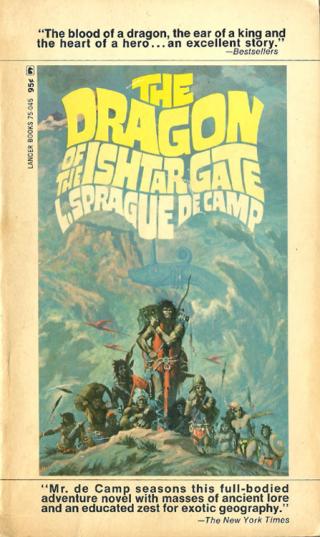
The Dragon of the Ishtar Gate
- Автор: Де Камп Лайон Спрэг
- Год: 1968
- Язык: английский
- Год: Lancer Books
- Жанр: Научная фантастика

Электронная книга - «The Dragon of the Ishtar Gate». Краткое содержание книги:
Dragon is probably closest in mood to de Camp's fantasy novels, while Bronze God and Arrows are closer to his science fiction, with their description of engineering problems, and personality clashes among researchers and engineers. Dragon also reflects de Camp's then-recent acquaintance with the Conan stories and other works of Robert E. Howard. Bessas, the huge Persian nobleman, is not only a close match for Conan in physique, but his mood swings, fixation on his mother, and tendency to toss of verses, seems a reflection of Howard himself. (Fortunately, his poems reflect de Camp's verbal dexterity and wit, not Howard's melancholy.)
" 'Aye. Now you shall come with me to the ruins of Balad al-Jann. There we shall revel amongst the tombs, served by my horde of lesser demons—'
" 'Excuse me, madam,' said Mizai, for he had heard many tales of men who went off into the sea to live with mermaids, or into the woods to live with nymphs, and somehow these tales always ended badly. 'What befell your last lover?'
" 'Oh, that is no matter. His powers began to fail, so I turned him into a scorpion. But think not to escape me! Your comrades are sunk in enchanted slumber; they will not aid—'
" 'That was not what I had in mind, my lady,' said Mizai. 'I did but think it behooved us to make trial of each other or ever we set up housekeeping in your City of Spirits. I could not bear to have you disappointed after you had gone to so much trouble; and, moreover, I doubt I should make a good scorpion.'
"Lailat agreed to Mizai's proposal. Now, my greatuncle may not have been wise, strong, or brave beyond the wont of most men, but in one regard he surpassed all mortals. And so it happened that presently Lailat sighed and said: 'My dear Mizai, you are perfect. I foresee a long and happy companionship—'
" 'Oh, but the trial has only begun,' quoth Mizai. 'Wait but an ush or two and you shall see.'
"So more time passed, and Lailat said: 'O Mizai, you are a lover beyond my wildest hopes. Let us forth—'
"But my great-uncle only replied as before: 'The test is by no means completed. Bide a few ush in patience." And when more time had passed, Lailat said: 'Truly, now we must go; for even in love there can be too much of a good thing.'
"But my great-uncle only answered as before. And when she became insistent, so did he. The dispute waxed warm, and of a sudden Mizai felt his face buffeted by mighty wings and his shoulder gashed by a sharp talon; for he held in his arms a great gray eagle-owl, which struggled to escape. He tossed the bird into the air, watched it flap away over the moonlit waste, and returned to the camp, laughing like one bereft of his senses."
Bessas' laugh rumbled. "A capital tale, boy; but now help to gather sticks for the fire."
Myron and Bessas solved the problem of the tent, but Bessas tugged too hard on the ropes on his side and pulled out the pegs on Myron's side. The structure collapsed. Skhâ snickered.
"You don't know your own strength, Bessas," said Myron mildly.
"Better to have it fall down now than later, when we're sleeping in it," said Bessas.
At last the tent was up. As he staked out the horses and mules in patches of grass, Myron reviewed in his mind the travels of recent days.
From Athar the four had ridden down the Phoenician coast, past the great precipitous promontory called Penuel, the Face of God; past Gubla with its warehouses full of papyrus from Egypt, awaiting transshipment to all parts of the Inner Sea; past Dog River with its guardian stone wolf and its inscriptions of ancient invading kings. They had seen the flowers and grottoes of Beroth under the towering snowcapped mass of Mount Libanos.
At Beroth they witnessed a sacrifice to the local Baal. The purple veil of the temple was drawn aside, revealing a huge squat bronzen statue of the god, horned and winged and gleaming with unguents. A fire crackled in Baal's potbelly.
Six matrons of the city's leading families stepped proudly forward to hand their first-born sons—children less than a year old, swaddled and bound—to shaven, skull-capped priests in gauzy purple robes. The priests paraded up the steps to the platform beside the god's outstretched hands and placed the children on these hands of hot metal. The screaming victims flopped like fish, rolled down the slope of the divine forearms, and fell through the gap between the god's elbows into the fire below. The twang of the harp, the clang of the sistrum, and the swelling sound of the hymn half drowned their shrieks; the stench of burning flesh mingled with the heavy odors of perfume and incense. Priests and priestesses, with their skirts hiked up to their waists and their eyelids painted green, pranced in the measures of a sacred dance.
When Myron and Bessas expressed their horror, Kothar snapped: "Hold your tongues, mortals, if you would not be torn to pieces! These folk take their religion to heart and will suffer no gibes from unclean out-landers."
After Beroth, they had passed through Sidon with its crowded, bustling harbor behind a meager breakwater, where fishermen's nets, dying in the sun, stretched from house to house like gigantic cobwebs. They paused at Old Tyre with its stinking dye works, filling the narrow streets with their reek, while New Tyre frowned across the water at them from its fortified island.
Myron had fraternized in the taverns with many Phoenician men of business. These were portly, full-bearded, hook-nosed men in robes and conical caps. Golden rings gleamed on their fingers and in their ears, and the dwarfish images of the Pataecian gods, in gold and crystal, hung round their necks.
The Punic merchants were men of a breed quite different from an adventurous pedant like Myron, or a bluff and brutal warrior like Bessas, or a mystical seer like Kothar. Despite a certain somber austerity of manner, they were often affable and sometimes even kindly, but in an abstracted way, because all the time they were really thinking of trade and profits ...
"Should you learn the shape of the earth, Master Myron, how would that affect our trade routes in the Western Ocean? Could our ships range on forever without fear of falling over the edge?"
"Aye, Master Myron, your servant has heard of your Greek Iliad. Can you purpose a plan whereby we could have it copied and sold at a profit?"
"The land of Kush? We know little of it here. But I will make it worth your while, friend Myron, to submit a confidential report on the openings in that land for imports and exports ..."
Yet these Phoenicians were no weaklings. They would fight like fiends in defense of their cities and their trade routes. They would defy stormy seas, man-eating savages, and strange gods in their eagerness to open up new lands to trade. But they looked upon Bessas' Aryan notions of honor as childish. Insult or rail at one and, instead of losing his temper in turn, he would merely say, well, do you wish to make a deal or do you not?
At length Myron wearied of their implacable commercialism. He was glad to reach Akko, the southernmost large Phoenician city.
In Akko the commander of the Persian garrison, to whom they applied for fodder, had warned them of a plague at Yapho, farther down the coast. They therefore turned inland, leaving behind them the white beaches around the mouth of the Belos, where men shoveled the gleaming sand into sacks to sell to the glassmakers. In Shechem, a Samaritan with his face tattooed blue had told them of a valley of ill fame ...
"Bessas!" exclaimed Myron. "This must be that Valley of Thieves whereof the man in Shechem warned us. He said that we should traverse it just before we reached Eshkol, and that it has an evil repute."
"Vaush! 'Twill prove the boys' mettle as well as their camping skill. We'll keep a double watch; the tent is small for three anyway."
"You mean, it's small for four. You occupy the room of two."
"I should say, it were small for two: one normal man like me and two half-sized Pygmies like you." Bessas continued:
"There is yet enough light for a few flights of arrows; so hang up the butt, Skhâ—on that tree yonder, so that shafts that miss shall strike the hillside and easily be found again."