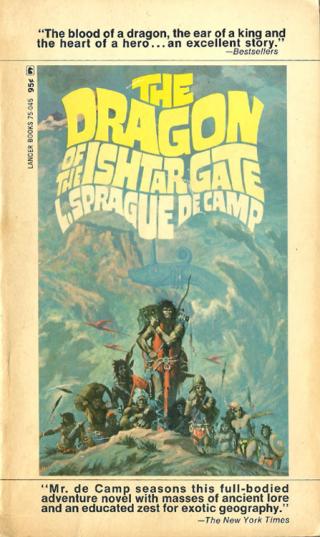
The Dragon of the Ishtar Gate
- Автор: Де Камп Лайон Спрэг
- Год: 1968
- Язык: английский
- Год: Lancer Books
- Жанр: Научная фантастика

Электронная книга - «The Dragon of the Ishtar Gate». Краткое содержание книги:
Dragon is probably closest in mood to de Camp's fantasy novels, while Bronze God and Arrows are closer to his science fiction, with their description of engineering problems, and personality clashes among researchers and engineers. Dragon also reflects de Camp's then-recent acquaintance with the Conan stories and other works of Robert E. Howard. Bessas, the huge Persian nobleman, is not only a close match for Conan in physique, but his mood swings, fixation on his mother, and tendency to toss of verses, seems a reflection of Howard himself. (Fortunately, his poems reflect de Camp's verbal dexterity and wit, not Howard's melancholy.)
"It were better not to speak my name in Ashdod, or in Ashqelon."
"Why?" asked Myron.
"Be-because there are rival temples of Dagon in these cities—rivals to ours, I mean—and while I do not think that their people would attack us, there might be some unpleasantness."
Myron said: "If these three temples all worship the same god, and if all are threatened by the Yahvists, I should think you would find it expedient to unite your forces."
"What, our people take orders from lousy Ashdodites and Ashqelonites?" Shimri guffawed. "As our cult is the oldest, going back to the Flood, they ought to take orders from us! Besides, we are the only ones that perform the correct ritual of baptism, with total immersion."
"Perhaps; but we Hellenes have learnt some costly lessons from the Persians about the value of unity."
They passed through Ashdod and Ashqelon without incident and in mid-afternoon reached Gaza, set amid yellow sandstone hills half a league from the sea. The citadel stood on a hill surrounded by hundred-foot bluffs, while the town sprawled untidily about the base of the hill. The streets were crowded with trains of dromedaries and other beasts of burden, for here met the caravan routes to Egypt, to Elath on the Red Sea, and to the great Phoenician and Syrian cities.
The temple of Dagon stood on a seaward slope. Within the temenos, at a lower level than the temple, was a structure like a Greek theater, with many tiers of stone seats. Instead of a stage, however, the seats faced a large tank of water. The pool was filled from a fountain, which sprayed from a vase in the hands of a sculptured Dagon: a long-bearded, benign-looking god whose lower half took the form of a fish's tail.
Beyond the upper tiers of seats spread the broad temenos, planted with palms and pomegranate trees. Amid the greenery rose a many-columned temple. In front of this temple, Shimri ben-Hanun presented his fellow travelers to the high priest of Dagon, the most holy and reverend Meremoth ben-Achish.
"Peace to you, my sons," said Meremoth, a short man with a paunch and a pleasant smile. "Certes you shall be quartered on the temple grounds, without cost to you, as a small return for your charity to Shimri. Dinner shall be sent to your quarters within the hour." (Shimri burst into a wide and foolish grin, so that to Myron he looked more than ever like some stalk-eyed sea creature.) "After you have eaten and rested, perhaps you were fain to witness our vernal ceremony of baptism. Who knows? You might be converted to the worship of the merciful Lord of the Waters."
"What happens, sir?" said Bessas.
"There are hymns and prayers and a sacred dance, thanking the god for the bountiful crops and fisheries of the season past. Then all the initiates enter the tank, one at a time, and there their sins of the year are washed away."
Shimri laughed, spraying saliva. "That is what the accursed Yahvists most object to. They—ah—they have some silly idea that we ought to go swimming in our shirts!"
Meremoth cast a sidelong glance at Shimri. "Do I understand that your purpose to take this lion of the faith with you to Kush?"
"Aye," said Bessas. "Think you he will do? If he fights as he eats, he were an army in himself."
"I think it a noble conceit; Philistaea will not be safe for him for many moons to come. Kalev! Conduct these gentlemen to the quarters reserved for pilgrims of rank ..."
Bessas swallowed the last of his dinner and rose. "We cannot idle away the afternoon if we wish to see that ceremony Father Meremoth promised us. I must buy a horse and some gear for Master Shimri. Remain here to guard our possessions, Skhâ."
Kothar, who ate little, had already excused himself, saying that he wished to speak of spiritual matters with one of the priests of Dagon. When Bessas, Myron, and Shimri returned from their shopping, Skhâ had disappeared, too. The temple servants disclosed that the Karian had gone out shortly before, after asking the way to the best tavern.
"We sent him to Baruch's," they said. "He carries a good line of Judaean and imported wines and Egyptian beer, and he robs not the stranger. Three streets north ..."
Because of the hour, Baruch's tavern was not yet crowded. A low sun beat in through the small window; flies buzzed gently in the dusty heat. In one corner sat three long-haired Persians in low-voiced converse. In another, a clean-shaven Egyptian pored over the cryptic picture writing on a long strip of papyrus. An Arab and a Judaean played tjau, or Egyptian checkers.
Skhâ son of Thuvlo had backed Baruch himself against the wine counter and was talking a stream of chatter in a high, excited voice, waving his pottery mug until the beer slopped over.
"... so here we were, in this accursed Tower of the Snail, with a hundred wild nomads swirling about and thirsting for our blood, their arrows flying thick as hail ..."
Skhâ's voice died as he became aware of Bessas, looming over him with a dangerously ruddy face. "Oh, greetings, Lord Bessas! I hoped you would come along because I came in here forgetting that I had no money, and was that not stupid of me? I was just telling Master Baruch—"
"Shut up and put down that mug!"
"Why?" said Skhâ. "Is it that—"
Bessas' hamlike hand came around and dealt the Karian a terrific buffet, sending him clear across a table to sprawl on the floor. Myron ran to pick up the unconscious man, saying:
"I hope you haven't broken his neck!"
"I think not; it takes a harder blow than that." Bessas threw the remains of Skhâ's beer in the young man's face. "He revives. Drag him back to the temple. How much is the scot, taverner?"
On their way back, Skhâ stumbled along in a daze, with one side of his face reddened and swollen. "You loosened my teeth," he mumbled at last.
"Chew on the other side of your face for a few days, and they'll tighten up again," said Bessas. "That is nought to what will happen the next time you desert your post. A whip for the horse, a bridle for the ass, and a rod for the fool's back."
"I will not follow a leader who uses his men so cruelly! I am no slave! I will go home!"
"Go ahead. But you will find it a long walk."
"How dare you! That piebald pony is mine!"
"Horse dung! You have just as much right to it as I have, which is right of possession. And who gave you leave to blab our affairs in public, so that the whole city shall know our plans? You know that we have ill-wishers, and our safety demands discretion. Better to stumble with the foot than with the tongue. Well, what are you waiting for? Yonder lies the Ashqelon Gate and the road to northward."
Skhâ trudged a few steps in silence. Then a voice spoke behind them in Persian:
"Are you not Bessas of Zariaspa?"
Bessas whirled. Myron could not be sure, but he thought this might be one of the Persians whom he had seen in Baruch's tavern. The man wore a short-sleeved shirt, embroidered trousers, and a bucket-shaped leathern hat.
"Who are you?" demanded Bessas. "May God befriend you; call your slave Cyaxares. I have that to say which will interest you."
"What is it?"
"Not in the street, sir. Will you excuse your friends and step this way?"
"Myron here is my lieutenant. What is news for me is news for him, too."
"We prefer to talk to you alone."
"No Myron, no talk."
"Be it as you wish. Hither, pray."
"Skhâ!" said Bessas. "Hasten back to the temple and tell Shimri and Kothar that we have gone with this man. If we be not back by dark, arm yourselves and look for us."
As Bessas and Myron followed Cyaxares, Myron muttered in Greek: "Suppose that, instead of reporting to the temple, Skhâ carries out his threat to desert? It will be some time before he ceases to resent that blow, which would have staggered an elephant. You are so hasty!"