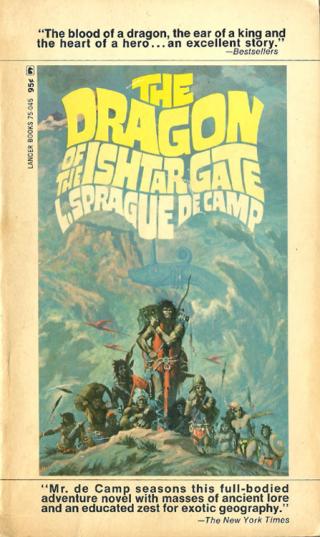
The Dragon of the Ishtar Gate
- Автор: Де Камп Лайон Спрэг
- Год: 1968
- Язык: английский
- Год: Lancer Books
- Жанр: Научная фантастика

Электронная книга - «The Dragon of the Ishtar Gate». Краткое содержание книги:
Dragon is probably closest in mood to de Camp's fantasy novels, while Bronze God and Arrows are closer to his science fiction, with their description of engineering problems, and personality clashes among researchers and engineers. Dragon also reflects de Camp's then-recent acquaintance with the Conan stories and other works of Robert E. Howard. Bessas, the huge Persian nobleman, is not only a close match for Conan in physique, but his mood swings, fixation on his mother, and tendency to toss of verses, seems a reflection of Howard himself. (Fortunately, his poems reflect de Camp's verbal dexterity and wit, not Howard's melancholy.)
"Stop!" cried Myron. "He wishes to speak."
The hostility of the Phoenicians only became louder, until Bessas shouldered his way to the front and cuffed a couple of the more violent townsfolk.
"Shut up!" he thundered. "What do you want, Arab?"
"I have a letter for Kothar bar-Malko."
"Who are you?"
"Adi ibn-Thabit, of the Banu Hassan."
"Are you one of those who just now attacked us?"
"Attack? The gods forbid! I am but a peaceful messenger."
"Know you aught of this attack?"
"I know only that I passed, on the road, a troop of the Banu Tarafa, having wounded men among them."
"They are not the same as your tribe?"
The Arab spat. "Those desert vermin? Nay! The Banu Hassan are civilized folk, who dwell in Thadamora and protect the caravans passing through. These others, are but sand thieves."
"How did you know who they were?"
"By their garments, their harness, and their speech."
"Did you speak with them?"
"Not I! They would have known me for a Hassani and slain me, as their Shaykh Waliq is at feud with our Shaykh Alman."
Kothar came forward, took his letter, and handed a small piece of silver to the Arab, who faded into the darkness. Kothar unrolled the letter in the light of a townsman's torch. He frowned over the spidery writing, then rolled the missive up and slipped it into his girdle. He looked at Myron and Bessas with a thoughtful expression.
"As soon as our wounds be healed, I shall be ready to guide you, at the last fee you named," he said.
As it fell out, Myron and Kothar became feverish from their wounds. Although Myron recovered quickly, the Syrian languished for several days. While waiting for Kothar to mend, Myron, who could not see any young person without an urge to teach him something, drilled his landlord's small son in the multiplication table. He also inquired about the origin of the Tower of the Snail, but of this the Marathites professed an ignorance as deep as his own.
At last, on the ninth of Ayaru, the company, now increased to four, set out for Athar. A day's ride brought them to this triple city, where the settlements of the Arvadites, the Sidonians, and the Tyrians formed separate walled inclosures within the outer wall.
The travelers put up at an inn in the Arvadite quarter. Bessas, Myron, and Skhâ sat down after their dinner to enjoy a qa* (* 1 qa = 1-1/2 pints.) of wine apiece, while Kothar who did not drink, engaged in low-voiced converse with the proprietor. Presently these two came to where the others sat.
"Gentlemen," said Kothar, "my familiar spirits have guided me to news that should interest you. Speak, good Master Ithobaal."
The innkeeper said: "A man was here two days ago, asking after Captain Bessas and Master Myron."
The two travelers named sat up so suddenly that Myron spilt his wine. Both burst into questions.
"Nay, nay," said Ithobaal. "The rogue did not give his name, and he was such an ordinary-looking little fellow that your servant would find it hard to describe him. A Persian, I should say from the cut of his trousers and the accent of his speech. He would not say what he wanted, and when I wist nought of those whom he sought he rode away."
Bessas asked: "On an ass?"
"Nay, on a fine riding camel."
Myron said: "When he found he couldn't keep pace with us, he must have changed his mount and cut across the desert by way of Thadamora."
"He must have, ridden as if the Corpse Fiend were after him," said Bessas, "to get here so soon."
"True," said Myron. "He no doubt traced us as far as Qadesh. Knowing our destination, but not knowing about our side journey to find Master Kothar, he inferred that we should turn south upon reaching the coast. Have you any idea whither he went, O Ithobaal?"
"Ere he departed, he said something about asking in Damascus."
"That," said Myron, "means that he is making a cast inland. If we remain on the coastal road, we shall keep clear of him."
"Unless," said Bessas thoughtfully, "he threw out that remark to deceive inquirers, like us." He smote the table. "By the four teats of Ishtar, but for those damned arrow pricks, we had been ahead of him yet! Hereafter we shall all wear our jacks whilst on the road, no matter how they irk us!"
Myron thought of replying that, as he and Kothar had been wounded in the limbs, their leathern cuirasses would not have saved them. But he knew Bessas too well to start an argument. Instead he said:
"I thought things had quieted down for the nonce, but it seems not. What with temples full of harlots, tombs full of antediluvian magic, and Persian spies, at least we are not finding our journey dull!"
VII – The Valley of Thieves
The fertile plains of Samaria gave way to the mountains of Judaea. The road—a mere track, unsuited to wheeled traffic—wound among long, sweeping slopes patchily covered with coarse, prickly scrub. Great flocks of northbound birds, from swifts to storks and steppe eagles, flew overhead. As the sun sank over the dusty gray-green hills of Ephraim, Myron said:
"O Bessas, we shall never reach Jerusalem tonight."
Bessas grunted. "I knew not that the roads of Judaea wound and writhed like serpents in pain. Kothar, how much farther to Jerusalem? ... Kothar!"
The Syrian awoke with a start. "Your pardon, mortal; I was communing with a distant colleague. What said you?"
"How far to Jerusalem?"
"Perhaps six or seven leagues."
The road had risen from a wide valley along a winding ridge. Now it dipped again, this time into a narrow, steep-sided valley whose slopes were thick with dusty-looking olive trees. A large yellow fox with black-rimmed ears barked at the travelers and ran for cover, dodging from one thorny apple-of-Sodom bush to another. Myron said:
"In an hour it will too dim to find our way. The moon is dark and the roads are rough."
"We'll camp here, then," said Bessas. "Our friends have been sleeping in beds long enough. It is time that we learnt if they be boys or men, for there will be a plenty of camping in Kush."
"I have camped in the desert near Barbalissos," said Skhâ. "What would you that I did?"
"You shall unharness the beasts, whilst Kothar gets a fire going and Myron and I assemble the tent. That knave who sold it to us in Babylon said it was so simple a child could put it up, but it looks as complicated as the Great King's pavilion."
Bessas unloaded the mass of poles, ropes, and tightly woven camel's hair canvas from the mule that bore it, while Kothar struggled with flint and steel and tinder. Skhâ, removing horses' bits and pack saddles, chattered on:
"Once my great-uncle Mizai, fighting for the last King Psamatik of Egypt, camped in the Desert of Shos whilst scouting the Persian bourn at the start of the war with Cambyses. The scouts were Arabs on camels, but the Karian battalion were sent to keep an eye on the Arabs lest they change sides or fade away into the desert without the king's knowledge.
"Around the campfire, the Arabs told tales of their national spirits and demons. So Mizai was not much astonished when, during his watch, he found before him a woman of strange and unearthly beauty. She was tall and slender, with long black hair and skin that shone white in the moonlight. The desert breeze fluttered a gown as sheer as cobwebs.
" 'Good evening, madam,' said Mizai.
" 'Hail, mortal,' said she. 'Know that I am Lailat, the spirit of the waste.'
" 'Forsooth?' said my great-uncle. 'Know that I am Mizai son of Avetho, a Karian. What would you?'
" 'I seek a new lover,' said she. 'For days I have watched this encampment in my other form, and you are the man I have chosen.'
" 'Well now,' said Mizai, 'that is most kind of you. Was that big owlish bird, which has been flapping about, you?'