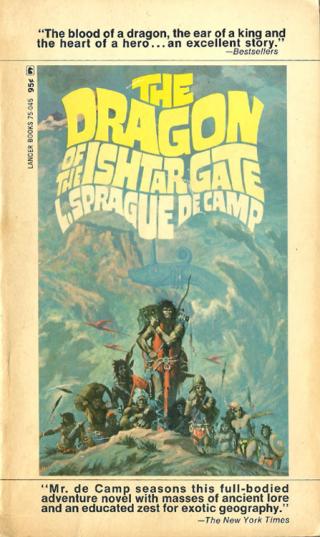
The Dragon of the Ishtar Gate
- Автор: Де Камп Лайон Спрэг
- Год: 1968
- Язык: английский
- Год: Lancer Books
- Жанр: Научная фантастика

Электронная книга - «The Dragon of the Ishtar Gate». Краткое содержание книги:
Dragon is probably closest in mood to de Camp's fantasy novels, while Bronze God and Arrows are closer to his science fiction, with their description of engineering problems, and personality clashes among researchers and engineers. Dragon also reflects de Camp's then-recent acquaintance with the Conan stories and other works of Robert E. Howard. Bessas, the huge Persian nobleman, is not only a close match for Conan in physique, but his mood swings, fixation on his mother, and tendency to toss of verses, seems a reflection of Howard himself. (Fortunately, his poems reflect de Camp's verbal dexterity and wit, not Howard's melancholy.)
"In the name of the blessed gods, my masters, you must stay in my house whilst you stop in Qadesh. Use my humble hut as your own."
"Thank you, sir," said Myron, "but your servants were really looking for your other son."
"Mean you my son Odainath? He is in the smithy; I will call—"
"No; I mean your son Kothar, the traveler—"
"E! forgive us! Kothar is no longer my son."
"Oh. We are sorry to hear of troubles within your house; but we must find Kothar."
"I do not speak of the doings of apostates and blasphemers, Ramman smite them!"
Malko and his visitors stood silently staring until Malko said: "But come in anyway. By the tongues of Reshap, your mention of this unpleasant matter has made me forget my duty of hospitality."
"But—" began Bessas. Myron jabbed him in the back with his thumb and, with effusive thanks to Malko, led his companions into the court.
An hour later, washed and combed, the travelers, over a skin of the local wine, told Malko of their journey.
"By Hadad and Ashtarth!" exclaimed the wainwright. "You must have set forth on a lucky day, to have escaped so many perils unscathed."
"We anticipate worse," said Myron. "We're on our way to Kush."
"Where is that?"
"Kush lies beyond Egypt to the south. They say it harbors little men less than a cubit tall, called Pygmies, as well as other wonders."
"By the blessed gods, that is indeed a rash project! Beware of deadly foreign demons and the grim gods of strangers."
"Being on the king's business, we must take our chances," said Myron. "So you see, Master Malko, as none of us has been to Egypt, we need a guide who speaks the language and knows his way about that land." As the old man frowned, Myron hurried on: "I'm sure that any member of your family, whatever his shortcomings, would be more trustworthy than the sort of guide we should pick up in the wineshops."
Perhaps the wine had mellowed Malko bar-Daniel. After he had sat in silence for a while, he said: "Well, the last I heard of Kothar he was living in Marath."
"Where is that?"
"On the coast between Arvad and Athar, about a day's journey hence. You must go back to Hemesa and take the road to the coast, which crosses the pass between the mountain ranges and follows the River of Freedom to the sea. Instead of turning south for Palestine and Egypt, you will turn north for about four leagues along the coastal road."
"Do you mean we turn right instead of left?"
"Aye. Thus you will reach Marath. If you poke about among the tombs of the necropolis, you will no doubt find my former son Kothar."
"Is he then deceased?" asked Myron.
"Dead to his family and to the true religion of his forefathers, but not dead in the common sense. Natheless, he dwells in a tomb."
"A curious choice of residence! Is he trying to save rent?"
Malko chuckled. "He says he absorbs magical influences from this ancient monument, which, he avers, goes back before the Flood. And this aura of ancient necromancy, quotha, makes easy the working of his sorceries."
"What is this tomb called?"
"The Tower of the Snail."
Bessas grunted. "A sinister-sounding name. I care not much for sorcery myself. I had my fill of it from that knave in Kabura who enchanted fleas up to the size of dogs and set them on those he disliked."
"Well," said Malko, "say not that I failed to forewarn you. I pray to the holy gods that my information lead you not into destruction."
"He who would journey to the rim of the world must expose himself to the shafts of fortune," said Bessas.
During dinner, Myron and Bessas told their host of the quest for the dragon.
"By the tusk that slew Tammuz!" said Malko. "That is a task for a demigod. I regret that we cannot help you out here; but the only Syrian dragon is that which sleeps under Mount Libanos."
"What dragon is this?" said Myron.
"Our legends state that, back in the days of the Flood or thereabouts, a colossal winged serpent with golden scales despoiled the land until Hadad smote it with a thunderbolt. To escape the god, the dragon dove slantwise into the earth, with such force that it dug the bed of the Serpentine River and finally plunged out of sight altogether. And there it still is. When the earth shakes, we know that the dragon has awakened and is stretching its coils. But I do not advise annoying it."
"I fear that this is not of the same species as the one we seek," said Myron, smiling. "Besides, it sounds too large for even such accomplished dragon hunters as ourselves to subdue."
The sun was sinking in blood and fire into the Syrian Sea when the travelers rode up the coastal road to the city of Marath. South of the town the land, barren and salty, rolled gently away to the sea on the left. On the right it sloped up to the distant ramparts of the Bargylos, on whose shoulders many outcrops of gray limestone, painted pink by the sunset, thrust through the dark-green scrub. Four furlongs to the north rose the massive cyclopean wall of Marath. On the northwestern horizon, the island city of Arvad rode on the purple sea, a jagged sable silhouette against the scarlet sky.
Bessas was lecturing on the iniquity of the knobby bronze bits used by the Immortals. "Certes, you can stop any horse from bolting with that fiendish thing," he fulminated, "but that should never happen to a rider who knows his business and keeps his wits. And a fortnight of such a bit will ruin any horse's mouth for delicate handling. By the beams of Tishtrya, any knave who'd use such a tool of torture on a decent hoi-se should be dipped in dung and hung up by the toes to dry! Now the proper way to—" He broke off to twist in his saddle and peer back. "There's a company on camels behind us."
Myron and Skhâ looked back. Myron said: "I wish I had your eyes. I see some moving specks like insects, but I cannot discern what manner of creatures they are."
Bessas shuddered. "I have an ominous feeling, as if my fravashi were trying to warn me."
"Oh, you have been listening too long to Malko's tales of antediluvian magic. Probably this Kothar is merely a man who has learnt to think for himself, so naturally he is regarded as a sorcerer."
" 'Tis those who follow that most concern me. Camels are seldom used along the Canaanitish coast."
"Traders, perhaps?"
"We shall see."
They rode past several tombs, some near to the road and some farther away. No sign of human life did they see around these structures. They caught up with a flock of sheep being driven towards Marath. The shepherd's great fierce dog barked and snarled at them and made their horses shy until the kilted shepherd collared it. Myron asked:
"Do you know of a man named Kothar, who lives in a tomb called the Tower of the Snail?"
"Kothar?" said the shepherd.
"Yes."
The shepherd said something in Canaanitish and pointed northwest. Bessas led the way off the road in the direction indicated. The shepherd scowled after them and urged his flock to greater speed.
The ground was covered with tall yellow-flowered thistles, among which a host of lizards scuttled and rustled. In front of the travelers, standing in a patch of marshy ground, the Tower of the Snail rose stark and black against the sunset.
This edifice was a cube over twenty cubits on a side, built of enormous blocks of rough stone. An opening on the south side and another on the east gave access to the burial chamber. On top, above the cornice, rose the ruins of a pyramidal stone structure, like a small black ziggurat. Some of the blocks from this pile had fallen into the reeds below.
Looking at the tomb, Myron felt a horripilation of awe and fear. The style of the monument was unlike anything that he had seen in his travels. It was as if some intelligent but non-human race, dwelling in this land before the coming of the Canaanites, had built this tower and then vanished utterly, leaving no fragment of their history or legendry behind.