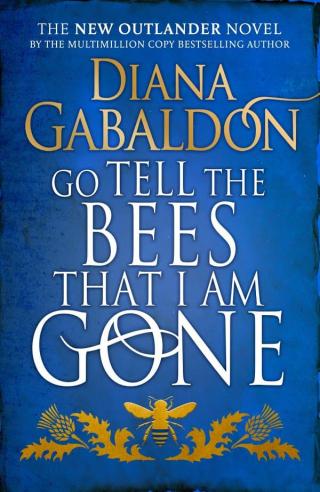
Go Tell the Bees That I Am Gone
- Автор: Гэблдон Диана
- Серия: Outlander #9
- Год: 2021
- Язык: английский
- Год: Delacorte Press
- ISBN: 978-1-473-51900-8
- Жанр: Исторические приключения

Электронная книга - «Go Tell the Bees That I Am Gone». Краткое содержание книги:
The past may seem the safest place to be . . . but it is the most dangerous time to be alive. . . .
Jamie Fraser and Claire Randall were torn apart by the Jacobite Rising in 1746, and it took them twenty years to find each other again. Now the American Revolution threatens to do the same. It is 1779 and Claire and Jamie are at last reunited with their daughter, Brianna, her husband, Roger, and their children on Fraser’s Ridge. Having the family together is a dream the Frasers had thought impossible. Yet even in the North Carolina backcountry, the effects of war are being felt. Tensions in the Colonies are great and local feelings run hot enough to boil Hell’s teakettle. Jamie knows loyalties among his tenants are split and it won’t be long until the war is on his doorstep. Brianna and Roger have their own worry: that the dangers that provoked their escape from the twentieth century might catch up to them. Sometimes they question whether risking the perils of the 1700s—among them disease, starvation, and an impending war—was indeed the safer choice for their family. Not so far away, young William Ransom is still coming to terms with the discovery of his true father’s identity—and thus his own—and Lord John Grey has reconciliations to make, and dangers to meet . . . on his son’s behalf, and his own. Meanwhile, the Revolutionary War creeps ever closer to Fraser’s Ridge. And with the family finally together, Jamie and Claire have more at stake than ever before.
“God. I’d forgot that part. It was him—Jack Randall. He came out o’ nowhere, walking through the fight, stark naked.”
“What?”
“Well, dinna ask me, Sassenach, I dinna ken why. He just … was.” His hand floated back to his chest, gingerly touching the small hollow in his breastbone. “And I dinna ken why I was, either. I just … was.”
140
Three Rounds with a Rhinoceros
“ONE WOULD THINK YOU’D done this before,” I remarked, smiling up between Brianna’s knees.
“If one thinks I’m ever doing this again …” she panted, but broke off, her sweating face contorting like a gargoyle’s. “NRRRRGH.”
“Wonderful, darling,” I said, my fingers on the rounded, hairy object showing briefly between her legs. I felt it for only a second before it disappeared again, an instant’s throbbing pulse, but that was enough; there was no sense of distress, only of bewilderment and an intense curiosity.
“Jesus, it looks like a coconut,” Roger blurted from his spot kneeling on the floor behind me.
“ARRRGHHHH! NGGGGHHH! I’m going to kill you! You—effing—” Brianna stopped, panted like a dog, then drove her blood-streaked legs hard into the straw-covered floor, half-rose from the birthing chair, and the baby shot out and fell heavily into my hands.
“Oh, my God,” said Roger.
“Don’t faint back there,” I said, busy swabbing the little boy’s nose and mouth. “Fanny? If he falls over, drag him out of the way.”
“I won’t faint,” he said, his voice trembling. “Oh, Bree. Oh. Oh, Bree!” I could feel him scuffling the straw as he rose to go to her, but my attention was split between Brianna and the baby—a good bit of blood, a small perineal tear, but no apparent hemorrhage—pink, wriggling, face screwed up in the exact gargoyle’s expression his mother had had a moment before, heart thumping like a tiny trip-hammer and … I was already smiling, but my smile widened as he jerked away from my bit of gauze and started yelling like an angry buzz saw.
“Apgar nine or ten,” I said happily. “Well done, darling—both of you!”
“Where’s his Apgar?” Fanny said, frowning at the baby. “Is that what you call his—”
“Oh. No, it’s a list you run through with a new baby, to evaluate their state. ‘Apgar’ stands for Activity, Pulse, Grimace—he’s certainly got that—Appearance—see how pink he is? A baby that’s had a difficult time might have bluish fingers and toes, or be blue all over—that would be very bad.” I had a quick vision of Amanda’s birth—and of the last blue baby I’d held—and gooseflesh rippled over my arms. I closed my eyes with a quick prayer for little Abigail Cloudtree and for the healthy grandson in my arms.
“What’s the ‘R’ for?” Roger asked, curious. I glanced up; he was cradling Bree’s head, gently wiping back the strands of sweat-soaked hair pasted to her face, but his eyes were glued to the baby.
“Respiration,” I said, raising my voice slightly to be heard over the baby’s rhythmic—and loud—cries. “If they’re yelling, they’re breathing. Come down here and cut his cord for him, Daddy. Fanny, come down here, too; the placenta will be along any minute.”
“Where’s Da?” Brianna said, lifting her head.
“Just here, lass.”
Jamie, who had been lurking in the doorway, tucked his rosary into his pocket and came in to Bree, bending down to kiss her forehead and murmur something to her in Gaelic that made her tired-but-smiling face blossom.
The room reeked of blood and shit and the peculiarly fecund, swampish smell of birthwaters.
“Here, sweetheart.” I rose, knees stiff from an hour of kneeling on the hard floor, and put the naked baby into her arms. “Be careful, he’s still a little slippery.” He had the faintly waxy look of a newborn, still coated with the protective vernix that had sheltered him in the waters he’d just traversed. It took a moment for my back to unkink sufficiently for me to stand fully upright, and I stretched my arms up, groaning.
“I’m not seeing it yet,” Fanny said. She was still kneeling, peering intently between Brianna’s splayed legs.
“See if he’ll suckle, will you, darling?” I said to Bree. “That will help your uterus contract.”
“That’s just what I need,” she muttered, but nothing touched the beatific smile that flickered on and off through the exhaustion that veiled her face. She tugged down the neck of her sweat- and bloodstained shift and carefully guided Junior’s squalling face to her breast. Everyone watched, riveted, as he rubbed his face to and fro on the breast, still squawking. Bree squinted down her nose, trying to move her nipple with one hand while holding the baby with the other. The nipples each showed a tiny drop of clear liquid.
“See?” I said to Fanny, nodding at them. “That’s colostrum. It comes before the real milk. It’s full of antibodies and useful things like that.” She turned her head to me, squiggle-eyed. “It means the baby will be protected from any illness—well, most illnesses—that his mother has had,” I explained.
The baby squirmed, and Bree nearly dropped him.
“Whoa!” said nearly everyone. She scowled at Roger, who was closest.
“I have him,” she said. Junior threw his head back and then flung it forward, found the nipple, and latched on with a sigh of exasperation that said, “Well, at last!” so eloquently that everybody laughed and the room relaxed.
A light tap on the doorjamb announced the advent of Patience and Prudence Hardman, their faces alight with curiosity.
“We heard the baby cry,” Prudence said. “What is it, pray?”
“And is thee well, Friend Bree?” Patience asked, smiling tentatively at Brianna, whose hair was beginning to dry and fluff, and who looked like a lion that had gone three rounds with a rhinoceros and wasn’t yet sure who’d won. She was still smiling, though, and stroked the baby’s head, looking down at him.
“He’s a little boy,” she said, her voice rough from screaming, but soft.
“Ooh!” Patience and Prudence said together, then looked at each other and laughed. Patience recovered, though, and asked whether Bree would like something to eat.
“Mummy’s made some soda bread with jam, in case thee should be famished, and there’s sweet milk aplenty,” Prudence added. “What is thy son’s name?”
“I’m starving,” Bree said. “As for … urgh.” She broke off, her eyes closing in a grimace. “Mmph.”
“There it is!” Fanny exclaimed. “It’s coming, I see— Oh!” She was on her hands and knees, peering intently, and jerked upright as the placenta slithered out and landed with a healthy plop! on the straw-strewn floorboards. Roger and Jamie looked hastily away, but the two young Quakers nodded in solemn approval.
“That looks just like Mummy’s, when she gave birth to Chastity,” Prudence said. “We made a tea of it.”
The placenta, dark with its writhing network of blood vessels and trailing the ropy remains of the umbilical cord, added its own meaty aroma to the pungent sweat and the smell of trampled fresh straw.
“I think perhaps we’ll bury it in the garden,” I said hastily, seeing the look on Bree’s face. “It’s very good for the soil. As to names—have you thought of any?”
“Lots,” she said, and looked down, nestling the baby closer. “But we thought we’d wait until we met him—or her—to decide for sure.”