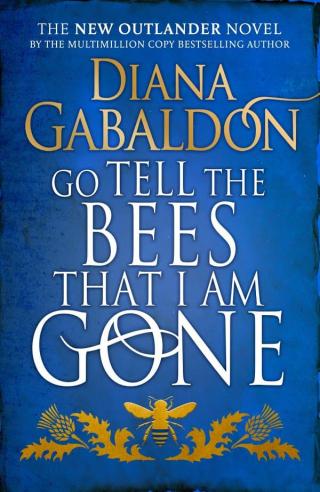
Go Tell the Bees That I Am Gone
- Автор: Гэблдон Диана
- Серия: Outlander #9
- Год: 2021
- Язык: английский
- Год: Delacorte Press
- ISBN: 978-1-473-51900-8
- Жанр: Исторические приключения

Электронная книга - «Go Tell the Bees That I Am Gone». Краткое содержание книги:
The past may seem the safest place to be . . . but it is the most dangerous time to be alive. . . .
Jamie Fraser and Claire Randall were torn apart by the Jacobite Rising in 1746, and it took them twenty years to find each other again. Now the American Revolution threatens to do the same. It is 1779 and Claire and Jamie are at last reunited with their daughter, Brianna, her husband, Roger, and their children on Fraser’s Ridge. Having the family together is a dream the Frasers had thought impossible. Yet even in the North Carolina backcountry, the effects of war are being felt. Tensions in the Colonies are great and local feelings run hot enough to boil Hell’s teakettle. Jamie knows loyalties among his tenants are split and it won’t be long until the war is on his doorstep. Brianna and Roger have their own worry: that the dangers that provoked their escape from the twentieth century might catch up to them. Sometimes they question whether risking the perils of the 1700s—among them disease, starvation, and an impending war—was indeed the safer choice for their family. Not so far away, young William Ransom is still coming to terms with the discovery of his true father’s identity—and thus his own—and Lord John Grey has reconciliations to make, and dangers to meet . . . on his son’s behalf, and his own. Meanwhile, the Revolutionary War creeps ever closer to Fraser’s Ridge. And with the family finally together, Jamie and Claire have more at stake than ever before.
“But you will have the comfort of knowing that your death will mean something. You will have saved millions of lives—and, incidentally, prevented the British empire from making the greatest economic blunder in history by abandoning America. That’s more than most soldiers get, isn’t it?”
139
Dreams of Glory
I WAS HAVING THE delightful sort of dream where you realize that you’re asleep and are enjoying it extremely. I was warm, bonelessly relaxed, and my mind was an exquisite blank. I was just beginning to sink down through this cloudy layer of bliss to the deeper realms of unconsciousness when a violent movement of the mattress under me jerked me into instant alertness.
By reflex, I rolled onto my side and reached for Jamie. I hadn’t achieved the stage of conscious thought yet, but my synapses had already drawn their own conclusions. He was still in bed, so we weren’t under attack and the house wasn’t afire. I heard nothing but his rapid breathing; the children were all right and no one had broken in. Ergo … it was his own dream that had awakened him.
This thought penetrated into the conscious part of my mind just as my hand touched his shoulder. He drew back, but not with the violent recoil he usually showed if I touched him too suddenly after a bad dream. He was awake, then; he knew it was me. Thank God for that, I thought, and drew a deep breath of my own.
“Jamie?” I said softly. My eyes were dark-adapted already; I could see him, half curled beside me, tense, facing me.
“Dinna touch me, Sassenach,” he said, just as softly. “Not yet. Let it pass.” He’d gone to bed in a nightshirt; the room was still chilly. But he was naked now. When had he taken it off? And why?
He didn’t move, but his body seemed to flow, the faint glow of the smoored fire shifting on his skin as he relaxed, hair by hair, his breathing slowing.
I relaxed a little, too, in response, though I still watched him warily. It wasn’t a Wentworth dream—he wasn’t sweating; I could almost literally smell fear and blood on him when he woke from those. They came rarely—but were terrible when they did come.
Battlefield? Perhaps; I hoped so. Some of those were worse than others, but he usually came back from a dream of battle fairly quickly and would let me cradle him in my arms and gentle him back toward sleep. I longed to do it now. An ember cracked on the hearth behind me, and the tiny spurt of sparks lit his face for an instant, surprising me. He looked … peaceful, his eyes dark-wide and fixed on something he could still see.
“What is it?” I whispered, after a few moments. “What do you see, Jamie?”
He shook his head slowly, eyes still fixed. Very slowly, though, the focus came back into them, and he saw me. He sighed once, deeply, and his shoulders went loose. He reached for me and I all but lunged into his arms, holding him tight.
“It’s all right, Sassenach,” he said into my hair. “I’m not … It’s all right.”
His voice sounded odd, almost puzzled. But he meant it; he was all right. He rubbed my back gently between the shoulder blades and I gingerly relaxed a little. He was very warm, despite the chill, and the clinical part of my mind checked him quickly—no shivering, no flinching … his breathing was quite normal and so was his heart rate, easily perceptible against my breast.
“Do you … can you tell me about it?” I said, drawing back after a bit. Sometimes he could, and it seemed to help. More often, he couldn’t, and would just shake until the dream let go its grip on his mind and let him turn away.
“I don’t know,” he said, the note of surprise still in his voice. “I mean—it was Culloden, but … it was different.”
“How?” I asked warily. I knew from what he’d told me that he remembered only bits and pieces of the battle, single vivid images. I’d never encouraged him to try to remember more, but I had noticed that such dreams came more frequently, the closer we came to any looming conflict. “Did you see Murtagh?”
“Aye, I did.” The tone of surprise in his voice deepened, and his hand stilled on my back. “He was with me, by me. But I could see his face; it shone like the sun.”
This description of his late godfather was more than peculiar; Murtagh had been one of the more dour specimens of Scottish manhood ever produced in the Highlands.
“He was … happy?” I ventured doubtfully. I couldn’t imagine anyone who’d set foot on Culloden moor that day had cracked so much as a smile—likely not even the Duke of Cumberland.
“Oh, more than happy, Sassenach—filled wi’ joy.” He let go of me then, and glanced down into my face. “We all were.”
“All of you—who else was there?” My concern for him had mostly subsided now, replaced by curiosity.
“I dinna ken, quite … there was Alex Kincaid, and Ronnie …”
“Ronnie MacNab?” I blurted, astonished.
“Aye,” he said, scarcely noticing my interruption. His brows were drawn inward in concentration, and there was still something of an odd radiance about his own face. “My father was there, too, and my grandsire—” He laughed aloud at that, surprised afresh. “I canna imagine why he’d be there—but there he was, plain as day, standing by the field, glowering at the goings-on, but lit up like a turnip on Samhain, nonetheless.”
I didn’t want to point out to him that everyone he’d mentioned so far was dead. Many of them hadn’t even been on the field that day—Alex Kincaid had died at Prestonpans, and Ronnie MacNab … I glanced involuntarily at the fire, glowing on the new black slate of the hearthstone. But Jamie was still looking into the depths of his dream.
“Ken, when ye fight, mostly it’s just hard work. Ye get tired. Your sword’s so heavy ye think ye canna lift it one more time—but ye do, of course.” He stretched, flexing his left arm and turning it, watching the play of light over the sun-bleached hairs and deep-cut muscle. “It’s hot—or it’s freezing—and either way, ye just want to go and be somewhere else. Ye’re scairt or ye’re too busy to be scairt until it’s over, and then ye shake because of what ye’ve just been doing …” He shook his head hard at this, dislodging the thoughts.
“Not this time. Once in a long while, something comes over ye—the red thing, is what I’ve always called it.” He glanced at me, almost shyly. “I had it—well, I was far beyond that—when I charged the field at Culloden. This time, though—” He ran a hand slowly through his hair. “In the dream … it was different. I wasna afraid at all, nor tired—do ye ever sweat in your dreams, Sassenach?”
“If you mean literally, yes. If you mean am I conscious of sweating in the dream … no, I don’t think so.”
He nodded, as though this confirmed something.
“Aye. I dinna think one smells things in a dream, either, unless it’s maybe smoke because the house took fire around ye whilst ye slept. But I felt things, just now, dreamin’. The rasp o’ the moor plants on my legs, gorse stuck to the edge of my kilt, and the feel o’ grass on my cheek when I fell. And I felt cold from the water I was lyin’ in, and felt my heart grow chill in my chest, and the beating grow slower … I kent I was bleeding, but nothing hurt—and I wasna afraid, either.”
“Did you take your clothes off in your dream?” I asked, touching his bare chest. He looked down at my finger, blank-faced. Then let his breath out explosively.