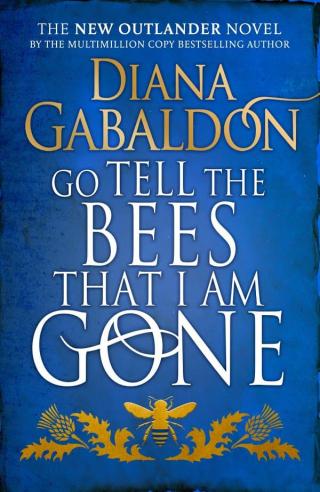
Go Tell the Bees That I Am Gone
- Автор: Гэблдон Диана
- Серия: Outlander #9
- Год: 2021
- Язык: английский
- Год: Delacorte Press
- ISBN: 978-1-473-51900-8
- Жанр: Исторические приключения

Электронная книга - «Go Tell the Bees That I Am Gone». Краткое содержание книги:
The past may seem the safest place to be . . . but it is the most dangerous time to be alive. . . .
Jamie Fraser and Claire Randall were torn apart by the Jacobite Rising in 1746, and it took them twenty years to find each other again. Now the American Revolution threatens to do the same. It is 1779 and Claire and Jamie are at last reunited with their daughter, Brianna, her husband, Roger, and their children on Fraser’s Ridge. Having the family together is a dream the Frasers had thought impossible. Yet even in the North Carolina backcountry, the effects of war are being felt. Tensions in the Colonies are great and local feelings run hot enough to boil Hell’s teakettle. Jamie knows loyalties among his tenants are split and it won’t be long until the war is on his doorstep. Brianna and Roger have their own worry: that the dangers that provoked their escape from the twentieth century might catch up to them. Sometimes they question whether risking the perils of the 1700s—among them disease, starvation, and an impending war—was indeed the safer choice for their family. Not so far away, young William Ransom is still coming to terms with the discovery of his true father’s identity—and thus his own—and Lord John Grey has reconciliations to make, and dangers to meet . . . on his son’s behalf, and his own. Meanwhile, the Revolutionary War creeps ever closer to Fraser’s Ridge. And with the family finally together, Jamie and Claire have more at stake than ever before.
At least they knew where Uncle Hal was—or was supposed to be. In Charles Town.
“Which is the devil of a lot of help,” he told Amaranthus, after two days of searching. “But if Papa doesn’t turn up here quite soon …”
“Yes,” she said, biting her lip. “I suppose you’ll have to go find Father Pardloe in Charles Town. If he …” Her voice died away.
“If he what?” he demanded, in no mood for obfuscation. She didn’t reply at once, but went to the sideboard and took down a bulbous black bottle. He recognized it; it was the German brandy Papa and Uncle Hal called black brandy, though the name was really “Blood of Martyrs.” He waved it away impatiently.
“I don’t need a drink.”
“Smell it.” She’d uncorked the bottle and now held it under his nose. He took an impatient sniff, then stopped. And sniffed again, more cautiously.
“I don’t pretend to be a judge of brandy,” Amaranthus said, watching him. “But Father Pardloe did give me a glass of this once. And it didn’t smell—or taste—like this.”
“You tasted it?” He raised a brow at her and she shrugged.
“Only a fingertip. It tastes much as it smells—hot, spicy. And that’s not how it should taste.”
William dipped a fingertip and tried it. She was right. It tasted … wrong, somehow. He wiped the drop of wine on his breeches, staring at her.
“Do you mean to say you think someone’s poisoned this?” His natural incredulity was lessened by the worry of the last few days, and he found that he wasn’t at all unwilling to believe this.
Amaranthus grimaced, gingerly putting the cork back into the bottle.
“A few weeks ago, Father Pardloe asked me did I know what foxglove is. I told him I did, and that he’d seen it—Mrs. Anderson has quite a lot of it bordering the front walk of her garden.” She took a short breath, as though her corset was too tight, and met William’s eye. “I told him it was poisonous. And I found that”—she nodded at the bottle—“locked up in the strongbox in his office. He gave me a key some time ago,” she added pointedly, “because all of my jewelry is in it.”
William looked at the bottle, black—and menacing. The fingers of the hand that had touched the stuff felt suddenly cold and seemed to be tingling. He rubbed them impatiently against his sleeve.
It wasn’t that he thought Uncle Hal wouldn’t kill someone he thought needed killing; he just didn’t believe he’d do it with poison. He said as much to Amaranthus, who looked at the bottle for a long moment, then back at him, her eyes troubled.
“Do you think he might have meant … to kill himself with it?” she asked quietly.
William swallowed. Faced with the imminent prospect of telling his wife what had become of their eldest son, and the eventual prospect of having his family and the regiment disgraced and destroyed … he didn’t think Harold, Duke of Pardloe, would seize upon suicide as an escape, but …
“Well, he didn’t take it with him to Charles Town,” he said firmly. “It’s no more than a three-day ride. I’ll go and find him. Put that stuff somewhere safe.”
WILLIAM HAD NOT expected ever to meet Sir Henry Clinton again. But there he was, frowning at William in a way that made it evident that Sir Henry recalled very well who he was. William had been waiting in an anteroom of the gracious Charles Town mansion presently serving as command headquarters for the Charles Town garrison, having requested a brief audience with Stephen Moore, one of Clinton’s aides-de-camp with whom he had been friendly—and one who he knew was familiar with the Duke of Pardloe. He’d sent in his name, though, and five minutes later Sir Henry himself popped up like a jack-in-the-box, his appearance nearly as startling.
“Still Captain Ransom, is it?” Sir Henry asked, elaborately courteous. There wasn’t any bar to a man resigning one commission and buying another, but the circumstances of William’s resignation of his commission under Sir Henry had been dramatic, and commanders in general disliked drama in their junior officers.
“It is, sir.” William bowed, very correctly. “I trust I see you well, sir?”
Sir Henry made a hrmph noise, but nodded briefly. He was, after all, surrounded by the evidences of a significant victory: the streets of Charles Town were pitted and marred by cannon fire, and soldiers—many of them black—were everywhere, laboriously restoring what they had spent weeks blowing up.
“I am come with a message for the Duke of Pardloe,” William said.
Sir Henry looked mildly surprised.
“Pardloe? But he’s gone.”
“Gone,” William repeated carefully. “Has the duke returned to Savannah?”
“He didn’t say he meant to,” Clinton replied, beginning to be impatient. “He left more than a week ago, though, so I imagine he’ll have got back to Savannah by now.”
William felt a coolness on the back of his neck, as though the room around them had subtly changed from one moment to the next and an unseen window had opened.
“Yes,” he managed to say, and bowed. “Thank you, sir.”
He walked out into the street and turned right, with no intent in mind save movement. He was at once alarmed and incensed. What the devil was Uncle Hal about? How dare he go off about his own business when his own brother had disappeared?
He stopped dead for a moment, as the thought struck him that his father and uncle might have disappeared together. But why? The thought died in the next moment, though, as he spotted a familiar red-coated form a hundred yards down the street, buying a packet of tobacco from a black woman in a spotted turban. Denys Randall.
“The very man I wanted to see,” he said a moment later, falling into step alongside Denys as he walked away from the tobacco seller.
Denys looked up, startled, then looked forward and back before turning to William.
“What the bloody hell are you doing here?” he asked.
“I might ask the same of you.”
“Don’t be ridiculous; I’m supposed to be here, and you aren’t.”
William didn’t bother asking what Randall was doing. He didn’t care.
“I’m looking for my uncle Pardloe. Sir Henry just told me that he left Charles Town more than a week ago.”
“He did,” Denys said promptly. “I crossed paths with him as I came down from Charlotte on the … oh, when was it … the thirteenth? Maybe the fourteenth …”
“Damn what day it was. You mean he was riding north, not south?”
“How clever you are, William,” Denys said in mock approval. “That’s exactly what I meant.”
“Stercus,” William said. His stomach knotted. “Was he alone?”
“Yes,” said Denys, looking at him sideways. “I thought that odd. I don’t know him to speak to, though, and hadn’t any reason to do so.”
William asked a few more questions, with no results, and so took his leave of Denys Randall, with luck, for good.
North. And what lay to the north that might lead the colonel of a large regiment to depart suddenly and without word to anyone, riding alone?
Ben. He’s going to see Ben. The vision of a black bottle rose in the back of his mind. Had Hal thought of poisoning himself, his son, or both of them?
“Too bloody Shakespearean,” William said aloud, turning his horse to the south. “Fucking Hamlet, or would it be Titus Andronicus?” He wondered whether his uncle ever read Shakespeare, for that matter—but it didn’t matter; wherever he’d gone, he hadn’t taken the bottle. At the moment, all he could do was go back to Savannah and hope to find his father there.