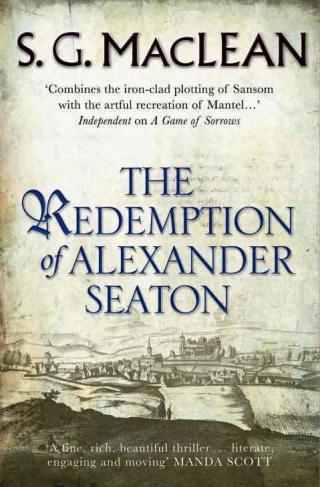
The Redemption of Alexander Seaton
- Автор: Маклин Шона Дж.
- Серия: Alexander Seaton #1
- Год: 2009
- Язык: английский
- Год: Quercus
- ISBN: 1847247911
- Жанр: Исторические детективы

Электронная книга - «The Redemption of Alexander Seaton». Краткое содержание книги:
Is the young man merely drunk or does his tottering walk suggest something more sinister?
When he collapses, vomiting, over the two whores who find him on that dark wet night, they guess rightly that he’s been murdered by poisoning.
So begins this gripping tale set in the town of Banff, Scotland in the 1620s. The body of the victim, the provost’s nephew and apothecary’s apprentice, is found in Alexander Seaton’s school house. Seaton is a school master by default, and a persona non-grata in the town – a disgraced would-be minister whose love affair with a local aristocrat’s daughter left him disgraced and deprived of his vocation. He has few friends, so when one of them is accused of the murder, he sets out to solve the crime, embarking on a journey that will uncover witchcraft, cruelty, prejudice and the darkness in men’s souls.
It is also a personal quest that leads Alexander to the rediscovery of his faith in God as well as his belief in himself.
Among her many strengths, Shona MacLean is brilliant at evoking period and place. You feel you are in those cold, dark, northern rooms, eavesdropping on her characters. You are totally involved in the rich, convincing world she has re-created.
The months passed, the yuletide festivities were long over, I passed my course in divinity to the approbation of all my teachers, and still Archie did not come home. I took up my teaching post in the grammar school of Banff while waiting for a kirk to fall vacant. The kirk of Boyndie in my own presbytery, not four miles from the town of Banff, fell vacant, and I was invited to preach there, to commence on my trials for the ministry. Still Archie did not come home.
And then the news arrived that he was dead. ‘They will weep for the Master of Hay!’ he had said. And they did weep. The whole of the North wept, a torrent of unceasing grief for the heir to Delgatie. The best and bravest of our youth, the hope and pride of his family, slaughtered in the German mud. I had been with him seventeen years, different as black and white and closer than brothers. I should have been with him then. I should have walked beside his horse through the mud; I should have put my body between his heart and the bayonet that killed him; I should have cradled his head in my lap as he died, leaving me worthless and alone.
Archie’s family was not to be consoled. His mother cried as if her very heart had been ripped out. His father looked into the long tunnel of death with no light behind him. They wanted me with them every hour of their blackest days. For I was of Archie, no substitute, no second or third best, but of their boy. They looked at me and they saw us climbing trees at seven. They saw us diving into waterfalls at twelve, fishing, hawking, laughing. They saw us ride through the castle gates at fifteen, to King’s College and all the delights of Aberdeen, riding to manhood and to our future. In my eyes they still saw their son’s brilliant smile. In my hearing, my Lord Delgatie begged forgiveness of God for grieving so deeply for his son. The God of Scotland gave children and He took them and His will was not to be questioned. I watched the old man’s heart break.
As for Katharine, Katharine was all but forgotten in those first weeks. She was left, frozen in her own grief, a loved younger child but no compensation for the heir that was lost. So engulfed was I during those early weeks in the maelstrom of grieving at Delgatie that I did not see it at first, but Katharine did. Katharine, the sole heir to Delgatie, must marry now, and marry well. No minister, nor bishop even, but land and family. The heirs of Delgatie would spring not from the son but from his sister, and all my hopes lay with Archie where he had fallen.
There was no one to speak for us. A relative was found, an old, wealthy, childless relative. Katharine would be despatched to his Borders tower-house to marry him and bear him children and return one day, or send her son, to hold Delgatie for the Hays. She understood; I understood. There was no pleading, no begging not to be sent to the cold bed of a man so old he might have been her father, no protest that one day I would be a man whom their daughter might, with no dishonour, marry. All that was gone.
Fate, in all her wilful cruelty, or helped along perhaps by Katharine’s now fearful and watchful parents, decreed that the day of my final trials at Fordyce should be the day of Katharine’s departure for her Borders jail. We had four weeks, a month of warning, but in that month I could only see her once. My preparations for the final trial, my work in the school, and Katharine’s farewell progress round the ladies and castles of Banff, Moray and the Garioch gave us but one day, and one night. Wary as she was by now, Archie’s mother could not refuse me that last hospitality. His lordship was away from home, but she watched us; we were scarcely left alone together two minutes in the day.
And then, in the darkness of the night, I stole to Katharine’s chamber and for the first and only time I took her as my wife, and told her she would always be my wife and mine only. And we slept, naked under the cover, entwined in each other’s arms. I had not meant to fall asleep. I should not have fallen asleep and slumbered with her those long hours till dawn. The light of the early May morning and the singing of the birds gradually began to play upon my eyes and ears. The perfect warmth and comfort of waking with Katharine still in my arms was slowly replaced by a dawning horror that I should not still be here. And as I opened my eyes, Katharine’s head and loosened hair across my bare chest, her pale arm on my shoulder, I was met by the horror of Lady Hay’s face. Her skin was drained of all colour save grey. She moved her mouth but no words would come. Her eyes were filled with the cold disaster of the scene before her. And then she spoke. Slowly, quietly. ‘Get out. You are filth. Get out.’ And then the woman who had loved me as a son staggered from the room and vomited.
And that had been my parting from Katharine, less than three weeks before my final trial for the ministry. I do not know how I kept my senses. A lie. I know how I kept my senses. I had lost the man who would have called himself my brother; I had lost the woman who should have been my wife. I had betrayed my childhood. Everything of my heart, what I had understood as my kin, was closed to me. Yet I still had my calling; I had always had my calling. Even in my one night with Katharine I had told myself there was no sin, because I had meant her for my wife. I did not acknowledge my wrong. Parted from her, I might have been convulsed with grief. Yet I had my calling and my trials were before me. I threw myself still deeper into my books. In those three weeks, less, I turned the Bible on its head and turned it back again. I composed the sermon of my life. There could be no chance of failure, of rejection. I would live for and through my calling. And this I believed until the words were in the mouth of the Moderator of the Presbytery of Fordyce that would have licensed me to preach as a minister of the Kirk of Scotland. And in that moment all tranquillity, all that I still understood in the world was shattered by the cry of my Lord Hay of Delgatie. His wife had finally broken and told him that very morning what I had done, and he had ridden to Fordyce with all the devils in Hell at his heels. He would die before he would see me a minister. He would throw in my face my betrayal of himself and of his family and every single thing they had done for me through all the years of my life. He laid not a finger on me, but before the brethren I was as a man beaten into a stupor. The moderator, aghast, pleading in his eyes, asked me to defend myself. But I could not utter a word. I had no answer for my accuser, for there was none left to give. My dignity lost, I stumbled from the kirk of Fordyce.