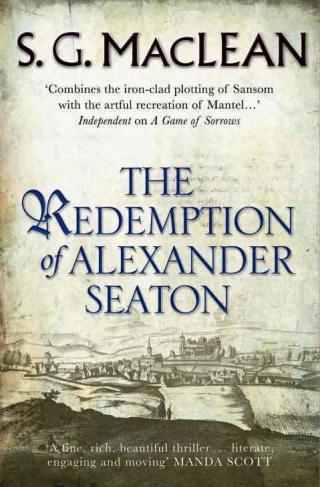
The Redemption of Alexander Seaton
- Автор: Маклин Шона Дж.
- Серия: Alexander Seaton #1
- Год: 2009
- Язык: английский
- Год: Quercus
- ISBN: 1847247911
- Жанр: Исторические детективы

Электронная книга - «The Redemption of Alexander Seaton». Краткое содержание книги:
Is the young man merely drunk or does his tottering walk suggest something more sinister?
When he collapses, vomiting, over the two whores who find him on that dark wet night, they guess rightly that he’s been murdered by poisoning.
So begins this gripping tale set in the town of Banff, Scotland in the 1620s. The body of the victim, the provost’s nephew and apothecary’s apprentice, is found in Alexander Seaton’s school house. Seaton is a school master by default, and a persona non-grata in the town – a disgraced would-be minister whose love affair with a local aristocrat’s daughter left him disgraced and deprived of his vocation. He has few friends, so when one of them is accused of the murder, he sets out to solve the crime, embarking on a journey that will uncover witchcraft, cruelty, prejudice and the darkness in men’s souls.
It is also a personal quest that leads Alexander to the rediscovery of his faith in God as well as his belief in himself.
Among her many strengths, Shona MacLean is brilliant at evoking period and place. You feel you are in those cold, dark, northern rooms, eavesdropping on her characters. You are totally involved in the rich, convincing world she has re-created.
This much, or the gist of it, William Cargill had known, or guessed. Knowing of old of my feelings for Katharine, he had known what Archie’s death would mean for us. The whole of the North knew of my humbling, my great fall, at Fordyce. But if my humiliation had been public, Katharine’s was worse. What was not known was guessed at, and whispered on the roads, in the inns, in the great halls of castles and at the firesides of hovels. Her name was bartered by those who were not worthy even to look on her face. Many wild theories abounded, until the people had some new scandal to keep their tongues active and their spirits content, but I had destroyed what I most loved, and Katharine, banished to that cold marriage bed, could never come back to Delgatie again.
William and I had never spoken of it before last night. ‘And for this, for what many men have done, ministers among them indeed, you were cast out from your brethren and they will never let you become a minister? Alexander, it is hypocrisy, and you should not bend to it. Why, Delgatie himself was a notorious adulterer in his younger days.’
I had heard this argument before, from Charles Thom, who had also guessed aright at the heart of the scandal. Jaffray had not argued in such a way, for he knew me better. ‘No, the hypocrisy has been mine, William. My Lord Hay is the head of a family, a magnate, a soldier, a leader of men. What he does in his bed or any other is of no consequence. Yet I sought to be a minister in God’s Kirk, to lead people from the path of damnation to the blessed assurance of righteousness. I knew what I did was wrong. And such was my arrogance in the face of God that I thought it did not matter because it was I who did it. And …’
‘And what?’
‘It was a betrayal. And my every memory of my whole life up to that point is coloured now by the knowledge of that betrayal. There is nothing in me that is not rotten.’
William would not allow this. ‘No, I will not have it. You did what other men, worse men have done. You loved the girl and she you. God in his Providence decreed she should not be your wife. In that at least, you may be wretched, but you are not rotten, for it was no work of yours that killed Archie and took Katharine from you.’
If this had only been so, I might have found myself a more tolerable being. But it was not so. William did not know it; no one knew it, save myself and Katharine. I had had a chance, only a chance, to hold onto the shreds of my life and to make of it something new. But I had rejected it, left it in the gutter. For, on the day of my fall at Fordyce, Katharine too had ridden from Delgatie. She had taken the finest horse left in the stables and she had ridden as no woman before her could have ridden. It availed her nothing. She could not catch her father’s party; she could not overtake him or plead my cause before the brethren as she had sworn to her mother she would do. By the time she arrived at Fordyce the kirk and kirkyard were empty and the brethren gone. She asked all about, but no one could tell her where I was or which way I had gone. Eventually, she came across a pedlar who had seen me on the road to Sandend. It did not take her long to find me then. I was on foot, and my form as well known to her as her own. We had not seen each other since that early morning in her chamber at Delgatie. How often since then I had meditated on the words, taken from the book of Proverbs and painted on the beams of that room’s ceiling: ‘If thou does labour in honesty, the labour goes, the honour bides with thee. If thou does any vice allow, the shame remains when pleasure is ago.’ The shame was burning now into me, burning my eyes so I could scarcely see. And the shame engendered in me a kind of madness, I think. There on the road she slid from her mount and took a step towards me.
‘Stay,’ I said.
‘Alexander …’
‘Come no closer. Do not come near to me.’
‘But Alexander–’
‘You know what has happened. You must know it. It is lost, all lost.’
‘But no, Alexander. No. All that is nothing to me. I love you more than life itself. I would defy God, my father, my mother, and all the legions of Hell to be with you. Alexander, I will not go. I will not marry him. I am yours. I will be yours. Alexander. We can marry and we can live, somehow.’
I was shaking my head at her, stepping back as she took another step forwards. ‘You have lost your mind.’
‘No, Alexander, but I have found my will. I will not leave you.’
She was before me, in all her pale and distracted beauty, and a troop of demons was taking hold of my mind. ‘You must leave me, Katharine, for I will not have you. You say it means nothing to you? Well, it means everything to me, and you have cost me all. All.’ All? What ‘all’ did I think there was without her? What ministry, what life did I think I would have led that did not have her in it? There was none, I knew that now. But I think, truly, in that moment I had been out of my senses, for I had turned from her and strode away, leaving her collapsed and crying in the road, the woman I had sworn to love until the day I died. Sometimes at night, when all the schoolhouse was silent save the noise of the sea at the shore, I would be kept awake by the sound of Katharine Hay’s desperate cries, as she lay weeping where I had left her, lying in the dirt on the road to Sandend. A hundred times on those nights I would have gone back to her, but she was no longer there.
And that I had told last night to William Cargill, the first living soul to hear from my lips how I had rejected the woman who had humbled and dishonoured herself for me. I wanted someone to know me for what I was. The bitterness Jaffray was always counselling me to let go of was at the root of my soul, and my soul knew what I had done.
William had sat silently for a long time after I had finished. He stoked the fire and stared into the flames. Finally he turned to me and said, ‘And yet I know you for a good man, Alexander. And this will pass. All pain will pass.’ We had said nothing further of the matter and had retired to our beds soon after, before the bell of St Nicholas struck midnight. If he could, I knew that William would take the great burden from my shoulder, and tell me I need carry it no longer, and I loved him for it. But William would never understand that should I once put down that rock, the man I had once believed myself to be would be destroyed for ever.
EIGHT
Much Business in Town
And thus I had slept through the early morning bells. I opened the window shutters and looked out. Elizabeth was in the backhand, gathering eggs from her chickens and trying, with little success, to keep the pig from trampling on the vegetable patch. She was much too small and slight for such a task, and soon the old manservant was out in the yard, bidding his mistress leave off such work, before the master should hear of it. She smiled at the chastisement and returned to her eggs.
I washed and dressed quickly, but William was long gone by the time I descended to the warmth of the kitchen. Elizabeth’s eyes were full of kindness – I saw William had told her my story – but she masked it as she could. William was a fortunate man. He had loved Elizabeth from the day he met her. He, a scholar, the son of a schoolmaster, she, a kitchen maid, the daughter of a cooper burgess. They had been promised to each other six years, while he completed his course in philosophy at the Marischal College in New Aberdeen and through all his absence at Leiden in the study of law. Neither had strayed. They had married within three months of his return from the Netherlands and now, as he had told me last night, she was carrying his child.
She regarded me with a mischievous glint in her eye. ‘You slept well, I trust, Mr Seaton. Or is this the accustomed hour of rising for the burgesses of Banff? I had heard of your slovenly ways in those parts, but would scarce have credited them.’