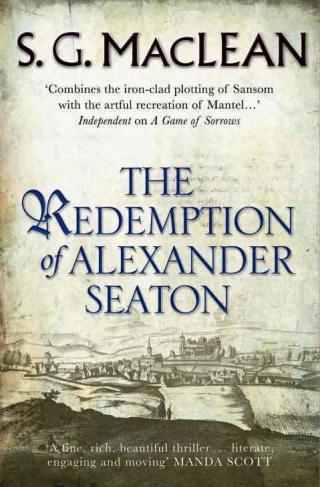
The Redemption of Alexander Seaton
- Автор: Маклин Шона Дж.
- Серия: Alexander Seaton #1
- Год: 2009
- Язык: английский
- Год: Quercus
- ISBN: 1847247911
- Жанр: Исторические детективы

Электронная книга - «The Redemption of Alexander Seaton». Краткое содержание книги:
Is the young man merely drunk or does his tottering walk suggest something more sinister?
When he collapses, vomiting, over the two whores who find him on that dark wet night, they guess rightly that he’s been murdered by poisoning.
So begins this gripping tale set in the town of Banff, Scotland in the 1620s. The body of the victim, the provost’s nephew and apothecary’s apprentice, is found in Alexander Seaton’s school house. Seaton is a school master by default, and a persona non-grata in the town – a disgraced would-be minister whose love affair with a local aristocrat’s daughter left him disgraced and deprived of his vocation. He has few friends, so when one of them is accused of the murder, he sets out to solve the crime, embarking on a journey that will uncover witchcraft, cruelty, prejudice and the darkness in men’s souls.
It is also a personal quest that leads Alexander to the rediscovery of his faith in God as well as his belief in himself.
Among her many strengths, Shona MacLean is brilliant at evoking period and place. You feel you are in those cold, dark, northern rooms, eavesdropping on her characters. You are totally involved in the rich, convincing world she has re-created.
The minister’s wife insisted I take some of the mutton stew she had made for her husband’s dinner. ‘In any case, Mr MacLennan will have no notion of mutton stew when he catches sight of these herring.’ She ladled me out a huge bowl from her steaming pot and went to the kist for oatmeal to coat the fish in.
By the time I had finished my meal, Sarah Forbes still slept soundly. There was no reason I could find words or voice for to stay until she woke, yet I was reluctant to leave. Mistress Youngson had assured me that she herself would go with Sarah to her uncle’s house, once she was awake and had taken a good hot meal. She assured me also that she would make it known in very clear terms that she and her husband would keep an eye on how the girl was treated. Yet I could see that she still had fears for Sarah’s welfare and that of her child. I walked out of the manse door and then I turned back to Mistress Youngson with my hand at my pouch. I pressed the coins into her hand. Five pounds Scots – the price of some books I had been going to buy for myself in Aberdeen. ‘Give it to them. Tell them it is from friends in Banff. It is for her food, and she must not be made to work beyond noon. Tell them there will be more when the child comes, if her friends are satisfied that she is not mistreated.’
She closed her hand over the coins and I could see tears in her eyes. ‘You are a good man, for all … for all else that might have happened.’ Further explanation was unnecessary. I thanked her for her kindness and rode away from King Edward.
The road became busier over the last few miles to Turriff with country people returning from the morning market in the town. Some of them might have known me, but I kept my hat pulled down low and, avoiding their eyes, kept my gaze fixed directly ahead of me. I did not turn to the left where the road branched off for Delgatie. I could count on the fingers of one hand the number of times I had reached this crossing and continued directly ahead rather than turning towards that great stronghold. I can have been little more than five years old when I first rode up with my father. Every step of the horse took me further into this strange, unimagined world. And then I had seen the castle. Only an ogre, I thought, a giant such as held sway in my mother’s stories, could live in such a place as that. Try as he might my father could not make me believe that the lord of that castle was the same jovial man who would arrive at the foundry with a great retinue of men, ordering arms for fighting and weapons for the hunt. He would joke with my father about my long slim fingers and my pale boy’s hands, and ask me to show him where were my hammerman’s muscles. I remembered my mother coming out on one such occasion and fixing his lordship with what I knew to be her most dangerous look and saying to him, ‘This child will be no hammerman,’ before taking my arm from his hand and bringing me back into her kitchen. My father was so ashamed it was days before I heard him address a word to her. But the laird of Delgatie never made sport of me again.
But that was over twenty years ago, that first of many visits, that first time I had met Archie, the laird’s boisterous bear cub of a son, who even at five years old transfixed and overwhelmed me with his intoxicating spirit. And then too I had met Katharine, the serious three-year-old Katharine, who even then watched her brother with a quiet wariness far beyond her years. But now Archie was dead, and Katharine was here no longer, gone far, far away from her home and her family because of me, and their father would have thrown me from the castle’s ramparts rather than welcome me within its walls once more.
The horse travelled steadily on, and I was soon in Turriff. I had no need to tarry in the town beyond changing my horse and delivering a letter from Jaffray to one of the doctors there. I refused the doctor’s offer of refreshment, and with the wind at my back left Turriff and rode hard towards Aberdeen.
The first time Archie and I had taken this road together we had been little more than fifteen, boys still, setting out for our studies at the King’s College in Aberdeen. We had ridden from the gates of Delgatie as his mother and sister watched from an upper window, my head full of Latin and Greek and Archie’s full of fighting and women. At the head of us, his lordship himself had ridden.
My own father no longer rode with Lord Hay. He was a burgess of Banff now, and owed his allegiance first to the town and then to the king. The laird would have given me a horse that almost matched Archie’s, but my father would not allow it, the first time in his life that he had ever spoken against Lord Hay. And the laird, understanding my father better then than I did, had not pressed the point but had had his stable master bring me round a roan cob – a respectable mount for one of my station. My father had by then stopped believing that I would ever be apprenticed to his trade. I was as tall and strong and able as any son he might have wished for, but I had my eye on other prizes and had little regard for the craft at which he excelled. I think he would gladly have burned the books my mother gave me in his hottest furnace, if he had thought she might ever forgive him. She would not have done, and he knew that well enough. But there had been bitter words between them on the eve of my leaving Banff for the college.
The evening had started well enough. Gilbert Grant was there, and Jaffray had come round too and brought the young Charles Thom with his fiddle to give us some music. In his bag the doctor had also brought a jar of the uisge beatha distilled by the mountain people, the people of Glenlivet to whom he journeyed every year in the summer. It was forbidden and fulminated against from every pulpit, but the doctor cared little for such fulmination when he was amongst friends. My mother made a small show of protest before going to fetch beakers for the men, and when she had her back turned, my father let the doctor pour a small measure into my own cup. ‘Be sure to sip it, boy. A taste. You will not need to swallow.’ I had never tasted anything like it. It numbed my lips and set fire to my tongue before melting, sweeter and more mellow than the finest of honey, on the roof of my mouth.
As the evening wore on, I noticed my father become more and more silent. At last he stood up and bade Charles Thom hold off from his playing. He pushed the food and drink away from him and then he addressed himself to me. If any had expected some final parting words of love or advice or paternal pride, they were disappointed. Before my mother and my friends, my father told me to remember that the one and only cause of my going to the King’s College was to serve the Master of Hay. Whatever vanities I might indulge in, whatever foolishness others might fill my head with, I was to remember I owed it all to the family of Delgatie, whose servant I was. Having said his piece, he called the dog from the hearth and strode out of the door. In the sudden silence of the room, I looked at my mother’s face and saw a death in it. For years she had quietly, secretly as she thought, nurtured my mind, brought me books, talked to me of everything she knew of the world, of philosophy and poetry and religion. She had made me into the son she would always have had, wherever Providence might have led her, and in her struggle to do it she had trampled on the man she knew my father to be and rendered him something else. In making me so completely hers, she had taken me from him, and I never saw it until that night. I do not know if my mother ever uttered a word to my father again.
And yet, my father had been right. My Latin and Greek would have availed me nothing had it not been for my connection to Archie. Of the few bursaries then available for poor scholars at King’s College, I was not eligible for any. All the available resources of the Kirk were focused on helping the divinity bursar of the presbytery survive his studies without starving or freezing. My father was not poor, but by no means could he keep me four years at the college while training up the apprentice he would not otherwise have needed. So, like a handful of other fortunate young men, I would undertake my studies, my fees paid and living full board in the college, as the servant of a nobleman friend. Archie. I had to rouse him twice in the morning, after the bursar had come past with his bell; I had to find ways of getting him past the janitor after the night curfew had fallen and the college gates were shut, holding him as straight as I could to try to mask the extent of his intoxication; more than once I had to travel in the other direction with him, concealing between our two cloaks some pretty girl who should have been at home in bed in her father’s house many hours before; I had to get him to the college kirk in the hours of divine service and do my best to keep him awake while he was there. In all, I did what I could to keep him out of trouble, and most of all, out of fights. It would not matter where a fight was, what it was over or whom it involved; if Archie got the merest whiff of it he would be in the thick of it in minutes, or, often enough, he would start a fight where there had been no fight at all. ‘Mind him well, Alexander,’ Archie’s mother had said as she bade me farewell, ‘and for the love of God, keep him safe.’