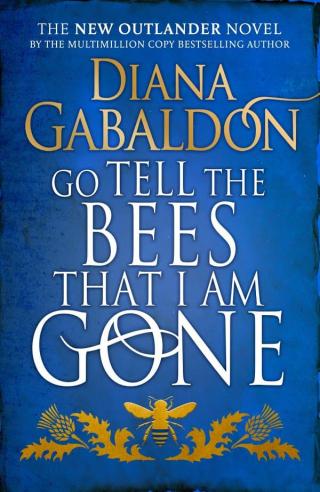
Go Tell the Bees That I Am Gone
- Автор: Гэблдон Диана
- Серия: Outlander #9
- Год: 2021
- Язык: английский
- Год: Delacorte Press
- ISBN: 978-1-473-51900-8
- Жанр: Исторические приключения

Электронная книга - «Go Tell the Bees That I Am Gone». Краткое содержание книги:
The past may seem the safest place to be . . . but it is the most dangerous time to be alive. . . .
Jamie Fraser and Claire Randall were torn apart by the Jacobite Rising in 1746, and it took them twenty years to find each other again. Now the American Revolution threatens to do the same. It is 1779 and Claire and Jamie are at last reunited with their daughter, Brianna, her husband, Roger, and their children on Fraser’s Ridge. Having the family together is a dream the Frasers had thought impossible. Yet even in the North Carolina backcountry, the effects of war are being felt. Tensions in the Colonies are great and local feelings run hot enough to boil Hell’s teakettle. Jamie knows loyalties among his tenants are split and it won’t be long until the war is on his doorstep. Brianna and Roger have their own worry: that the dangers that provoked their escape from the twentieth century might catch up to them. Sometimes they question whether risking the perils of the 1700s—among them disease, starvation, and an impending war—was indeed the safer choice for their family. Not so far away, young William Ransom is still coming to terms with the discovery of his true father’s identity—and thus his own—and Lord John Grey has reconciliations to make, and dangers to meet . . . on his son’s behalf, and his own. Meanwhile, the Revolutionary War creeps ever closer to Fraser’s Ridge. And with the family finally together, Jamie and Claire have more at stake than ever before.
Jamie didn’t flinch at the telling, but Roger could feel the words go into his own flesh like darts. Jenny. Christ, how will I face her?
He drew a deep breath. They were nearly there.
“Buck wanted to kill him—Randall. Right away, without hesitation.”
There was the barest breath of a laugh in Jamie’s voice, though it wavered a bit.
“He was Dougal’s son, then.”
“Absolutely no doubt about it,” Roger assured him. “You should have seen the two of them together.”
“I wish I had.”
Roger rubbed a hand over his face, shaking his head.
“The thing is—we could have stopped him. Killed him, I mean. We were armed. I’d been to see him before, with your da. He’d have no fear of me; I could have gone into his office with Buck and done it. Or we might have followed him to his lodgings, done it there; we’d have had a good chance of getting away.”
Jamie had flinched, just once, at the word “da.” He sat quiet now, though, his eyes the only thing alive in his face.
“I wouldn’t let Buck do it,” Roger blurted, speaking to those eyes. “I knew what would happen—all of it—and I let it happen. To your family. To you.”
Jamie looked down but didn’t speak. Roger felt fresh air from the creek come up from below, and felt the cold shadow of the trees touch his burning face.
At last Jamie stirred, nodding his head once, then twice, deciding.
“And if ye’d killed him?” he said quietly. “If I hadna been an outlaw, I’d not have been near Craigh na Dun, and in bad need of a healer, on that day when …” One eyebrow lifted.
Roger nodded, wordless.
“Brianna?” Jamie said softly, her name the sound of cool breeze in the Gàidhlig. “Would she have happened? And the bairns? You, for that matter?”
“It—we—might still have happened,” Roger said, and swallowed. “Another way. But aye. I was scared it might not. But I’m not—” He bit that off. Jamie knew he wasn’t making excuses.
“Aye, well.” Jamie got to his feet, scattering a cloud of gnats like a shower of gold dust in the evening light. “Dinna fash, then. I willna let Jenny kill ye. Come on, or the supper will be burnt.”
Roger felt rather as though a rug had been pulled out from under him. He didn’t know what he’d been expecting, but apparent calm acceptance wasn’t it.
“You … don’t …” he began hesitantly.
“I don’t.” Jamie reached down a hand, and when Roger took it, hauled him to his feet so they stood face-to-face, the trees beginning to rustle around them in the evening breeze.
“I spent a great deal of time thinking, ken,” Jamie said conversationally, tilting his head toward the creek, “when I lived as an outlaw after Culloden. Out under the sky, listening to the voices ye hear in the wind. And I would look back, wondering at the things I’d done—and not done—and thinking what if I’d done it differently? If we’d not chosen to try to stop Charles Stuart … it would have been different for us, at least, if not for the Highlands. I’d maybe have kept Claire by me. If I’d not gone to fight Jack Randall in the Bois de Boulogne, would I have two daughters now?” He shook his head, the lines in his face deep and his eyes dark with shadows.
“No man owns his own life,” he said. “Part of you is always in someone else’s hands. All ye can do is hope it’s mostly God’s hands you’re in.” He touched Roger’s shoulder, nodding toward the trail. “We should go.”
Roger followed, eased in mind, but unable to see the grubby, coarse shirt that covered Jamie’s back without still seeing the scars beneath.
“Mind,” Jamie said, turning to Roger at the head of the trail, “I think ye maybe shouldna tell Jenny what ye just told me. Not first thing, I mean. Let her get used to ye.”
JAMIE TOOK THE kindling sticks from Fanny and Mandy and bade them watch to see how you put them in to build up a fire. The fire had been burning all day, but low, as it wasn’t needed to do anything more than boil water and cook the stew Claire had made: bits of roasted possum flavoring a mass of young potatoes with carrots, peas, wild mushrooms, and onions. He glanced over his shoulder to be sure she was occupied elsewhere, then beckoned the girls in, conspiratorially.
“Let’s have a wee whiff,” he whispered, and they giggled, pressing in against his shoulders as he reached out with the pot lifter and slowly raised the lid, letting out a puff of damp steam, scented with meat and wine and onions. The girls sniffed as hard as ever they could, and he let it come in through his nose, all the way to the back of his throat. His wame rumbled at the luscious smell, and the girls burst into giggles again at the sound, glancing guiltily round.
“What on earth are you doing, Da?” He turned to find his daughter towering over him, a look of disapproval on her face. “Mandy, watch out! You’ve got Esmeralda almost in the fire!”
“Only teaching the wee lassies a bit o’ cookery,” he said airily, and, handing her the pot lifter, bowed and left, the music of girls’ laughter in his ears.
It was a good time to go; supper would be ready soon, and the light was going. He’d been looking out for Jenny, meaning to take her aside and prepare her a bit before she met Roger Mac.
Prepare her, how? he wondered. Say, “D’ye mind a man who came to Lallybroch forty years ago, lookin’ for his son? Ye don’t? Oh. Well, he’s here … only …”
Maybe she would remember. She’d been a young lass and Roger Mac was no bad-looking. And from what Roger Mac had told him, Da had spent a good bit of time in helping him to search, so perhaps …
The realization that he’d thought about Da so casually, thinking of him as still alive, made him feel as though he’d missed the last stair and come down staggering.
“Eh?” He became aware that Claire had asked him something and was waiting for an answer. “Sorry, Sassenach, I was thinking. What did ye say?”
She raised a brow at him, but smiled and handed him a bottle.
“I said, would you please open that?” It was a bottle of last year’s muscat wine that Jimmy Robertson had given Claire in thanks for her setting his youngest son’s broken arm.
“Ye think it’ll be worth drinking?” he asked, taking the bottle and examining it critically. The cork was tight in the bottle-neck, but dry and brittle; Claire had evidently tried to pull it and the greater part had broken off, crumbling in her hand.
“No,” she said, “but since when has that consideration ever stopped a Scot from drinking anything?”
“It hasna stopped any Englishmen I know, either. Maybe a Frenchman would be more choosy.” He held the brown glass bottle up to the light, to see the level of the wine inside, then drew his dirk and struck the neck of the bottle with a ringing tap of the blade. The glass broke cleanly, though at an angle, and he handed it back to her. “It doesna smell corked, at least.”
“Oh, good. I’ll—is that Oggy? Or a catamount?”
“It sounds like a catamount havin’ the griping farts, so it’s likely Oggy.”
She laughed, which made him feel momentarily happy. He took a sip of the wine, made a face, and gave it back to her.
“Who are ye planning to serve that to?”
“Nobody,” she replied, sniffing gingerly. “I’m going to soak a very tough-looking chunk of elk in it overnight with the last of the ramps and then boil it with beans and rice. What are they ever going to name that child—and when, do you think?”