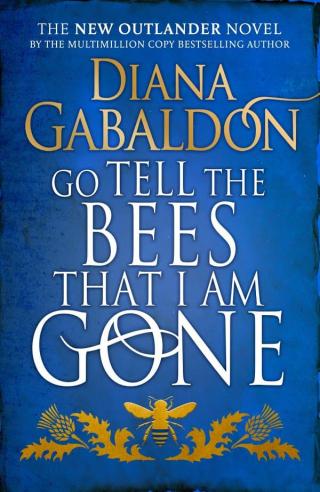
Go Tell the Bees That I Am Gone
- Автор: Гэблдон Диана
- Серия: Outlander #9
- Год: 2021
- Язык: английский
- Год: Delacorte Press
- ISBN: 978-1-473-51900-8
- Жанр: Исторические приключения

Электронная книга - «Go Tell the Bees That I Am Gone». Краткое содержание книги:
The past may seem the safest place to be . . . but it is the most dangerous time to be alive. . . .
Jamie Fraser and Claire Randall were torn apart by the Jacobite Rising in 1746, and it took them twenty years to find each other again. Now the American Revolution threatens to do the same. It is 1779 and Claire and Jamie are at last reunited with their daughter, Brianna, her husband, Roger, and their children on Fraser’s Ridge. Having the family together is a dream the Frasers had thought impossible. Yet even in the North Carolina backcountry, the effects of war are being felt. Tensions in the Colonies are great and local feelings run hot enough to boil Hell’s teakettle. Jamie knows loyalties among his tenants are split and it won’t be long until the war is on his doorstep. Brianna and Roger have their own worry: that the dangers that provoked their escape from the twentieth century might catch up to them. Sometimes they question whether risking the perils of the 1700s—among them disease, starvation, and an impending war—was indeed the safer choice for their family. Not so far away, young William Ransom is still coming to terms with the discovery of his true father’s identity—and thus his own—and Lord John Grey has reconciliations to make, and dangers to meet . . . on his son’s behalf, and his own. Meanwhile, the Revolutionary War creeps ever closer to Fraser’s Ridge. And with the family finally together, Jamie and Claire have more at stake than ever before.
Jamie let go without response and smiled. Aye, try it, ye wee bastard.
“I ken your name, sir. I’ve heard ye spoken of, now and then.”
From the corner of his eye, he saw Claire’s brows rise.
“Mr. Cleveland is a famous Indian fighter, a nighean,” he said, not taking his eyes off the man. “He’s killed a good many Cree and Cherokee, by his own report.”
“Caughnawaga, too. I don’t keep a count,” Cleveland said, chuckling in a way that said he remembered every man he’d killed, and enjoyed his memories. “I suppose your relations with the Indians are a mite more amiable?”
“I have friends in the Cherokee villages.” Not all of his friends in the villages were Indians, but Scotchee Cameron was no business of Cleveland’s.
“Splendid!” Cleveland’s ruddy face grew redder. “I hoped that might be the case.”
Jamie tilted his head with a noncommittal noise in his throat.
Claire evidently caught some note of what he was actually thinking, for she cleared her own throat and stepped up beside him, touching his arm.
“Mr. Cleveland’s wagon broke down, a mile or so down the trace—a sprung tyre. Perhaps you should go look at it?”
He smiled at her; she was transparent as a bottle of gin.
“Surely,” he said, and, turning to Cleveland, added, “I hope your cargo didna gang agley when the wheel broke. If ye’ve anything fragile, perhaps …”
“Oh, no,” Cleveland said casually. “It’s just a handful of guns and a bit of powder; everything’s sound enough.” He grinned at Jamie, exposing a row of stout, good teeth, though there was a shred of wet dark-brown tobacco caught between two of them.
“Speaking of guns, though,” he went on. “That’s one thing I had in mind to talk to you about. But yes, let’s do as your good lady suggests.” He made Claire a creditable bow then turned and took hold of Jamie’s arm, compelling him toward the trace.
Jamie disengaged himself without comment and, turning back to Claire, said, “Send Bobby and Aaron along wi’ some tools, will ye, Sassenach? And maybe a bit of beer, if there’s any left.”
Cleveland was waiting, and turned at once toward the wagon trace, leaving Jamie to come as he would. He followed, eyes on the broad back and tree-trunk legs. A very worn leather belt, showing the marks of cartridge box and powder horn, and presently supporting a large knife in an equally worn sheath—one decorated with dyed porcupine quills in an Indian pattern.
The man had maybe twenty years’ advantage on him—and at least a hundred pounds, though Cleveland was an inch or two shorter. He’s likely always been the biggest in any company he finds himself in. So he’s likely never had to care whether folk like him or not.
THE WAGON STOOD in a hollow of dark-green shade, where the wagon trace ran deep between two hillocks, both covered with a dense growth of balsam fir, hemlock, and pine. Jamie felt the coolness touch his face like a hand and drew a deep, clean breath of turpentine and cypress berries.
He was glad to see that the wagon wheel itself wasn’t damaged; the iron tyre that surrounded it had sprung loose, but none of the wood was broken. He could maybe get this man—and his guns; he spared a glance at the contents of the wagon—back on his way before hospitality required the Frasers to provide dinner and a bed.
“Ye came looking for me,” he said bluntly, looking up from the wheel. They hadn’t spoken on the walk save for brief courtesies. With the guns in plain sight, though, it was clearly time for business.
Cleveland nodded and took off his hat, openly appraising. His stomach strained the fabric of his hunting shirt, but it looked like hard fat, of the sort that would armor a man’s vitals.
“I did. Heard a good bit about you these two years past, one way and another.”
“Folk who listen to gossip will hear nae good of themselves,” Jamie said, in the Gàidhlig.
“What?” Cleveland was startled. “What’s that? Ain’t French, I heard a-plenty of that.”
“It’s the Gàidhlig,” Jamie said with a shrug, and repeated the sentiment in English. Cleveland smiled in response.
“You’d be right about that, Mr. Fraser,” he said. Bending, he picked up the heavy iron strip as though it were made of dandelion fluff and stood meditatively turning it in his hands. “There’s a good bit of talk abroad about how you came to lose your army commission.”
Despite himself, Jamie felt warmth rise up his neck.
“I resigned my commission, Mr. Cleveland, following the Battle of Monmouth. I had been temporarily appointed as field general in order to take command of a number of independent militia companies. These disbanded following the battle. There was no further need of my services.”
“I’d heard that you quit without notice, leaving half your men alone on the battlefield, in order to tend your ailing wife.” Cleveland’s bushy brows rose inquiringly. “Though having met Mrs. Fraser, I can certainly understand your feelin’s as a man.”
Jamie turned to face him over the wagonload of muskets and powder.
“I’ve no need to defend myself to you, sir. If ye’ve something to say to me, say it and have done. I’ve a privy to dig.”
Cleveland raised one hand, palm out, and bent his head, conciliating.
“No offense intended, Mr. Fraser. I only want to know whether you’re planning to rejoin the army. In whatever capacity.”
“No,” Jamie said shortly. “Why?”
“Because if not,” Cleveland said, and fixed him with a calculating eye, “you might be interested to know that a-many of your Whiggish neighbors over the mountains”—he jerked his chin in the rough direction of Tennessee County—“landowners, I mean, men who have something to lose—are raising private militias to protect their families and their property. I thought you might be considering something of the sort.”
Jamie felt his dislike of the man alter slightly, sliding reluctantly toward curiosity.
“And if I were?” he said.
Cleveland shrugged.
“It would be good to keep in touch with other groups. There’s no tellin’ where the British might pop up, but when they do—mark me, Mr. Fraser, when they do—I for one would like to know about it in time to take action.”
Jamie looked down into the wagon: muskets, and old ones, for the most part, with dry, cracked stocks and scratched muzzles—but a few regular British Brown Besses in better condition. Bought, traded, or stolen? he wondered.
“Action,” he repeated carefully. “And who are some of these men you speak of?”
“Oh, they exist,” Cleveland said, answering the thought rather than the question. “John Sevier. Isaac Shelby. William Campbell and Frederick Hambright. A good many others thinking on it, I can tell you.”
Jamie nodded but didn’t say more.
“One other thing I heard about you, Mr. Fraser,” said Cleveland, picking up one of the muskets from the wagon bed, idly checking the flint, “is that you were an Indian agent. That true?”
“I was.”
“And a good one, by report.” Cleveland smiled, suddenly clumsily playful. “I hear tell there’s quite a few redheaded children down in the Cherokee villages, hey?”
Jamie felt as though Cleveland had struck him across the face with the musket. Was that really being said, or was this some piece of foolery by which Cleveland hoped to involve him in something shabby?
“I’ll wish ye good day, sir,” he said stiffly. “My men will be down with tools to mend your wheel directly.”