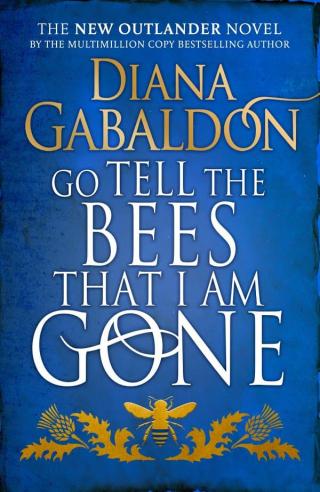
Go Tell the Bees That I Am Gone
- Автор: Гэблдон Диана
- Серия: Outlander #9
- Год: 2021
- Язык: английский
- Год: Delacorte Press
- ISBN: 978-1-473-51900-8
- Жанр: Исторические приключения

Электронная книга - «Go Tell the Bees That I Am Gone». Краткое содержание книги:
The past may seem the safest place to be . . . but it is the most dangerous time to be alive. . . .
Jamie Fraser and Claire Randall were torn apart by the Jacobite Rising in 1746, and it took them twenty years to find each other again. Now the American Revolution threatens to do the same. It is 1779 and Claire and Jamie are at last reunited with their daughter, Brianna, her husband, Roger, and their children on Fraser’s Ridge. Having the family together is a dream the Frasers had thought impossible. Yet even in the North Carolina backcountry, the effects of war are being felt. Tensions in the Colonies are great and local feelings run hot enough to boil Hell’s teakettle. Jamie knows loyalties among his tenants are split and it won’t be long until the war is on his doorstep. Brianna and Roger have their own worry: that the dangers that provoked their escape from the twentieth century might catch up to them. Sometimes they question whether risking the perils of the 1700s—among them disease, starvation, and an impending war—was indeed the safer choice for their family. Not so far away, young William Ransom is still coming to terms with the discovery of his true father’s identity—and thus his own—and Lord John Grey has reconciliations to make, and dangers to meet . . . on his son’s behalf, and his own. Meanwhile, the Revolutionary War creeps ever closer to Fraser’s Ridge. And with the family finally together, Jamie and Claire have more at stake than ever before.
“The commander was an officer named Buncombe. Your father called him ‘a decent fellow for a Sassenach’—and he was. Brian had brought two bottles of whisky—good stuff,” he added, glancing at Jamie, and saw the flicker of a returned smile at that. “We drank with Buncombe, and he promised to have his soldiers make inquiries. That made me feel … hopeful. As though I might really have some chance of finding Jem.”
He hesitated for a moment, trying to think how to say what he wanted to, but after all, Jamie had known Brian himself.
“It wasn’t so much Buncombe’s courtesy. It was Brian Dhu,” he said, looking straight at Jamie. “He was … kind, very kind, but it was more than that.” He had a vivid memory of it, of Brian, riding in front of him up a hill, bonnet and broad shoulders dark with rain, his back straight and sure. “You felt—I felt—as though … if this man was on my side, then things would be all right.”
“Everyone felt that about him,” Jamie said softly, looking down.
Roger nodded, silent. Jamie’s auburn head was bent, his gaze fixed on his knees—but Roger saw that head turn a fraction of an inch, and tilt as though in answer to a touch, and a tiny ripple of something between awe and simple acknowledgment stirred the hairs on his own scalp.
There it is, he thought, at once surprised and not surprised at all. He’d seen it—or rather, felt it—before, but it had taken several repetitions before he’d realized fully what it was. The summoning of the dead, when those who loved them spoke of them. He could feel Brian Dhu, here beside this mountain creek, as surely as he had felt him that dreich day in the Highlands.
Roger gave a brief nod to the ghost who stood with them, thought, Forgive me, and went on.
He told of William Buccleigh MacKenzie, who’d once nearly killed Roger but now was in the way of making amends by helping to find Jem. How together they had met Dougal MacKenzie, out collecting rents with his men—
“Jesus,” Jamie said, though Roger noticed he didn’t cross himself at mention of Dougal. His mouth curved up at the corner. “Did Dougal ken the—that this man Buck was his son?”
“No,” Roger said dryly. “As Buck hadn’t been born yet. Buck kent Dougal was his father, though; that was a bit of a shock for him.” Not only for him.
“I imagine it would be,” Jamie murmured. A tinge of amusement lingered on his face, and Roger wondered—not for the first time—at the ability of Highlanders to step back and forth between this world and the next. Jamie had killed his uncle when he had to, but had made his peace postmortem; he’d heard Jamie call on Dougal for help in battle—and seen him get it, too.
Roger and Buck had got it, as welclass="underline" Dougal had lent them horses for their journey.
But as Roger had said, this wasn’t about his own search for son and father. This was about what he owed to another father and another son. To the shade of Brian Dhu—and to Jamie.
“I’ll tell ye the rest sometime. But for now—we went back to Lallybroch, for Brian had sent word that he’d found a thing that was maybe to do with my business.
“The thing was a sort of pendant sent to him from the garrison commander at Fort William. It seemed odd and it had the name ‘MacKenzie’ on it, so both the commander and Brian thought I should see it.” There was a remembered tightness in his chest as he saw the disks in his mind: pressed cardboard, one red, one green, both imprinted with the name “J. W. MacKenzie” and a string of cryptic numbers—the ID dog tags of an RAF flyer, and proof positive that they were looking for a different Jeremiah.
“We needed to find where those tags had come from, aye? So we went back to Fort William. And—” He had to stop and breathe deep, to get it out. “Captain Buncombe had left; the new garrison commander was a Captain Randall.”
All amusement had vanished from Jamie’s face, which was now blank as a slate.
“Aye,” Roger said, and coughed a bit. “Him.” The new commander had been cordial, personable. “Helpful,” Roger said. “It was—” He searched for a word, then spread his hands, helpless to find it. “It was weird. I mean … I knew … what he’d …”
“Done to me?” Jamie’s eyes were fixed on his, unreadable.
“What he’d do to you. Claire told me—us. When she …” He caught sight of Jamie’s face and hurried on. “I mean, she kent ye were dead, or I’m sure she wouldn’t have—”
“She told ye everything, then.” Jamie’s expression hadn’t changed much, but his face had gone pale.
Oh, shit.
“Well, just the … er … the general outli—” He stopped. Ye’ll never make a decent minister if ye can’t be honest. Buck had said that to him, and he was right. Roger took a breath.
“Yes,” he said simply, and felt his innards hollow out.
Without a word, Jamie got to his feet and, turning away, took several steps into the bushes, stopped, and threw up.
Oh, Jesus. Oh, God. What was I thinking!
Roger felt as though he’d been holding his breath for an hour, and took a sip of air, and then another. He’d been thinking far ahead—to what he needed to say to Jamie, to explain and apologize, to ask forgiveness. He needed to do that, if he and Bree were to live here again. But he hadn’t thought at all that Jamie might not realize that Roger—and Bree, for God’s sake!—knew the intimate details of his personal Gethsemane; had known them for years.
Bloody, bloody, bloody … oh, hell …
Roger sat with his fists clenched, listening to Jamie gulp air, spit, and pant. He kept his eyes fixed on a scarlet ladybug with black spots that had lighted on his knee; it trundled to and fro over the gray homespun, curious antennae prodding the cloth. At last there was a rustling of bushes, and Jamie came back and sat down, back pressed against the sapling. Roger opened his mouth, and Jamie made a short chopping gesture with one hand.
“Don’t,” he said. His shirt was damp with sweat, wilted over his collarbones. All the evening insects had come out now; clouds of gnats floated over their heads, and the crickets had begun to chirp. A mosquito whined past Roger’s ear, but he didn’t lift a hand to swat it.
Jamie sighed and gave Roger a very direct look.
“Go on, then,” he said. “Tell me the rest.”
Roger nodded and met Jamie’s eyes.
“I knew about Randall, and what he was,” he said bluntly. “And what would happen. Not just to you—to your sister. And your father.”
This time Jamie did cross himself, slowly, and whispered something in Gaelic that Roger didn’t catch, but didn’t ask to have repeated.
“I told Buck, then—just, about the—the flogging, not about—” The fingers of Jamie’s maimed hand flickered, as though about to make the chopping motion again. “About your father, and what happened to him then.”
He felt again the cold horror of that conversation. If he did nothing to stop Jack Randall, Brian Dhu Fraser would be dead within a year, dead of an apoplexy suffered while watching his son being flogged to death (as he thought) by Captain Randall. Jamie would be outlawed, wounded in body and soul, bearing the guilt of knowing that his father’s death lay upon him, knowing that he had abandoned his home and tenants to his bereaved and shattered sister. And Jenny, that lovely young girl, left completely alone, without even a brother’s protection.