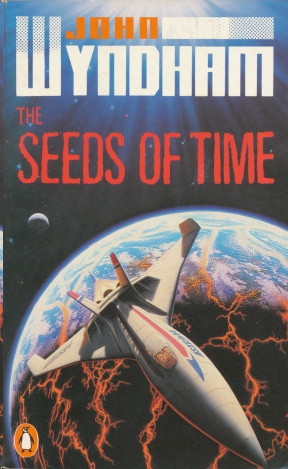
The Seeds of Time
- Автор: Уиндем Джон Паркс Лукас Бейнон Харрис
- Язык: английский
- Год: Michael Joseph
- ISBN: 0-7181-0362-9
- Жанр: Научная фантастика

Электронная книга - «The Seeds of Time». Краткое содержание книги:
‘Don’t let them in,’ she said, and then gave her attention to the telephone.
I hesitated. The rather peremptory knocking came again. One can’t just stand about, not letting people in; besides, to take a strange young lady hurriedly into one’s cottage, and immediately bolt the door against all comers … ? At the third knocking I opened up.
The aspect of the man on my doorstep took me aback. Not his face-that was suitable enough in a young man of, say, twenty-five-it was his clothes. One is not prepared to encounter something that looks like a close-fitting skating suit, worn with a full-cut, hip-length, glass-buttoned jacket, certainly not on Dartmoor, at the end of the summer season. However, I pulled myself together enough to ask what he wanted. He paid no attention to that as he stood looking over my shoulder at the girl.
‘Tavia,’ he said. ‘Come here!’
She didn’t stop talking hurriedly into the telephone. The man stepped forward.
‘Steady on!’ I said. ‘First, I’d like to know what all this is about.’
He looked at me squarely.
‘You wouldn’t understand,’ he said, and raised his arm to push me out of the way.
I have always felt that I would strongly dislike people who tell me that I don’t understand, and try to push me off my own threshold. I socked him hard in the stomach, and as he doubled up I pushed him outside and closed the door.
‘They’re coming,’ said the girl’s voice behind me. ‘The police are coming.’
‘If you’d just tell me,’ I began. But she pointed.
‘Look out at the window,’ she said.
I turned. There was another man outside, dressed similarly to the first who was still audibly wheezing on the doorstep. He was hesitating. I reached my twelve-bore off the wall, grabbed some cartridges from the drawer and loaded it. Then I stood back, facing the door.
‘Open it, and keep behind it,’ I told her.
She obeyed, doubtfully.
Outside, the second man was now bending solicitously over the first. A third man was coming up the path. They saw the gun, and we had a brief tableau.
‘You, there,’ I said. ‘You can either beat it quick, or stay and argue it out with the police. Which is it to be?’
‘But you don’t understand. It is most important ‘ began one of them.
‘All right. Then you can stay there and tell the police how important it is,’ I said, and nodded to the girl to close the door again.
We watched through the window as the two of them helped the winded man away.
The police, when they arrived, were not amiable. They took down my description of the men reluctantly, and departed coolly. Meanwhile, there was the girl.
She had told the police as little as she well could - simply that she had been pursued by three oddly dressed men and had appealed to me for help. She had refused their offer of a lift to Plyton in the police car, so here she still was.
‘Well, now,’ I suggested, ‘perhaps you’d like to explain to me just what seems to be going on?’
She sat quite still facing me with a long level look which had a tinge of-sadness?-disappointment?-well, unsatisfactoriness of some kind. For a moment I wondered if she were going to cry, but in a small voice she said: ‘I had your letter-and now I’ve burned my boats.’ I sat down opposite to her. After fumbling a bit I found my cigarettes and lit one.
‘You-er-had my letter, and now you’ve-er-burnt your boats?’ I repeated.
‘Yes,’ she said. Her eyes left mine and strayed round the room, not seeing much.
‘And now you don’t even know me,’ she said. Whereupon the tears came, fast.
I sat there helplessly for a half-minute. Then I decided to go into the kitchen and put on the kettle while she had it out. All my female relatives have always regarded tea as the prime panacea, so I brought the pot and cups back with me when I returned.
I found her recovered, sitting staring pensively at the unlit fire. I put a match to it. She watched it take light and burn, with the expression of a child who has just received a present.
‘Lovely,’ she said, as though a fire were something completely novel. She looked all round the room again. ‘Lovely,’ she repeated.
‘Would you like to pour?’ I suggested, but she shook her head, and watched me do it.
Tea,’ she said. ‘By a fireside!’
Which was true enough, but scarcely remarkable.
‘I think it is about time we introduced ourselves,’ I suggested. ‘I am Gerald Lattery.’
‘Of course,’ she said, nodding. It was not to my mind an altogether appropriate reply, but she followed it up by: ‘I am Octavia Lattery-they usually call me Tavia.’
Tavia?-Something clinked in my mind, but did not quite chime.
‘We are related in some way?’ I asked her.
‘Yes-very distantly,’ she said, looking at me oddly. ‘Oh, dear,’ she added, ‘this is difficult,’ and looked as if she were about to cry again. ‘Tavia…?’ I repeated, trying to remember. ‘There’s something…’ Then I had a sudden vision of an embarrassed elderly gentleman. ‘Why, of course; now what was the name? Doctor-Doctor Bogey, or something?’
She suddenly sat quite still.
‘Not-not Doctor Gobie?’ she suggested.
‘Yes, that’s it. He asked me about somebody called Tavia. That would be you?’
‘He isn’t here?’ she said, looking round as if he might be hiding in a corner.
I told her it would be about two years ago now. She relaxed.
‘Silly old Uncle Donald. How like him! And naturally you’d have no idea what he was talking about?’
‘I’ve very little more now,’ I pointed out, ‘though I can understand how even an uncle might be agitated at losing you.’
‘Yes. I’m afraid he will be-very,’ she said.
‘Was: this was two years ago,’ I reminded her.
‘Oh, of course you don’t really understand yet, do you?’
‘Look,’ I told her. ‘One after another, people keep on telling me that I don’t understand. I know that already-it is about the only thing I do understand.’
‘Yes. I’d better explain. Oh dear, where shall I begin?’ I let her ponder that, uninterrupted. Presently she said: ‘Do you believe in predestination?’
‘I don’t think so,’ I told her.
‘Oh-no, well perhaps it isn’t quite that, after all-more like a sort of affinity. You see, ever since I was quite tiny I remember thinking this was the most thrilling and wonderful age-and then, of course, it was the time in which the only famous person in our family lived. So I thought it was marvelous. Romantic, I suppose you’d call it.’
‘It depends whether you mean the thought or the age …’ I began, but she took no notice.
‘I used to picture the great fleets of funny little aircraft during the wars, and think how they were like David going out to hit Goliath, so tiny and brave. And there were the huge clumsy ships, wallowing slowly along, but getting there somehow in the end, and nobody minding how slow they were. And quaint black and white films; and horses in the streets; and shaky old internal combustion engines; and coal fires; and exciting bombings; and trains running on rails; and telephones with wires; and, oh, lots of things. And the things one could do! Fancy being at the first night of a new Shaw play, or a new Coward play, in a real theatre! Or getting a brand-new T. S. Eliot, on publishing day. Or seeing the Queen drive by to open Parliament. A wonderful, thrilling time!’
‘Well, it’s nice to hear somebody think so,’ I said. ‘My own view of the age doesn’t quite ‘
‘Ah, but that’s only to be expected. You haven’t any perspective on it, so you can’t appreciate it. It’d do you good to live in ours for a bit, and see how flat and stale and uniform everything is-so deadly, deadly dull.’