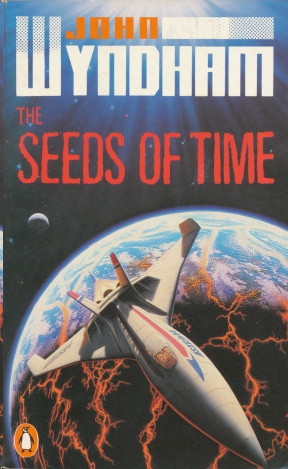
The Seeds of Time
- Автор: Уиндем Джон Паркс Лукас Бейнон Харрис
- Язык: английский
- Год: Michael Joseph
- ISBN: 0-7181-0362-9
- Жанр: Научная фантастика

Электронная книга - «The Seeds of Time». Краткое содержание книги:
In the mild warmth of noon Bert let his boat carry him along. Behind him, a fan of ripples spread gently and then lapsed back into placidity. Still further back the immense silence closed in again, and nothing remained to show that he had passed that way. The scene had scarcely changed for several days and several hundred miles of his quietly chugging progress.
His boat was a queer craft. There was nothing else like it on Mars-nor any other place. For he had built it himself and without knowing anything about the building of boats. There had been a kind of plan-well, a rough idea-in his head, at first, but he had had to modify that so many times that most of it had grown empirically from the plates and materials he had been able to find. The result had something of sampan, punt and rain-water tank in its ancestry, but it satisfied Bert.
He sprawled in comfortable indolence at the stern of his craft. One arm in a tattered sleeve hung over the tiller, the other lay across his chest. Long legs in patchwork trousers sprawled out to end in strange boots with canvas uppers and soles contrived of woven fibres; he had made those himself, too. The reddish beard on his thin face was trimmed to a point; above it his dark eyes looked ahead with little interest from under the torn, stained brim of a felt hat.
He listened to the phut-phutting of the old engine as he might to the purr of a friendly cat; indeed, he thought of it as an old friend, bestowing upon it a kindly care to which it responded with grunts of leisurely goodwill as it bore him along. There were times when he talked to it encouragingly or told it the things he thought; it was a habit he did not approve of and which he curbed when he noticed it, but quite often he did not notice. He felt an affection for the wheezy old thing, not only for carrying him along thousands of miles of water, but because it kept the silence at bay.
Bert disliked the silence which brooded over desert and water like a symptom of mortification, but he did not fear it. It did not drive him, as it did most, to live in the settlements where there was neighbourliness, noise and the illusion of hope. His restlessness was stronger than his dislike of the empty lands; it carried him along when the adventurous, finding no adventure, had turned back or given in to despair.
He wanted little but, like a gipsy, to keep moving. Bert Tasser he had been years ago, but it was so long since he had heard the surname that he had almost forgotten it: everybody else had. He was just Bert-for all he knew he was the only Bert.
‘Ought to be showing up soon,’ he murmured, either to the patient engine or himself, and sat up in order to see better. A slight change was beginning to show on the bank; a weed was becoming more frequent among the scrawny bushes, a slender-stalked growth with polished, metallic-looking leaves, sensitive to the lightest breath of wind. He could see them shivering with little flashes in increasing numbers ahead, and he knew that if he were to stop the engine now he would hear not the dead envelope of silence, but the ringing clash of myriads of small hard leaves.
Tinker bells,’ he said. ‘Yes, it won’t be far now.’ From a locker beside him he pulled a much-worn hand-drawn map, and consulted it. From it he referred to an equally well-used notebook, and read over the list of names written on one of the pages. He was still muttering them as he returned the papers to the locker and his attention to the way ahead. Half an hour passed before a dark object became visible to break the monotonous line of the bank.
‘There it is now,’ he said, as if to encourage the engine over the last few miles.
The building, which had appeared oddly shaped even from a distance, revealed itself as a ruin on closer approach. The base was square and decorated on the sides with formal patterns in what had once been high relief, but was now so smoothed that the finer details were lost. Once it had supported some kind of tower; though exactly what kind had to be guessed, for no more than the first twenty feet of the upper structure remained. It, too, bore remnants of worn carving, and, like the base, was built of a dusky red rock.
Standing a hundred yards or so back from the bank, it was deceptive in its isolation. The size and the degree of misadventure which time and adaptation had brought it only became appreciable as one approached more closely.
Bert held on his course until he was opposite before he turned his clumsy craft. Then he swung over and headed towards the bank at slow speed until he grounded gently on the shelving shore. He switched off the engine, and the indigenous sounds took charge; the tinny chime of the tinker bells, a complaining creak from a ramshackle wheel turning slowly and unevenly a little to his left along the bank, and an intermittent thudding from the direction of the ruin.
Bert went forward to the cabin. It was snug enough to keep him warm in the cold nights, but ill lit, for glass was hard to come by. Groping in the dimness he found a bag of tools and an empty sack, and slung them over one shoulder. He waded ashore through the few inches of water, drove in a hook to hold his boat against the unlikely chance of disturbance in the placid water, and turned with a long easy stride towards the building.
To either side of the place and beyond it clustered a few small fields where neatly lined crops stood fresh and green among narrow irrigation ditches. Against one wall of the stone cube was an enclosure and a shed roughly built of irregular fragments which might have been part of the vanished tower. Despite its inexpert appearance it was neatly kept, and from beyond it came occasionally, the grunt of small animals. In the near face of the cube was a doorway, and to either side of it unsquare holes which, though glassless, appeared to be windows. Outside the door a woman was at work, pounding grain on a shallow worn rock with a kind of stone club which she held in both hands. Her skin was a reddish brown, her dark hair rolled high on her head, and her only garment a skirt of coarse russet cloth stencilled with a complex yellow pattern. She was middle aged, but there was no slackening of muscles or deterioration of poise.
She looked up as Bert approached, and spoke in the local patois:
‘Hullo, Earthman,’ she said, ‘we were expecting you, but you’ve been a long time.’
Bert replied in the same language.
‘Late am I, Annika? I never know the date, but it seemed about time I was this way again.’
He dropped the bags, and instantly a dozen little bannikuks scampered to investigate them. Disappointed, they clustered round his feet mewing inquisitively, and turning their little marmoset-like faces up to him. He scattered a handful of nuts from his pocket for them, and sat down on a convenient stone. Recalling the list of names in the notebook he asked after the rest of the family.
They were well, it seemed. Yanff, her eldest son, was away, but Tannack, the younger, was here, so were the girls Guika and Zaylo; Guika’s husband, too, and the children, and there was a new baby since he last came. Except for the baby they were all down in the far field: they would be back soon.
He looked where she pointed, and saw the dark dots moving in the distance among the neat rows.
‘Your second crops are coming along nicely,’ he said.
‘The Great Ones remember,’ she said in a matter-of-fact way.
He sat watching her as she worked. Her colouring and that of the setting made him think of pictures he had seen years ago-by Gauguin, was it?-though she was not the kind of woman that Gauguin had painted. Possibly he would not have seen beauty there, as Bert himself had failed to at first. Martians, with their lighter build and delicate bones, had looked frail and skinny to him when he first saw them, but he had grown used to the difference: an Earth woman would look queer and dumpy now, he guessed-if he were ever to see one. Aware of his gaze upon her Annika stopped pounding and turned to look at him; she did not smile but there was a kindness and understanding in her dark eyes.