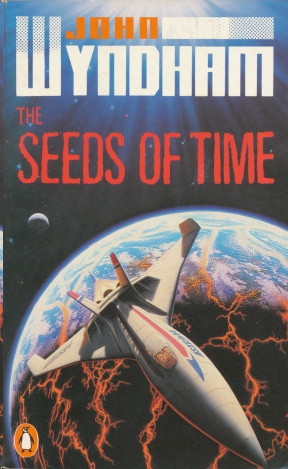
The Seeds of Time
- Автор: Уиндем Джон Паркс Лукас Бейнон Харрис
- Язык: английский
- Год: Michael Joseph
- ISBN: 0-7181-0362-9
- Жанр: Научная фантастика

Электронная книга - «The Seeds of Time». Краткое содержание книги:
The Seeds of Time
John Wyndham
Foreword
THE best definition of the science-fiction story that I know is Mr Edmund Crispin’s: that it ‘is one which presupposes a technology, or an effect of technology, or a disturbance in the natural order, such as humanity, up to the time of writing, has not in actual fact experienced.’
The disposition of something like ninety per cent of science-fiction to use this definition only in conjunction with the adventure-narrative form of story is primarily an accident of commercial exploitation, and an unfortunate one that makes it difficult to see the trees for the wood.
When, a good many years ago now, I first happened upon magazines that specialized in stories of the kind, their proprietors had already concocted the formula which they knew, with that conviction that sustains minor showmen everywhere, to be the only one that the public would stand for and pay for; and almost the only reason for not dismissing their productions forthwith was the occasional discovery of the different story that had somehow got under their guard.
In general, the formula has been preserved so that even now, after twenty-five years, the bulk of science-fiction, and its adaptations to film and broadcast serial form, has been determinedly kept in the cliff-hanger class.
Nevertheless, there came a time when certain editors grew mildly mutinous with the perception that the terms of reference did not truly restrict them to the adventures of galactic gangsters in space-opera, and they began, some by stealth, others by declaration, to encourage their authors to do a bit more exploration within the definition.
With that, the field became open to experiments, and the nine stories I have chosen here are (or were) virtually experiments, made at intervals during fifteen years, in adapting the science-fiction motif to various styles of short story. The earliest, Meteor, is closest to the usual adventure-narrative, and was written to suit a pre-war editor (though its beginning was later adapted a little for post-war republication).
Taking a look at science-fiction again after a wartime interval, one seemed to see indications that it was trying to change its spots. This idea set off the somewhat pastoral Time to Rest. It was swiftly returned by an American agent with the hurt reproof that it wouldn’t do at alclass="underline" this kind of thing, as I ought to know, hadn’t a chance unless it was packed full of adjectives and action. However, it did later on appear in four periodicals and two anthologies, so I felt better about it.
Meanwhile, Pillar to Post, written to suit, I hoped, the policy of a newly arisen American magazine, came near enough to it to be accepted and afterwards anthologized. After that, I rather gave up other people’s policies, and tried various styles. The intention of Chronoclasm, in the comedy-romantic, was to entertain the general reader and break away from the science-fiction enthusiast. Pawley’s Peepholes is satirical farce. Opposite Number attempts, with perhaps qualified success, the light presentation of a somewhat complicated idea. For Dumb Martian and Survival I tried to use the pattern of the English short-story in its heyday. Compassion Circuit is the short horror-story. A neo-Gothick trifle, could one say? And finally there is Wild Flower where one has encouraged science-fiction to try the form of the modern short-story.
In the careers of these stories my debts have become too widely spread to be acknowledged here with the detail one could wish, and since it would be invidious to mention only some editors and their periodicals, I must have recourse to the collective (and the order of the alphabet). Thus, with a great deal more gratitude than adequacy, I fear, I take this opportunity of thanking those editors, a number of whom I can never hope to meet, in Australia, France, Great Britain, Holland, Italy, South Africa, Sweden, and the U.S.A. who have so much encouraged me by printing one or more of these experiments on the theme: ‘I wonder what might happen if…?’
j. w.
Chronoclasm
I FIRST heard of Tavia in a sort of semi-detached way. An elderly gentleman, a stranger, approached me in Plyton High Street one morning. He raised his hat, bowed, with perhaps a touch of foreignness, and introduced himself politely:
‘My name is Donald Gobie, Doctor Gobie. I should be most grateful, Sir Gerald, if you could spare me just a few minutes of your time. I am so sorry to trouble you, but it is a matter of some urgency, and considerable importance.’ I looked at him carefully.
‘I think there must be some mistake,’ I told him. ‘I have no handle to my name-not even a knighthood.’
He looked taken aback.
‘Dear me. I am sorry. Such a likeness-I was quite sure you must be Sir Gerald Lattery.’
It was my turn to be taken aback.
‘My name is Gerald Lattery,’ I admitted, ‘but Mister, not Sir.’
He grew a little confused.
‘Oh, dear. Of course. How very stupid of me. Is there…’ he looked about us, ‘-is there somewhere where we could have a few words in private?’ he asked.
I hesitated, but only for a brief moment. He was clearly a gentleman of education and some culture. Might have been a lawyer. Certainly not on the touch, or anything of that kind. We were close to The Bull, so I led the way into the lounge there. It was conveniently empty. He declined the offer of a drink, and we sat down.
‘Well, what is this trouble, Doctor Gobie?’ I asked him. He hesitated, obviously a little embarrassed. Then he spoke, with an air of plunging:
‘It is concerning Tavia, Sir Gerald-er, Mr Lattery. I think perhaps you don’t understand the degree to which the whole situation is fraught with unpredictable consequences. It is not just my own responsibility, you understand, though that troubles me greatly-it is the results that cannot be foreseen. She really must come back before very great harm is done. She must, Mr Lattery.’
I watched him. His earnestness was beyond question, his distress perfectly genuine.
‘But, Doctor Gobie ,’ I began.
‘I can understand what it may mean to you, sir, nevertheless I do implore you to persuade her. Not just for my sake and her family’s, but for everyone’s. One has to be so careful; the results of the least action are incalculable. There has to be order, harmony; it must be preserved. Let one single seed fall out of place, and who can say what may come of it? So I beg you to persuade her ...’
I broke in, speaking gently because whatever it was all about, he obviously had it very much at heart.
‘Just a minute, Doctor Gobie. I’m afraid there is some mistake. I haven’t the least idea what you are talking about.’
He checked himself. A dismayed expression came over his face.
‘You ?’ he began, and then paused in thought, frowning. ‘You don’t mean you haven’t met Tavia yet?’ he asked.
‘As far as I know, I do. I’ve never even heard of anyone called Tavia,’ I assured him.
He looked winded by that, and I was sorry. I renewed my offer of a drink. But he shook his head, and presently he recovered himself a little.
‘I am so sorry,’ he said. “There has been a mistake indeed. Please accept my apologies, Mr Lattery. You must think me quite light-headed. I’m afraid. It’s so difficult to explain. May I ask you just to forget it, please forget it entirely.’
Presently he left, looking forlorn. I remained a little puzzled, but in the course of the next day or two I carried out his final request-or so I thought.
The first time I did see Tavia was a couple of years later, and, of course, I did not at the time know it was she. I had just left The Bull. There was a number of people about in the High Street, but just as I laid a hand on the car door I became aware that one of them on the other side of the road had stopped dead, and was watching me. I looked up, and our eyes met. Hers were hazel.