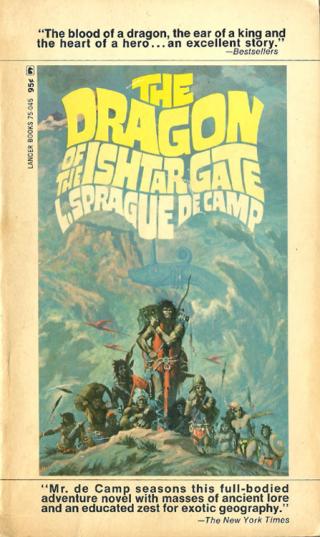
The Dragon of the Ishtar Gate
- Автор: Де Камп Лайон Спрэг
- Год: 1968
- Язык: английский
- Год: Lancer Books
- Жанр: Научная фантастика

Электронная книга - «The Dragon of the Ishtar Gate». Краткое содержание книги:
Dragon is probably closest in mood to de Camp's fantasy novels, while Bronze God and Arrows are closer to his science fiction, with their description of engineering problems, and personality clashes among researchers and engineers. Dragon also reflects de Camp's then-recent acquaintance with the Conan stories and other works of Robert E. Howard. Bessas, the huge Persian nobleman, is not only a close match for Conan in physique, but his mood swings, fixation on his mother, and tendency to toss of verses, seems a reflection of Howard himself. (Fortunately, his poems reflect de Camp's verbal dexterity and wit, not Howard's melancholy.)
"Nothing at the moment; but I have too often seen how oracles are manipulated to take much account of them."
"Scorn not divine warnings. We are not so sure of our way and our fate as lightly to cast aside any helpful signs."
Myron slowly repeated the poem in Persian. "So we seek something in vain? That would mean that the dragon is not to be captured at the Nile's headwaters after all."
"It might mean, not that it cannot be caught, but only that it never has been caught, by reason of its strength and ferocity."
"Or that something else—life for your mother, which you seek, and eminence as a philosopher, for me—are not to be had by searching. Well, it's true enough, I suppose—Zarina is mortal like the rest of us—but the remainder of the verse is so confused that I can make nothing of it."
Bessas sighed. "No doubt, when all is over, the meaning will stand out as plainly as the noses on the Achaemenids' faces, and we shall berate ourselves as dunces for not having seen it. Meantime we had better be on the road."
They passed Mari, a cluster of huts and a caravan station amidst the ruins of a great city. Myron rummaged through the buff-brown piles of debris with his head down, like a dog with its nose on a scent, until Bessas bellowed:
"By the bronzen balls of Ahriman, why do you waste time there?"
"I hope to find a clue to the history of this city. The people hereabouts know nothing."
"The wiser folk they. Besides, if you fool around these places long enough, you might scare up the ghost of some long-dead king. These are uncanny places. Many deeds of blood and darkness have been done in them, and evil influences last down the ages. The Corpse Fiend take your curiosity; come along!"
They passed Dura on its towering cliff, with the crumbling ruins of an Assyrian fortress. And every day, dust devils danced upon the horizon. Bessas, more and more uneasy, muttered spells of exorcism and became punctilious in his prayers to Mithra. He also exercised Vayu who, like a proper war horse, had been trained to assail his rider's foes with teeth and hooves and, if his rider fell, to stand over and protect him.
A dust storm swooped upon them, forcing them to huddle in their tent for half a day, while they listened to the howls and fiendish laughter of the demons of the waste. During the lulls in the storm, Bessas told of demons he had encountered on the fringes of the Empire.
One especially unpleasant one, nine feet tall and covered with long white hair, dwelt in the mountains of the Austanes east of Bactria. This fiend could suck all the bones out of a man's body without breaking his skin. He had not, said Bessas, actually seen this demon, but he had heard it shuffling about his hut at night and seen its footprints in the snow the next day. Only the drumming and incantations of the village shaman had kept the demon from breaking into the. hut. Although skeptical towards tales of demons and other spooks, Myron thought it more tactful to keep his doubts to himself.
They passed Sirki, where the Araxes adds its flood to the Euphrates, and whence the caravans set out for lone Thadamora in the waste. Here they heard how things went in the Desert of Aram. By protecting the caravans, Shaykh Alman, lord of Thadamora, was trying to build up caravan trade through his oasis. At the same time the nomadic Shaykh Waliq, at feud with the Thadamorites, attacked these same caravans, making the short cut across the Syrian desert an exciting passage.
Beyond Azaura, human habitations became more frequent. Hills and ridges appeared to the south. Blue lagoons fringed the Euphrates, in which mud shoals lay like colossal crocodiles. The land became more fertile, and the date palm gave way to the olive tree. Dust devils ceased to shadow the travelers.
Myron, gazing at some curious flat-topped hills that rose over a hundred feet from the banks of the river, said: "I wonder what could have given those hills that curious shape, like tables—"
"Oh, hold your tongue, Greekling!" snapped Bessas. "Your everlasting questions irk me."
Myron looked sharply at his companion. During the first part of their journey up the Euphrates, Bessas had been cheerful and good company. Now he showed increasing irascibility. Once he wept for a solid hour but refused to give any reasons for his sorrow.
The night of the twenty-ninth of Nisanu they spent at the ford of Tiphsah. Noon of the next day found them in Barbalissos. Here the Euphrates, descending from the north, bends around to eastward on its way to Sippar and Babylon, and here a steep escarpment rises on the south and west of the river.
In the tavern, Bessas cocked an ear at the buzz of talk and asked: "O Myron, what language do these folk speak? I know it not."
"Neither do I." Myron spoke in Aramaic to a short, stout youth who wore a necklace of amulets of copper and crystaclass="underline" "Your pardon, sir, but do you understand me?"
"Aye; I speak the Syrian tongue. How can your slave serve you?"
"By sitting down, having a mug of wine at our expense, and telling us what travelers in the region ought to know. For one thing, what language do we hear about us?"
"Karian. Our forebears were mercenaries serving Croesus of Lydia, who fell into Cyrus' hands at the downfall of Sardeis. King Cyrus settled us here in Barbalissos, far from our native heath. Whither are you bound, my masters?"
Myron told briefly of their mission and asked about roads and accommodations in Syria. The youth answered, but then burst out:
"Masters, for such a journey you will have to hire more men ere you reach your goal, will you not? I am told that in Africa live wild black men, who eat other men when they catch them. You will need strong arms besides your own to force your way through such perilous country."
"We shall see what we need when we get there," said Bessas. "Why?"
The youth held out his hands. "Oh, my masters, take me with you! I will not even ask for pay until we reach Egypt, so long as I can go."
"We are not—" began Bessas, but Myron interrupted:
"Why are you so eager, Master—what's your name?"
"Your servant is clept Skhâ son of Thuvlo. My father is the fuller and dyer of Barbalissos and, by Teshub's beard, I tire of the stench of urine in my nostrils! Naturally, he expects me to follow in his trade. But he has two other strong sons, and I am fain to leave this dull little puddle of a town, see the world, and peradventure become a warrior as were my forefathers."
"You're a little pudgy for that sort of work, youngster," said Bessas.
"I am no weakling, even if not so long in the limbs as you! I serve in the town guard and practice with warlike gear."
"Hold out your hand," said Bessas. "Now grip mine."
Skhâ squeezed Bessas' great paw, clamping down until the sweat ran down his face into the fuzzy young beard. Bessas easily matched the pressure. Then the Bactrian began to squeeze in his turn, until at last he fetched a grunt of pain from the youth. Bessas at once released the hand, whose fingers were now swollen and purple.
"Not bad for a townsman," said Bessas.
"Then take me, I beg!" cried Skhâ. "I work hard, and I shall certainly be a brave fighter when the need arises. I fear nought, for these"—he touched the necklace of amulets—"protect me. All I shall cost you is food until we reach Egypt. Then you may pay me the going wage."
Bessas twisted a strand of his beard around his forefinger. "Master Skhâ, you say you will cost us only bread and wine from here to Egypt. But we have no spare beast to bear you, nor spare arms to arm you with."
"True," said Skhâ, his mouth turning down. "Ah, woe and misfortune!"
"Well then," continued Bessas, "we leave for Halpa at dawn tomorrow. If you would go with us, join us, armed and mounted, within an hour of our departure."
"But how—"
"How you do it is your affair. On such a journey, we need resource. Good night."