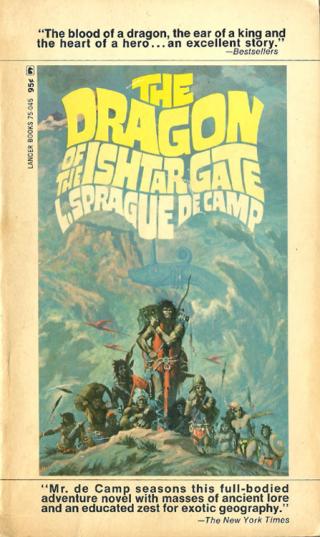
The Dragon of the Ishtar Gate
- Автор: Де Камп Лайон Спрэг
- Год: 1968
- Язык: английский
- Год: Lancer Books
- Жанр: Научная фантастика

Электронная книга - «The Dragon of the Ishtar Gate». Краткое содержание книги:
Dragon is probably closest in mood to de Camp's fantasy novels, while Bronze God and Arrows are closer to his science fiction, with their description of engineering problems, and personality clashes among researchers and engineers. Dragon also reflects de Camp's then-recent acquaintance with the Conan stories and other works of Robert E. Howard. Bessas, the huge Persian nobleman, is not only a close match for Conan in physique, but his mood swings, fixation on his mother, and tendency to toss of verses, seems a reflection of Howard himself. (Fortunately, his poems reflect de Camp's verbal dexterity and wit, not Howard's melancholy.)
Bessas, with a deep chuckle, reached inside his trousers and brought forth a long girdle of stout cloth. When he unfolded it, golden coins winked yellowly in the lamplight.
"One of Xerxes' golden archers stopped the point," he said. "And belike my little prayer to Mithra helped."
On the next morning, an hour before the first light of dawn appeared above the canal-stitched Euphratean plain, Myron and Bessas joined a caravan setting out for Damascus. Yawning and shivering, each rode one of the horses that Bessas had bought and led one of the mules. To each mule's back was lashed one of the two spears. Myron wore his short sword in Median fashion, low on the right side, with the thong on the end of the scabbard tied around his thigh.
The caravan sorted itself out into a straggling serpentine column. Asses brayed, camels gargled and roared, horses whinnied, and caravaneers shouted commands, advice, and curses.
The column trailed northward along Processional Way and through the mighty Ishtar Gate, where sleepy Persian soldiers stamped their frozen feet and blew on their hands. Torchlight flickered on the bulls and dragons of the great blue gate; the nearest sirrush seemed to Myron to leer at him. Each caravaneer, as he passed through the gate, uttered a prayer to his favorite god.
Out through the northern suburbs they trailed and along the river road, into the morning mist. The city faded into the murk behind them.
In Myron's scrip reposed a parchment copy of their contract with Murashu and Sons, promising to pay back fifty darics with annual interest at twenty parts in a hundred. Myron had a blurred recollection of Bessas, leaning over both copies and signing by rushlight, scowling and licking his bearded lips as he painfully traced out each letter. Embas had explained that the temple of Mithra had guaranteed the loan. This brought Murashu down to the normal interest rate, even though the emissaries of the Mithraeum had hauled the banker out of bed to close the deal.
"Most of it is in bar silver," said Embas, "because such silver commands a premium in Egypt above the monetary value of the coinage. The Egyptians dislike coins, holding them a newfangled scheme to enable rascals to cheat honest men."
"I found the same stupidity in India," said Bessas.
"Then why cannot the traveler simply melt down his shekels in Egypt?" asked Myron.
"Because such defacement of the royal coinage, if found out, would only cost you your heads, as it cost the satrap Aryandes his."
When the sun stood high, Bessas said: "I see no sign of pursuit. Let's not loaf along with these stinking camels all the way to Id, but seek our own gait."
The travelers pulled out of line, spurred to a canter, and soon neared the head of the line of camels. Then, however, a man on an ass—a smallish, nondescript man—rode out in front of them.
"My masters!" he called. "Do you follow the Euphrates to Barbalissos?"
"What is that to you?" asked Bessas with a scowl.
"I thought you might permit your slave to go with you. I cannot stay with the caravan beyond Sirki, for there they take the desert road to Thadamora, and that road is impassable save to camels. Withal, one must pay a caravan toll to Shaykh Alman. So meseemed—"
Bessas began to slide his Parthian bow from its case, muttering: "By the waters of Ardvi, it is time we ended this damned—"
"Not so precipitate!" said Myron in Greek. "We don't even know whose side he is on."
"Well, then?"
"We can easily outrun him. That ass is no Pegasos."
Bessas grinned and called out: "You are welcome to stay with us whilst you can!"
Bessas and Myron clapped spurs to their steeds. Leading their pack mules at full gallop, they raced on up the palm-lined left bank of the Euphrates and were soon out of sight of the caravan and of the man on the ass as well.
Meanwhile, in another room in Babylon, as difficult of access as the Mithraeum but very differently appointed, Labashi received his minions. The room, though small, was hung with costly stuffs and gleaming ornaments. The air was thick with incense. Tables and floor were heaped with masses of documents: sheets of papyrus and sheepskin and clay tablets. Astrological charts were pinned to the wall hangings.
Labashi sat on a raised chair, clad in raiment of a thin shiny unknown stuff that had come from far to the east. Nobody else, not even the king, as yet possessed a garment of this lustrous material. Labashi was a hunchback, with a large head and regular features, which he shaved in priestly style.
As Labashi's lieutenant, limping from wounds, gave his report, Labashi's black eyes bored into him with an unwinking basilisk stare. Once Labashi slapped his thigh with anger when the lieutenant told of the arrival of rescuers. When he had finished, the lieutenant stood with bowed head, awaiting the blast.
It never came. Instead, Labashi said softly: "Well, then, another scheme we must try. Honor demands that we persevere and do not our colleague Ardigula disappoint." He rose and walked to one of the star charts, which he studied for several ush*(* 1 ush = 4 minutes.). At last he said: "Find me one of Shaykh Waliq's tribesmen, that I may send a message to the shaykh."
V – The Temple of the Harlots
Up the mighty river rode Myron and Bessas, past endless lines of date palms, past creaking swapes by which early-rising peasants hoisted water from the public canals to the heads of their irrigation ditches, past fields of young wheat and barley, past lakes and marshes whence waterfowl rose with a thunder of wings. They passed Agade with its massive wall and dreams of ancient greatness, and Sippar with its many-storied ziggurat. They crossed canals and passed mud-walled villages innumerable.
At Kounaxa they waited for a string of dromedaries to plod across the floating bridge that spanned the Euphrates, their bells emitting a melancholy tune. Myron, looking apprehensively at the structure, remarked to the villager who took the bridge tolls:
"Your bridge doesn't look particularly secure. The planks sag, and half the boats are low in the water."
"Oh, good and great master!" said the peasant with the air of fawning servility that subjects of the Persian Empire were wont to adopt towards the Great King's servants. "That will soon be mended. The King of All Kings—may the gods preserve him—has promised your vile and unworthy slaves a new bridge."
As they crossed the rickety structure, Myron said: "Let's hope they get their new bridge before this one sinks with a quiet gurgle beneath its users."
Bessas replied: "Three things should not be counted upon: the level of a river, the tameness of a lion, and the promise of a king. Especially a king like our popeyed friend."
"Embas spoke of—ah—that same man as the son of a usurper. What did he mean?"
Bessas lowered his voice. "Repeat this not, lest your head fly off like the ball in a game of stick-and-ball. Some think the supposed false Bardias, whom Darius claimed to have slain ere he took the throne after Cambyses' death, was not false at all. They think he was Cambyses' veritable brother, whom Cambyses had never slain as Darius claimed."
"My dear fellow! Do you mean that story of Gomates the Mage, who took the place of Bardias after the latter's murder and even fooled Bardias' wives, is a lot of cock and bull?"
"So some believe. But there is no tale more dangerous to relate. You know the saying: He that keeps his mouth tightly shut shall live, while he that blathers shall meet destruction."
They rode on. At Id, Myron insisted on stopping to see the asphalt wells and to watch the Idites scooping the sticky black stuff into baskets. Bessas, fuming, growled:
"If you stop to look at every new sight along the way, we shall be dead of old age ere we return."